

222
H. Wittig
Several strategies to deal with this problem have been applied over many years,
among them the “static approximation” [179], the non-relativistic formulation
(NRQCD) [180], the so-called “Fermilab-approach” [181] and finite-size scaling
techniques [182, 183].
Since the charm quark is lighter than the b-quark by roughly a factor three, one
may attempt to treat charm as a fully relativistic, propagating quark in simulations.
Still, one can incur large lattice artefacts in this way, and a careful extrapolation
to the continuum limit is then required. However, such an extrapolation may be
spoilt if the leading lattice artefacts cannot be isolated in the results, due to the
relatively large mass of the charm quark. Still, if one has reason to trust the results
obtained for relativistic charm quarks, one may extrapolate them to the mass of bquark, which is yet another way of circumventing the problem that the b-quark is
too heavy to be treated relativistically. Typically, the ansatz for the extrapolation of
a particular quantity to the mass of the b-quark is motivated by its expected quark
mass dependence in Heavy Quark Effective Theory (HQET).
In the static approximation the b-quark is assumed to be infinitely heavy [179].
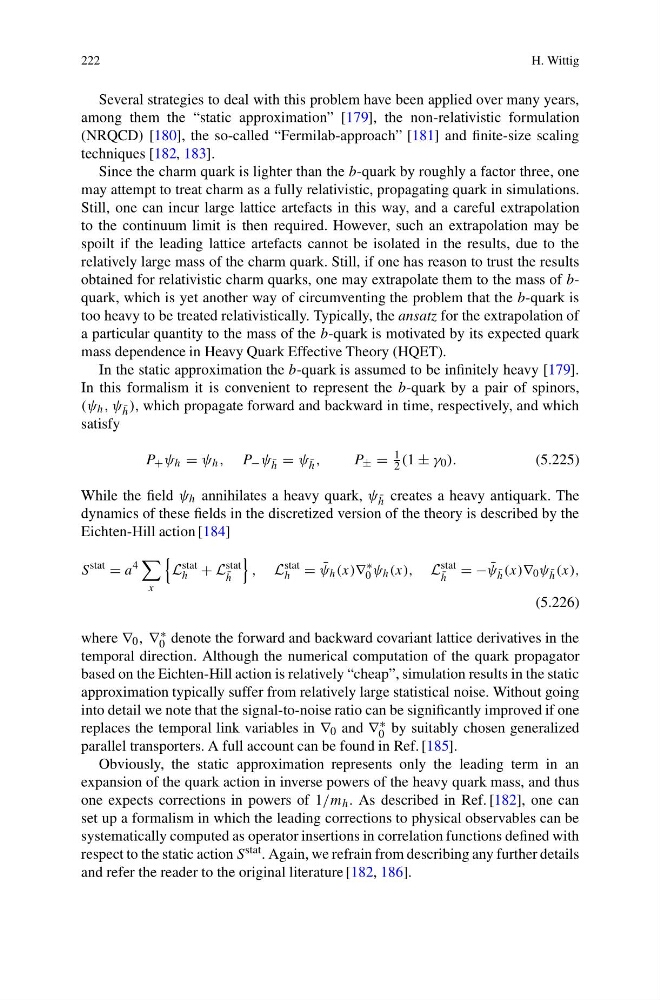
In this formalism it is convenient to represent the b-quark by a pair of spinors,
(ψ h , ψ ¯
h ), which propagate forward and backward in time, respectively, and which
satisfy
P + ψ h = ψ h , P − ψ ¯
h = ψ ¯
h ,
P ± =
1
2 (1 ± γ 0 ).
(5.225)
While the field ψ h annihilates a heavy quark, ψ ¯
h creates a heavy antiquark. The
dynamics of these fields in the discretized version of the theory is described by the
Eichten-Hill action [184]
S
stat
= a
4
x
L
stat
h + L
stat
¯
h
, L
stat
h = ¯
ψ h (x)∇
∗
0 ψ h (x), L
stat
¯
h
= − ¯
ψ ¯
h (x)∇ 0 ψ ¯
h (x),
(5.226)
where ∇ 0 , ∇ ∗
0 denote the forward and backward covariant lattice derivatives in the
temporal direction. Although the numerical computation of the quark propagator
based on the Eichten-Hill action is relatively “cheap”, simulation results in the static
approximation typically suffer from relatively large statistical noise. Without going
into detail we note that the signal-to-noise ratio can be significantly improved if one
replaces the temporal link variables in ∇ 0 and ∇ ∗
0 by suitably chosen generalized
parallel transporters. A full account can be found in Ref. [185].
Obviously, the static approximation represents only the leading term in an
expansion of the quark action in inverse powers of the heavy quark mass, and thus
one expects corrections in powers of 1/m h . As described in Ref. [182], one can
set up a formalism in which the leading corrections to physical observables can be
systematically computed as operator insertions in correlation functions defined with
respect to the static action S stat . Again, we refrain from describing any further details
and refer the reader to the original literature [182, 186].
H. Wittig
Several strategies to deal with this problem have been applied over many years,
among them the “static approximation” [179], the non-relativistic formulation
(NRQCD) [180], the so-called “Fermilab-approach” [181] and finite-size scaling
techniques [182, 183].
Since the charm quark is lighter than the b-quark by roughly a factor three, one
may attempt to treat charm as a fully relativistic, propagating quark in simulations.
Still, one can incur large lattice artefacts in this way, and a careful extrapolation
to the continuum limit is then required. However, such an extrapolation may be
spoilt if the leading lattice artefacts cannot be isolated in the results, due to the
relatively large mass of the charm quark. Still, if one has reason to trust the results
obtained for relativistic charm quarks, one may extrapolate them to the mass of bquark, which is yet another way of circumventing the problem that the b-quark is
too heavy to be treated relativistically. Typically, the ansatz for the extrapolation of
a particular quantity to the mass of the b-quark is motivated by its expected quark
mass dependence in Heavy Quark Effective Theory (HQET).
In the static approximation the b-quark is assumed to be infinitely heavy [179].
In this formalism it is convenient to represent the b-quark by a pair of spinors,
(ψ h , ψ ¯
h ), which propagate forward and backward in time, respectively, and which
satisfy
P + ψ h = ψ h , P − ψ ¯
h = ψ ¯
h ,
P ± =
1
2 (1 ± γ 0 ).
(5.225)
While the field ψ h annihilates a heavy quark, ψ ¯
h creates a heavy antiquark. The
dynamics of these fields in the discretized version of the theory is described by the
Eichten-Hill action [184]
S
stat
= a
4
x
L
stat
h + L
stat
¯
h
, L
stat
h = ¯
ψ h (x)∇
∗
0 ψ h (x), L
stat
¯
h
= − ¯
ψ ¯
h (x)∇ 0 ψ ¯
h (x),
(5.226)
where ∇ 0 , ∇ ∗
0 denote the forward and backward covariant lattice derivatives in the
temporal direction. Although the numerical computation of the quark propagator
based on the Eichten-Hill action is relatively “cheap”, simulation results in the static
approximation typically suffer from relatively large statistical noise. Without going
into detail we note that the signal-to-noise ratio can be significantly improved if one
replaces the temporal link variables in ∇ 0 and ∇ ∗
0 by suitably chosen generalized
parallel transporters. A full account can be found in Ref. [185].
Obviously, the static approximation represents only the leading term in an
expansion of the quark action in inverse powers of the heavy quark mass, and thus
one expects corrections in powers of 1/m h . As described in Ref. [182], one can
set up a formalism in which the leading corrections to physical observables can be
systematically computed as operator insertions in correlation functions defined with
respect to the static action S stat . Again, we refrain from describing any further details
and refer the reader to the original literature [182, 186].