

5 QCD on the Lattice
221
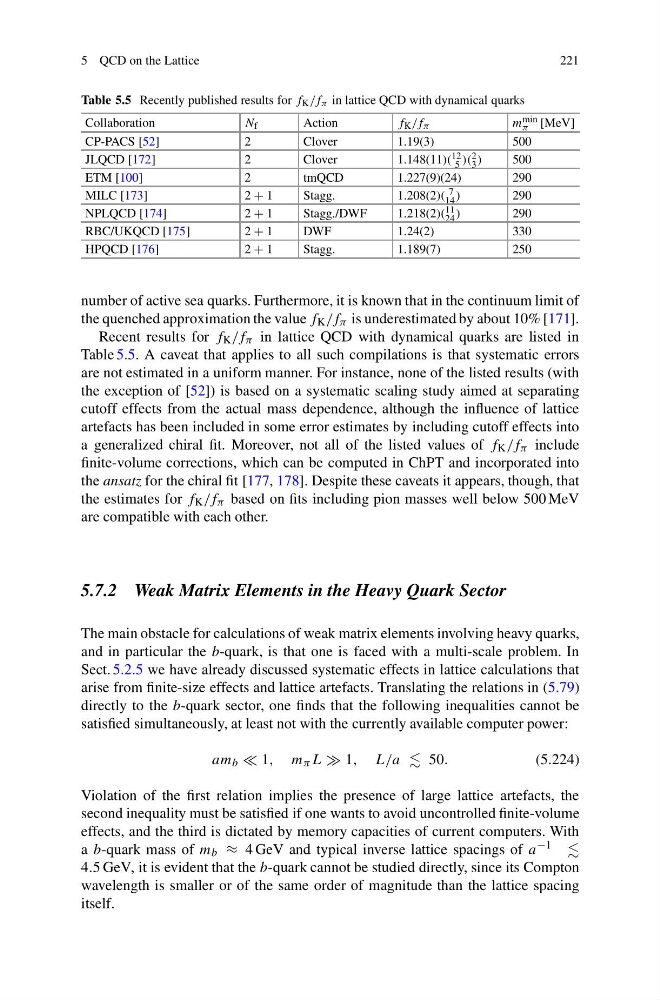
Table 5.5 Recently published results for f K /f π in lattice QCD with dynamical quarks
Collaboration
N f
Action
f K /f π
m min
π [MeV]
CP-PACS [52]
2
Clover
1.19(3)
500
JLQCD [172]
2
Clover
1.148(11)( 12
5 )( 2
3 )
500
ETM [100]
2
tmQCD
1.227(9)(24)
290
MILC [173]
2 + 1
Stagg.
1.208(2)( 7
14 )
290
NPLQCD [174]
2 + 1
Stagg./DWF
1.218(2)( 11
24 )
290
RBC/UKQCD [175]
2 + 1
DWF
1.24(2)
330
HPQCD [176]
2 + 1
Stagg.
1.189(7)
250
number of active sea quarks. Furthermore, it is known that in the continuum limit of
the quenched approximation the value f K /f π is underestimated by about 10% [171].
Recent results for f K /f π in lattice QCD with dynamical quarks are listed in
Table 5.5. A caveat that applies to all such compilations is that systematic errors
are not estimated in a uniform manner. For instance, none of the listed results (with
the exception of [52]) is based on a systematic scaling study aimed at separating
cutoff effects from the actual mass dependence, although the influence of lattice
artefacts has been included in some error estimates by including cutoff effects into
a generalized chiral fit. Moreover, not all of the listed values of f K /f π include
finite-volume corrections, which can be computed in ChPT and incorporated into
the ansatz for the chiral fit [177, 178]. Despite these caveats it appears, though, that
the estimates for f K /f π based on fits including pion masses well below 500 MeV
are compatible with each other.
5.7.2 Weak Matrix Elements in the Heavy Quark Sector
The main obstacle for calculations of weak matrix elements involving heavy quarks,
and in particular the b-quark, is that one is faced with a multi-scale problem. In
Sect. 5.2.5 we have already discussed systematic effects in lattice calculations that
arise from finite-size effects and lattice artefacts. Translating the relations in (5.79)
directly to the b-quark sector, one finds that the following inequalities cannot be
satisfied simultaneously, at least not with the currently available computer power:
am b 1, m π L 1, L/a 50.
(5.224)
Violation of the first relation implies the presence of large lattice artefacts, the
second inequality must be satisfied if one wants to avoid uncontrolled finite-volume
effects, and the third is dictated by memory capacities of current computers. With
a b-quark mass of m b ≈ 4 GeV and typical inverse lattice spacings of a −1
4.5 GeV, it is evident that the b-quark cannot be studied directly, since its Compton
wavelength is smaller or of the same order of magnitude than the lattice spacing
itself.
221
Table 5.5 Recently published results for f K /f π in lattice QCD with dynamical quarks
Collaboration
N f
Action
f K /f π
m min
π [MeV]
CP-PACS [52]
2
Clover
1.19(3)
500
JLQCD [172]
2
Clover
1.148(11)( 12
5 )( 2
3 )
500
ETM [100]
2
tmQCD
1.227(9)(24)
290
MILC [173]
2 + 1
Stagg.
1.208(2)( 7
14 )
290
NPLQCD [174]
2 + 1
Stagg./DWF
1.218(2)( 11
24 )
290
RBC/UKQCD [175]
2 + 1
DWF
1.24(2)
330
HPQCD [176]
2 + 1
Stagg.
1.189(7)
250
number of active sea quarks. Furthermore, it is known that in the continuum limit of
the quenched approximation the value f K /f π is underestimated by about 10% [171].
Recent results for f K /f π in lattice QCD with dynamical quarks are listed in
Table 5.5. A caveat that applies to all such compilations is that systematic errors
are not estimated in a uniform manner. For instance, none of the listed results (with
the exception of [52]) is based on a systematic scaling study aimed at separating
cutoff effects from the actual mass dependence, although the influence of lattice
artefacts has been included in some error estimates by including cutoff effects into
a generalized chiral fit. Moreover, not all of the listed values of f K /f π include
finite-volume corrections, which can be computed in ChPT and incorporated into
the ansatz for the chiral fit [177, 178]. Despite these caveats it appears, though, that
the estimates for f K /f π based on fits including pion masses well below 500 MeV
are compatible with each other.
5.7.2 Weak Matrix Elements in the Heavy Quark Sector
The main obstacle for calculations of weak matrix elements involving heavy quarks,
and in particular the b-quark, is that one is faced with a multi-scale problem. In
Sect. 5.2.5 we have already discussed systematic effects in lattice calculations that
arise from finite-size effects and lattice artefacts. Translating the relations in (5.79)
directly to the b-quark sector, one finds that the following inequalities cannot be
satisfied simultaneously, at least not with the currently available computer power:
am b 1, m π L 1, L/a 50.
(5.224)
Violation of the first relation implies the presence of large lattice artefacts, the
second inequality must be satisfied if one wants to avoid uncontrolled finite-volume
effects, and the third is dictated by memory capacities of current computers. With
a b-quark mass of m b ≈ 4 GeV and typical inverse lattice spacings of a −1
4.5 GeV, it is evident that the b-quark cannot be studied directly, since its Compton
wavelength is smaller or of the same order of magnitude than the lattice spacing
itself.