

220
H. Wittig
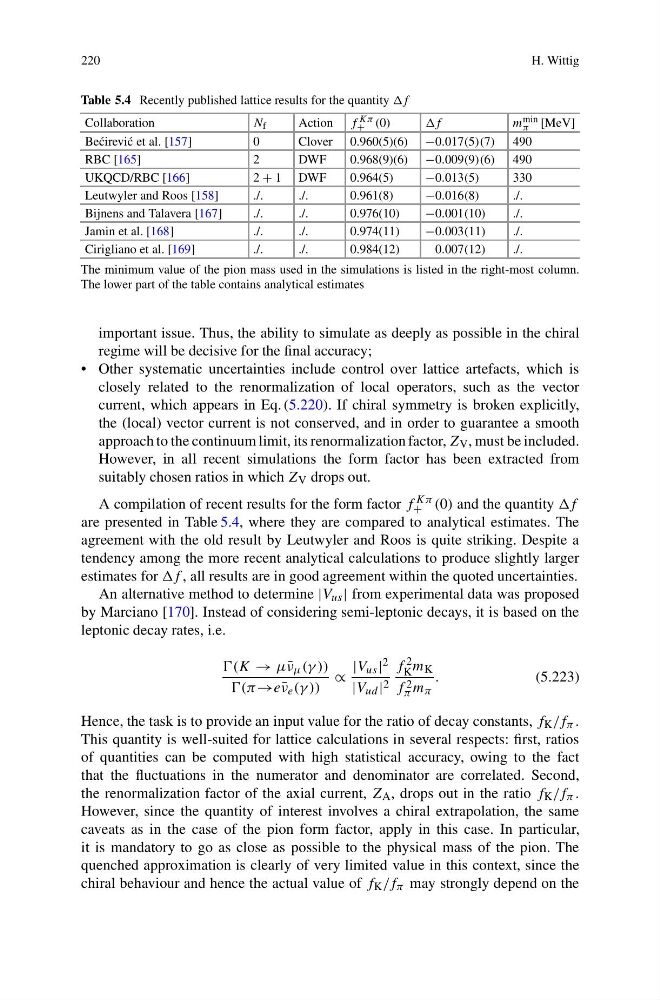
Table 5.4 Recently published lattice results for the quantity f
Collaboration
N f
Action f
Kπ
+ (0)
f
m min
π [MeV]
Be´ cirevi´ c et al. [157]
0
Clover 0.960(5)(6) −0.017(5)(7) 490
RBC [165]
2
DWF
0.968(9)(6) −0.009(9)(6) 490
UKQCD/RBC [166]
2 + 1 DWF
0.964(5)
−0.013(5)
330
Leutwyler and Roos [158]
./.
./.
0.961(8)
−0.016(8)
./.
Bijnens and Talavera [167]
./.
./.
0.976(10)
−0.001(10)
./.
Jamin et al. [168]
./.
./.
0.974(11)
−0.003(11)
./.
Cirigliano et al. [169]
./.
./.
0.984(12)
0.007(12)
./.
The minimum value of the pion mass used in the simulations is listed in the right-most column.
The lower part of the table contains analytical estimates
important issue. Thus, the ability to simulate as deeply as possible in the chiral
regime will be decisive for the final accuracy;
• Other systematic uncertainties include control over lattice artefacts, which is
closely related to the renormalization of local operators, such as the vector
current, which appears in Eq. (5.220). If chiral symmetry is broken explicitly,
the (local) vector current is not conserved, and in order to guarantee a smooth
approach to the continuum limit, its renormalization factor, Z V , must be included.
However, in all recent simulations the form factor has been extracted from
suitably chosen ratios in which Z V drops out.
A compilation of recent results for the form factor f
Kπ
+ (0) and the quantity f
are presented in Table 5.4, where they are compared to analytical estimates. The
agreement with the old result by Leutwyler and Roos is quite striking. Despite a
tendency among the more recent analytical calculations to produce slightly larger
estimates for f , all results are in good agreement within the quoted uncertainties.
An alternative method to determine |V us | from experimental data was proposed
by Marciano [170]. Instead of considering semi-leptonic decays, it is based on the
leptonic decay rates, i.e.
(K → μ¯ ν μ (γ ))
(π→e ¯
ν e (γ ))
∝
|V us | 2
|V ud | 2
f 2
K m K
f 2
π m π
.
(5.223)
Hence, the task is to provide an input value for the ratio of decay constants, f K /f π .
This quantity is well-suited for lattice calculations in several respects: first, ratios
of quantities can be computed with high statistical accuracy, owing to the fact
that the fluctuations in the numerator and denominator are correlated. Second,
the renormalization factor of the axial current, Z A , drops out in the ratio f K /f π .
However, since the quantity of interest involves a chiral extrapolation, the same
caveats as in the case of the pion form factor, apply in this case. In particular,
it is mandatory to go as close as possible to the physical mass of the pion. The
quenched approximation is clearly of very limited value in this context, since the
chiral behaviour and hence the actual value of f K /f π may strongly depend on the
H. Wittig
Table 5.4 Recently published lattice results for the quantity f
Collaboration
N f
Action f
Kπ
+ (0)
f
m min
π [MeV]
Be´ cirevi´ c et al. [157]
0
Clover 0.960(5)(6) −0.017(5)(7) 490
RBC [165]
2
DWF
0.968(9)(6) −0.009(9)(6) 490
UKQCD/RBC [166]
2 + 1 DWF
0.964(5)
−0.013(5)
330
Leutwyler and Roos [158]
./.
./.
0.961(8)
−0.016(8)
./.
Bijnens and Talavera [167]
./.
./.
0.976(10)
−0.001(10)
./.
Jamin et al. [168]
./.
./.
0.974(11)
−0.003(11)
./.
Cirigliano et al. [169]
./.
./.
0.984(12)
0.007(12)
./.
The minimum value of the pion mass used in the simulations is listed in the right-most column.
The lower part of the table contains analytical estimates
important issue. Thus, the ability to simulate as deeply as possible in the chiral
regime will be decisive for the final accuracy;
• Other systematic uncertainties include control over lattice artefacts, which is
closely related to the renormalization of local operators, such as the vector
current, which appears in Eq. (5.220). If chiral symmetry is broken explicitly,
the (local) vector current is not conserved, and in order to guarantee a smooth
approach to the continuum limit, its renormalization factor, Z V , must be included.
However, in all recent simulations the form factor has been extracted from
suitably chosen ratios in which Z V drops out.
A compilation of recent results for the form factor f
Kπ
+ (0) and the quantity f
are presented in Table 5.4, where they are compared to analytical estimates. The
agreement with the old result by Leutwyler and Roos is quite striking. Despite a
tendency among the more recent analytical calculations to produce slightly larger
estimates for f , all results are in good agreement within the quoted uncertainties.
An alternative method to determine |V us | from experimental data was proposed
by Marciano [170]. Instead of considering semi-leptonic decays, it is based on the
leptonic decay rates, i.e.
(K → μ¯ ν μ (γ ))
(π→e ¯
ν e (γ ))
∝
|V us | 2
|V ud | 2
f 2
K m K
f 2
π m π
.
(5.223)
Hence, the task is to provide an input value for the ratio of decay constants, f K /f π .
This quantity is well-suited for lattice calculations in several respects: first, ratios
of quantities can be computed with high statistical accuracy, owing to the fact
that the fluctuations in the numerator and denominator are correlated. Second,
the renormalization factor of the axial current, Z A , drops out in the ratio f K /f π .
However, since the quantity of interest involves a chiral extrapolation, the same
caveats as in the case of the pion form factor, apply in this case. In particular,
it is mandatory to go as close as possible to the physical mass of the pion. The
quenched approximation is clearly of very limited value in this context, since the
chiral behaviour and hence the actual value of f K /f π may strongly depend on the