

5 QCD on the Lattice
219
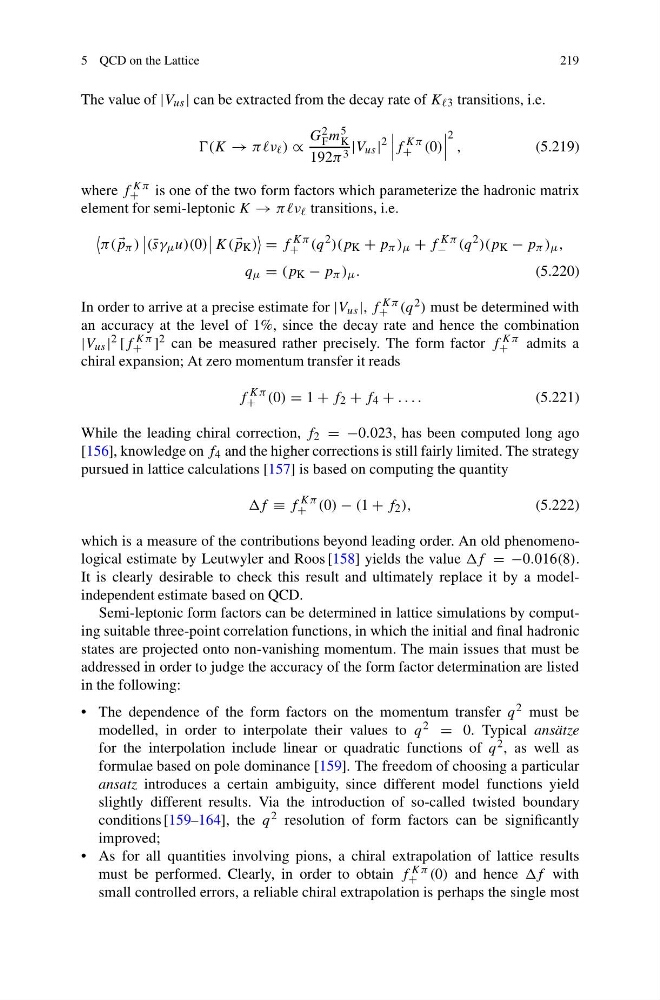
The value of |V us | can be extracted from the decay rate of K transitions, i.e.
(K → ππν ) ∝
G 2
F m
5
K
192π 3 |V us |
2
f
Kπ
+ (0)
2
,
(5.219)
where f
Kπ
+ is one of the two form factors which parameterize the hadronic matrix
element for semi-leptonic K → ππν transitions, i.e.
π(
p π )
(¯ sγ μ u)(0)
K(
p K )
= f
Kπ
+ (q
2 )(p K + p π ) μ + f
Kπ
− (q
2 )(p K − p π ) μ ,
q μ = (p K − p π ) μ .
(5.220)
In order to arrive at a precise estimate for |V us |, f
Kπ
+ (q 2 ) must be determined with
an accuracy at the level of 1%, since the decay rate and hence the combination
|V us | 2 [f
Kπ
+ ] 2 can be measured rather precisely. The form factor f
Kπ
+
admits a
chiral expansion; At zero momentum transfer it reads
f
Kπ
+ (0) = 1 + f 2 + f 4 + . . . .
(5.221)
While the leading chiral correction, f 2 = −0.023, has been computed long ago
[156], knowledge on f 4 and the higher corrections is still fairly limited. The strategy
pursued in lattice calculations [157] is based on computing the quantity
≡ f
Kπ
+ (0) − (1 + f 2 ),
(5.222)
which is a measure of the contributions beyond leading order. An old phenomenological estimate by Leutwyler and Roos [158] yields the value f = −0.016(8).
It is clearly desirable to check this result and ultimately replace it by a modelindependent estimate based on QCD.
Semi-leptonic form factors can be determined in lattice simulations by computing suitable three-point correlation functions, in which the initial and final hadronic
states are projected onto non-vanishing momentum. The main issues that must be
addressed in order to judge the accuracy of the form factor determination are listed
in the following:
• The dependence of the form factors on the momentum transfer q 2 must be
modelled, in order to interpolate their values to q 2 = 0. Typical ansätze
for the interpolation include linear or quadratic functions of q 2 , as well as
formulae based on pole dominance [159]. The freedom of choosing a particular
ansatz introduces a certain ambiguity, since different model functions yield
slightly different results. Via the introduction of so-called twisted boundary
conditions [159–164], the q 2 resolution of form factors can be significantly
improved;
• As for all quantities involving pions, a chiral extrapolation of lattice results
must be performed. Clearly, in order to obtain f Kπ
+ (0) and hence f with
small controlled errors, a reliable chiral extrapolation is perhaps the single most
219
The value of |V us | can be extracted from the decay rate of K transitions, i.e.
(K → ππν ) ∝
G 2
F m
5
K
192π 3 |V us |
2
f
Kπ
+ (0)
2
,
(5.219)
where f
Kπ
+ is one of the two form factors which parameterize the hadronic matrix
element for semi-leptonic K → ππν transitions, i.e.
π(
p π )
(¯ sγ μ u)(0)
K(
p K )
= f
Kπ
+ (q
2 )(p K + p π ) μ + f
Kπ
− (q
2 )(p K − p π ) μ ,
q μ = (p K − p π ) μ .
(5.220)
In order to arrive at a precise estimate for |V us |, f
Kπ
+ (q 2 ) must be determined with
an accuracy at the level of 1%, since the decay rate and hence the combination
|V us | 2 [f
Kπ
+ ] 2 can be measured rather precisely. The form factor f
Kπ
+
admits a
chiral expansion; At zero momentum transfer it reads
f
Kπ
+ (0) = 1 + f 2 + f 4 + . . . .
(5.221)
While the leading chiral correction, f 2 = −0.023, has been computed long ago
[156], knowledge on f 4 and the higher corrections is still fairly limited. The strategy
pursued in lattice calculations [157] is based on computing the quantity
≡ f
Kπ
+ (0) − (1 + f 2 ),
(5.222)
which is a measure of the contributions beyond leading order. An old phenomenological estimate by Leutwyler and Roos [158] yields the value f = −0.016(8).
It is clearly desirable to check this result and ultimately replace it by a modelindependent estimate based on QCD.
Semi-leptonic form factors can be determined in lattice simulations by computing suitable three-point correlation functions, in which the initial and final hadronic
states are projected onto non-vanishing momentum. The main issues that must be
addressed in order to judge the accuracy of the form factor determination are listed
in the following:
• The dependence of the form factors on the momentum transfer q 2 must be
modelled, in order to interpolate their values to q 2 = 0. Typical ansätze
for the interpolation include linear or quadratic functions of q 2 , as well as
formulae based on pole dominance [159]. The freedom of choosing a particular
ansatz introduces a certain ambiguity, since different model functions yield
slightly different results. Via the introduction of so-called twisted boundary
conditions [159–164], the q 2 resolution of form factors can be significantly
improved;
• As for all quantities involving pions, a chiral extrapolation of lattice results
must be performed. Clearly, in order to obtain f Kπ
+ (0) and hence f with
small controlled errors, a reliable chiral extrapolation is perhaps the single most