

5 QCD on the Lattice
209
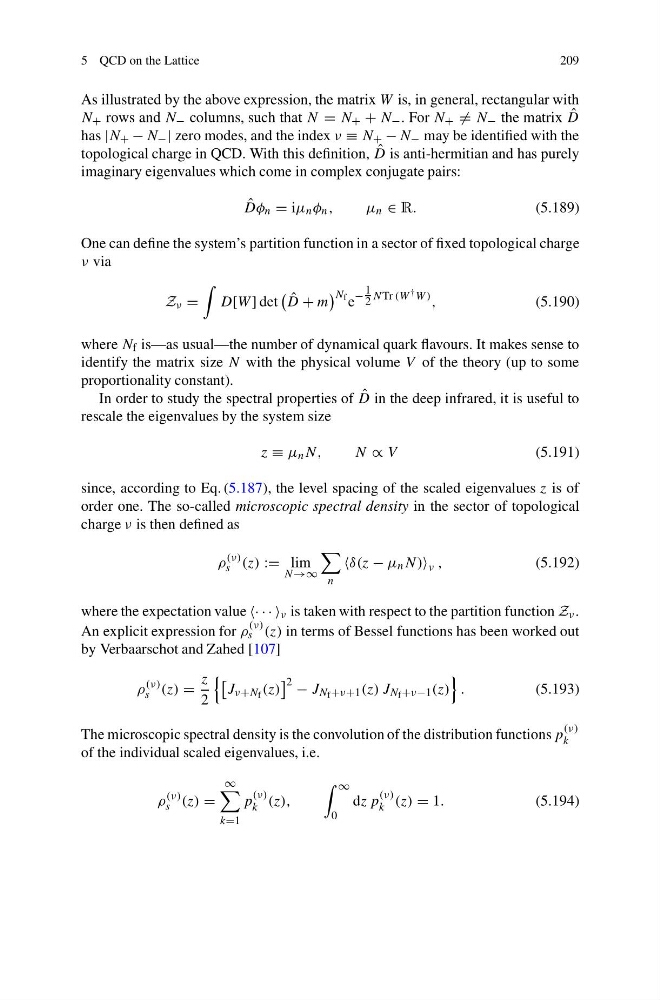
As illustrated by the above expression, the matrix W is, in general, rectangular with
N + rows and N − columns, such that N = N + + N − . For N + = N − the matrix ˆ
D
has |N + − N − | zero modes, and the index ν ≡ N + − N − may be identified with the
topological charge in QCD. With this definition, ˆ
D is anti-hermitian and has purely
imaginary eigenvalues which come in complex conjugate pairs:
ˆ
Dφ n = iμ n φ n ,
μ n ∈ R.
(5.189)
One can define the system’s partition function in a sector of fixed topological charge
ν via
Z ν =
D[W ] det
ˆ
D + m
N f e
−
1
2 NTr (W † W ) ,
(5.190)
where N f is—as usual—the number of dynamical quark flavours. It makes sense to
identify the matrix size N with the physical volume V of the theory (up to some
proportionality constant).
In order to study the spectral properties of ˆ
D in the deep infrared, it is useful to
rescale the eigenvalues by the system size
z ≡ μ n N,
N ∝ V
(5.191)
since, according to Eq. (5.187), the level spacing of the scaled eigenvalues z is of
order one. The so-called microscopic spectral density in the sector of topological
charge ν is then defined as
ρ
(ν)
s (z) := lim
N→∞
n
δ(z − μ n N) ν ,
(5.192)
where the expectation value · · · ν is taken with respect to the partition function Z ν .
An explicit expression for ρ
(ν)
s (z) in terms of Bessel functions has been worked out
by Verbaarschot and Zahed [107]
ρ
(ν)
s (z) =
z
2
J ν+N f (z)
2 − J N f +ν+1 (z) J N f +ν−1 (z)
.
(5.193)
The microscopic spectral density is the convolution of the distribution functions p
(ν)
k
of the individual scaled eigenvalues, i.e.
ρ
(ν)
s (z) =
∞
k=1
p
(ν)
k (z),
∞
0
dz p
(ν)
k (z) = 1.
(5.194)
209
As illustrated by the above expression, the matrix W is, in general, rectangular with
N + rows and N − columns, such that N = N + + N − . For N + = N − the matrix ˆ
D
has |N + − N − | zero modes, and the index ν ≡ N + − N − may be identified with the
topological charge in QCD. With this definition, ˆ
D is anti-hermitian and has purely
imaginary eigenvalues which come in complex conjugate pairs:
ˆ
Dφ n = iμ n φ n ,
μ n ∈ R.
(5.189)
One can define the system’s partition function in a sector of fixed topological charge
ν via
Z ν =
D[W ] det
ˆ
D + m
N f e
−
1
2 NTr (W † W ) ,
(5.190)
where N f is—as usual—the number of dynamical quark flavours. It makes sense to
identify the matrix size N with the physical volume V of the theory (up to some
proportionality constant).
In order to study the spectral properties of ˆ
D in the deep infrared, it is useful to
rescale the eigenvalues by the system size
z ≡ μ n N,
N ∝ V
(5.191)
since, according to Eq. (5.187), the level spacing of the scaled eigenvalues z is of
order one. The so-called microscopic spectral density in the sector of topological
charge ν is then defined as
ρ
(ν)
s (z) := lim
N→∞
n
δ(z − μ n N) ν ,
(5.192)
where the expectation value · · · ν is taken with respect to the partition function Z ν .
An explicit expression for ρ
(ν)
s (z) in terms of Bessel functions has been worked out
by Verbaarschot and Zahed [107]
ρ
(ν)
s (z) =
z
2
J ν+N f (z)
2 − J N f +ν+1 (z) J N f +ν−1 (z)
.
(5.193)
The microscopic spectral density is the convolution of the distribution functions p
(ν)
k
of the individual scaled eigenvalues, i.e.
ρ
(ν)
s (z) =
∞
k=1
p
(ν)
k (z),
∞
0
dz p
(ν)
k (z) = 1.
(5.194)