

210
H. Wittig
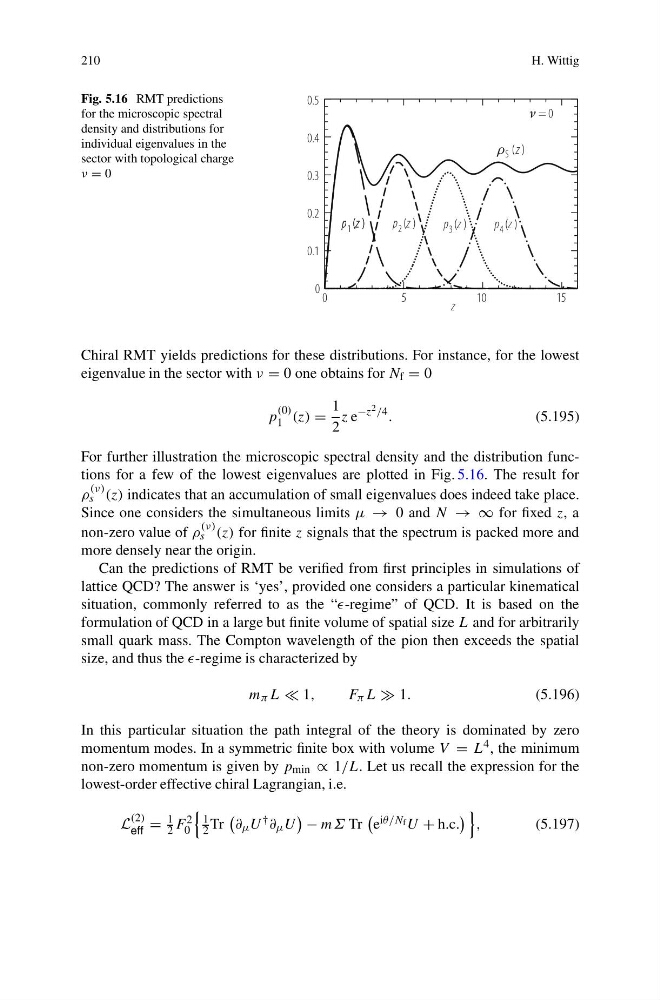
Fig. 5.16 RMT predictions
for the microscopic spectral
density and distributions for
individual eigenvalues in the
sector with topological charge
ν = 0
0.5
0.4
0.3
0.2
0.1
0 0
5
10
15
z
= 0
S ( )
z
p z
1 ( )
p z
1 ( )
p z
2 ( )
p z
3 ( )
p z
4 ( )
Chiral RMT yields predictions for these distributions. For instance, for the lowest
eigenvalue in the sector with ν = 0 one obtains for N f = 0
p
(0)
1 (z) =
1
2
z e
−z 2 /4 .
(5.195)
For further illustration the microscopic spectral density and the distribution functions for a few of the lowest eigenvalues are plotted in Fig. 5.16. The result for
ρ
(ν)
s (z) indicates that an accumulation of small eigenvalues does indeed take place.
Since one considers the simultaneous limits μ → 0 and N → ∞ for fixed z, a
non-zero value of ρ
(ν)
s (z) for finite z signals that the spectrum is packed more and
more densely near the origin.
Can the predictions of RMT be verified from first principles in simulations of
lattice QCD? The answer is ‘yes’, provided one considers a particular kinematical
situation, commonly referred to as the “-regime” of QCD. It is based on the
formulation of QCD in a large but finite volume of spatial size L and for arbitrarily
small quark mass. The Compton wavelength of the pion then exceeds the spatial
size, and thus the -regime is characterized by
m π L 1,
F π L 1.
(5.196)
In this particular situation the path integral of the theory is dominated by zero
momentum modes. In a symmetric finite box with volume V = L 4 , the minimum
non-zero momentum is given by p min ∝ 1/L. Let us recall the expression for the
lowest-order effective chiral Lagrangian, i.e.
L
(2)
eff =
1
2 F 2
0
1
2 Tr
∂ μ U † ∂ μ U
− mΣ Tr
e iθ/N f U + h.c.
,
(5.197)
H. Wittig
Fig. 5.16 RMT predictions
for the microscopic spectral
density and distributions for
individual eigenvalues in the
sector with topological charge
ν = 0
0.5
0.4
0.3
0.2
0.1
0 0
5
10
15
z
= 0
S ( )
z
p z
1 ( )
p z
1 ( )
p z
2 ( )
p z
3 ( )
p z
4 ( )
Chiral RMT yields predictions for these distributions. For instance, for the lowest
eigenvalue in the sector with ν = 0 one obtains for N f = 0
p
(0)
1 (z) =
1
2
z e
−z 2 /4 .
(5.195)
For further illustration the microscopic spectral density and the distribution functions for a few of the lowest eigenvalues are plotted in Fig. 5.16. The result for
ρ
(ν)
s (z) indicates that an accumulation of small eigenvalues does indeed take place.
Since one considers the simultaneous limits μ → 0 and N → ∞ for fixed z, a
non-zero value of ρ
(ν)
s (z) for finite z signals that the spectrum is packed more and
more densely near the origin.
Can the predictions of RMT be verified from first principles in simulations of
lattice QCD? The answer is ‘yes’, provided one considers a particular kinematical
situation, commonly referred to as the “-regime” of QCD. It is based on the
formulation of QCD in a large but finite volume of spatial size L and for arbitrarily
small quark mass. The Compton wavelength of the pion then exceeds the spatial
size, and thus the -regime is characterized by
m π L 1,
F π L 1.
(5.196)
In this particular situation the path integral of the theory is dominated by zero
momentum modes. In a symmetric finite box with volume V = L 4 , the minimum
non-zero momentum is given by p min ∝ 1/L. Let us recall the expression for the
lowest-order effective chiral Lagrangian, i.e.
L
(2)
eff =
1
2 F 2
0
1
2 Tr
∂ μ U † ∂ μ U
− mΣ Tr
e iθ/N f U + h.c.
,
(5.197)