

208
H. Wittig
where the expectation value is taken with respect to the QCD functional integral. 18
Note that in Eq. (5.184) the ordering of limits must be obeyed. In particular, since
the spontaneous breaking of a continuous symmetry cannot occur in finite volume,
the limit V → ∞ must be taken before the chiral limit and the spectrum in the deep
infrared are considered.
The Banks–Casher relation provides not only a method to determine the condensate, but also suggests a mechanism how spontaneous chiral symmetry breaking
comes about. Indeed, Eq. (5.184) implies that a non-zero value of the quark
condensate is generated through a non-vanishing value of the spectral density in
the deep infrared. In other words, spontaneous chiral symmetry breaking is driven
by an accumulation of small eigenvalues. An immediate consequence of the Banks–
Casher relation is that the level spacing λ between the small eigenvalues is given
by
≡
1
ρ(λ)
=
π
V Σ
.
(5.187)
Hence, as V → ∞ the level spacing becomes arbitrarily small. In the free theory,
i.e. in the absence of a non-trivial gauge field one finds that ρ(λ) ∝ λ 3 , which
vanishes as λ → 0. The accumulation of eigenvalues near zero with a rate predicted
by Eq. (5.187) must therefore arise through the interaction with the gauge field.
In order to test the Banks–Casher scenario, a possible strategy is to compute
the spectral density and check whether it actually produces an arbitrarily dense
spectrum near the origin. Analytic predictions for ρ(λ) can be derived in the
framework of effective theories of QCD at low energies, namely ChPT, as well
as chiral Random Matrix Theory (RMT). The latter also yields predictions for the
distributions of individual eigenvalues, in addition to the spectral density.
Chiral Random Matrix Theory goes back to an idea of Wigner who tried to utilize
statistical properties for the theoretical description of systems with many degrees
of freedom and complicated dynamics, such as nuclear resonances. Rather than
trying to model the local interactions within such a system explicitly, all possible
interactions that are consistent with the symmetries of the theory are equally likely.
The Hamiltonian is then approximated by a matrix whose elements are uncorrelated
but obey a particular probability distribution. The main guiding principle for the
RMT description of QCD is the requirement that all global symmetries must be
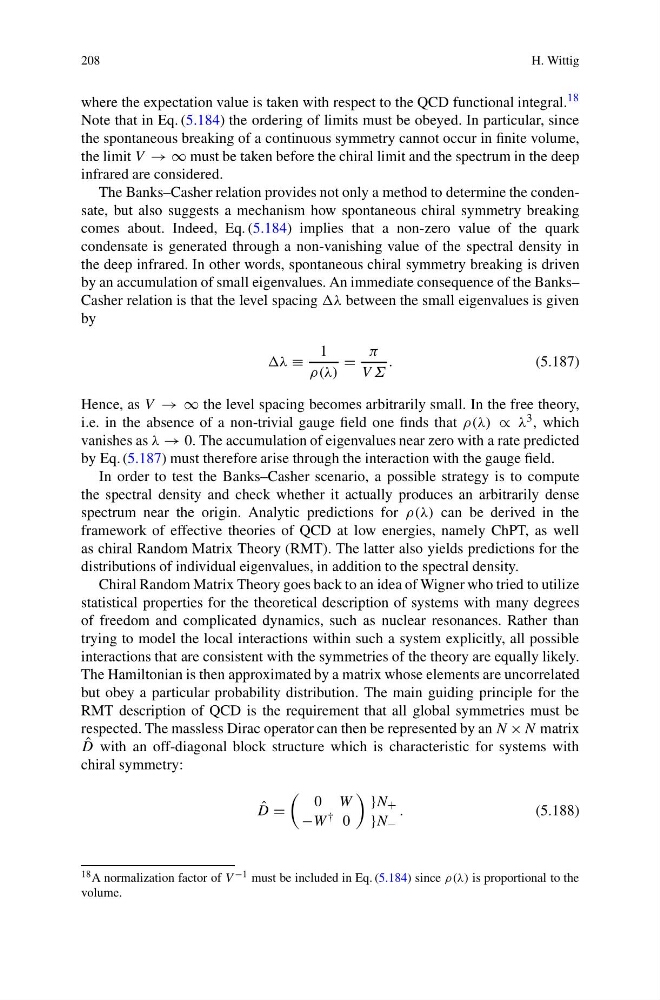
respected. The massless Dirac operator can then be represented by an N × N matrix
ˆ
D with an off-diagonal block structure which is characteristic for systems with
chiral symmetry:
ˆ
D =
0 W
−W † 0
}N +
}N −
.
(5.188)
18 A normalization factor of V −1 must be included in Eq. (5.184) since ρ(λ) is proportional to the
volume.
H. Wittig
where the expectation value is taken with respect to the QCD functional integral. 18
Note that in Eq. (5.184) the ordering of limits must be obeyed. In particular, since
the spontaneous breaking of a continuous symmetry cannot occur in finite volume,
the limit V → ∞ must be taken before the chiral limit and the spectrum in the deep
infrared are considered.
The Banks–Casher relation provides not only a method to determine the condensate, but also suggests a mechanism how spontaneous chiral symmetry breaking
comes about. Indeed, Eq. (5.184) implies that a non-zero value of the quark
condensate is generated through a non-vanishing value of the spectral density in
the deep infrared. In other words, spontaneous chiral symmetry breaking is driven
by an accumulation of small eigenvalues. An immediate consequence of the Banks–
Casher relation is that the level spacing λ between the small eigenvalues is given
by
≡
1
ρ(λ)
=
π
V Σ
.
(5.187)
Hence, as V → ∞ the level spacing becomes arbitrarily small. In the free theory,
i.e. in the absence of a non-trivial gauge field one finds that ρ(λ) ∝ λ 3 , which
vanishes as λ → 0. The accumulation of eigenvalues near zero with a rate predicted
by Eq. (5.187) must therefore arise through the interaction with the gauge field.
In order to test the Banks–Casher scenario, a possible strategy is to compute
the spectral density and check whether it actually produces an arbitrarily dense
spectrum near the origin. Analytic predictions for ρ(λ) can be derived in the
framework of effective theories of QCD at low energies, namely ChPT, as well
as chiral Random Matrix Theory (RMT). The latter also yields predictions for the
distributions of individual eigenvalues, in addition to the spectral density.
Chiral Random Matrix Theory goes back to an idea of Wigner who tried to utilize
statistical properties for the theoretical description of systems with many degrees
of freedom and complicated dynamics, such as nuclear resonances. Rather than
trying to model the local interactions within such a system explicitly, all possible
interactions that are consistent with the symmetries of the theory are equally likely.
The Hamiltonian is then approximated by a matrix whose elements are uncorrelated
but obey a particular probability distribution. The main guiding principle for the
RMT description of QCD is the requirement that all global symmetries must be
respected. The massless Dirac operator can then be represented by an N × N matrix
ˆ
D with an off-diagonal block structure which is characteristic for systems with
chiral symmetry:
ˆ
D =
0 W
−W † 0
}N +
}N −
.
(5.188)
18 A normalization factor of V −1 must be included in Eq. (5.184) since ρ(λ) is proportional to the
volume.