

5 QCD on the Lattice
207
5.6.2 Lattice Calculations of the Quark Condensate
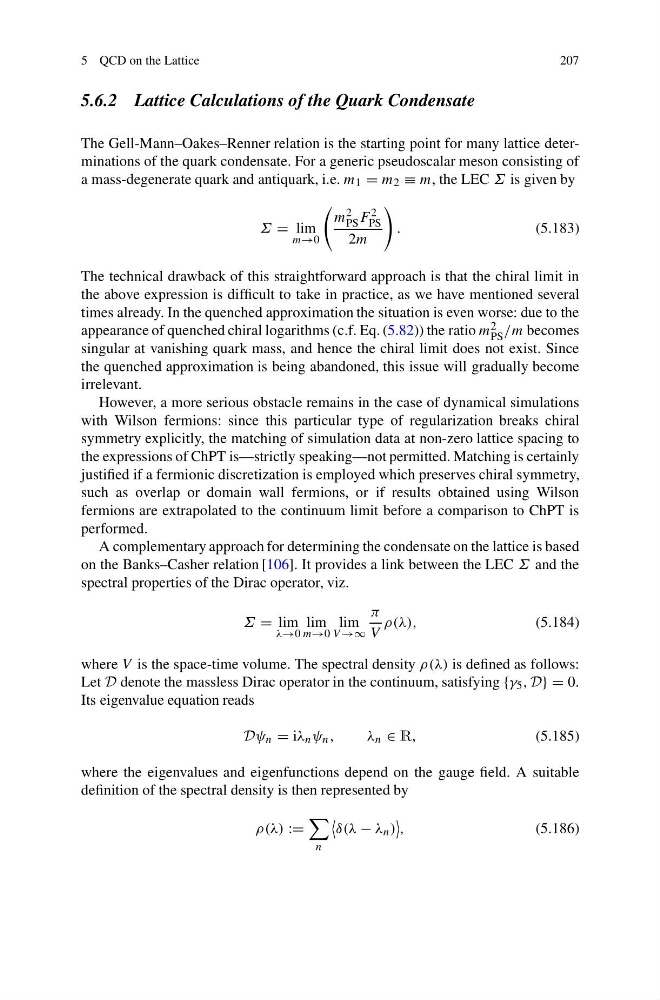
The Gell-Mann–Oakes–Renner relation is the starting point for many lattice determinations of the quark condensate. For a generic pseudoscalar meson consisting of
a mass-degenerate quark and antiquark, i.e. m 1 = m 2 ≡ m, the LEC Σ is given by
Σ = lim
m→0
m 2
PS F 2
PS
2m
.
(5.183)
The technical drawback of this straightforward approach is that the chiral limit in
the above expression is difficult to take in practice, as we have mentioned several
times already. In the quenched approximation the situation is even worse: due to the
appearance of quenched chiral logarithms (c.f. Eq. (5.82)) the ratio m 2
PS /m becomes
singular at vanishing quark mass, and hence the chiral limit does not exist. Since
the quenched approximation is being abandoned, this issue will gradually become
irrelevant.
However, a more serious obstacle remains in the case of dynamical simulations
with Wilson fermions: since this particular type of regularization breaks chiral
symmetry explicitly, the matching of simulation data at non-zero lattice spacing to
the expressions of ChPT is—strictly speaking—not permitted. Matching is certainly
justified if a fermionic discretization is employed which preserves chiral symmetry,
such as overlap or domain wall fermions, or if results obtained using Wilson
fermions are extrapolated to the continuum limit before a comparison to ChPT is
performed.
A complementary approach for determining the condensate on the lattice is based
on the Banks–Casher relation [106]. It provides a link between the LEC Σ and the
spectral properties of the Dirac operator, viz.
Σ = lim
λ→0
lim
m→0
lim
V →∞
π
V
ρ(λ),
(5.184)
where V is the space-time volume. The spectral density ρ(λ) is defined as follows:
Let D denote the massless Dirac operator in the continuum, satisfying {γ 5 , D} = 0.
Its eigenvalue equation reads
Dψ n = iλ n ψ n ,
λ n ∈ R,
(5.185)
where the eigenvalues and eigenfunctions depend on the gauge field. A suitable
definition of the spectral density is then represented by
ρ(λ) :=
n
δ(λ − λ n )
,
(5.186)
207
5.6.2 Lattice Calculations of the Quark Condensate
The Gell-Mann–Oakes–Renner relation is the starting point for many lattice determinations of the quark condensate. For a generic pseudoscalar meson consisting of
a mass-degenerate quark and antiquark, i.e. m 1 = m 2 ≡ m, the LEC Σ is given by
Σ = lim
m→0
m 2
PS F 2
PS
2m
.
(5.183)
The technical drawback of this straightforward approach is that the chiral limit in
the above expression is difficult to take in practice, as we have mentioned several
times already. In the quenched approximation the situation is even worse: due to the
appearance of quenched chiral logarithms (c.f. Eq. (5.82)) the ratio m 2
PS /m becomes
singular at vanishing quark mass, and hence the chiral limit does not exist. Since
the quenched approximation is being abandoned, this issue will gradually become
irrelevant.
However, a more serious obstacle remains in the case of dynamical simulations
with Wilson fermions: since this particular type of regularization breaks chiral
symmetry explicitly, the matching of simulation data at non-zero lattice spacing to
the expressions of ChPT is—strictly speaking—not permitted. Matching is certainly
justified if a fermionic discretization is employed which preserves chiral symmetry,
such as overlap or domain wall fermions, or if results obtained using Wilson
fermions are extrapolated to the continuum limit before a comparison to ChPT is
performed.
A complementary approach for determining the condensate on the lattice is based
on the Banks–Casher relation [106]. It provides a link between the LEC Σ and the
spectral properties of the Dirac operator, viz.
Σ = lim
λ→0
lim
m→0
lim
V →∞
π
V
ρ(λ),
(5.184)
where V is the space-time volume. The spectral density ρ(λ) is defined as follows:
Let D denote the massless Dirac operator in the continuum, satisfying {γ 5 , D} = 0.
Its eigenvalue equation reads
Dψ n = iλ n ψ n ,
λ n ∈ R,
(5.185)
where the eigenvalues and eigenfunctions depend on the gauge field. A suitable
definition of the spectral density is then represented by
ρ(λ) :=
n
δ(λ − λ n )
,
(5.186)