

5 QCD on the Lattice
201
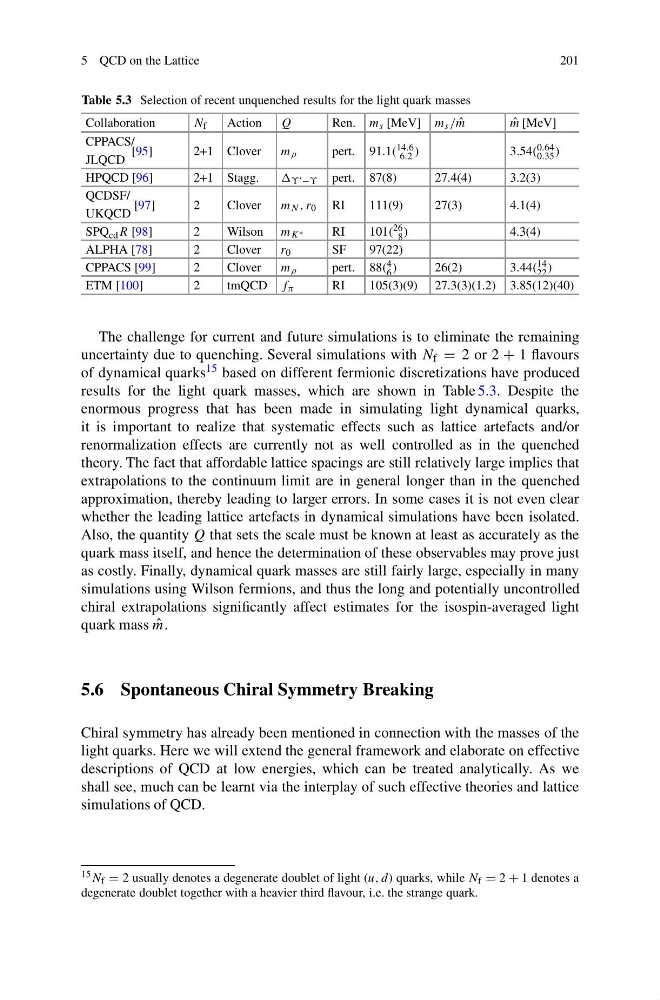
Table 5.3 Selection of recent unquenched results for the light quark masses
Collaboration
N f
Action
Q
Ren. m s [MeV] m s / ˆ
m
ˆ
m [MeV]
CPPACS/
JLQCD
[95]
2+1 Clover
m ρ
pert. 91.1( 14.6
6.2 )
3.54( 0.64
0.35 )
HPQCD [96]
2+1 Stagg.
ϒ −ϒ pert. 87(8)
27.4(4)
3.2(3)
QCDSF/
UKQCD
[97]
2
Clover
m N , r 0 RI
111(9)
27(3)
4.1(4)
SPQ cd R [98]
2
Wilson m K ∗
RI
101( 26
8 )
4.3(4)
ALPHA [78]
2
Clover
r 0
SF
97(22)
CPPACS [99]
2
Clover
m ρ
pert. 88( 4
6 )
26(2)
3.44( 14
22 )
ETM [100]
2
tmQCD f π
RI
105(3)(9) 27.3(3)(1.2) 3.85(12)(40)
The challenge for current and future simulations is to eliminate the remaining
uncertainty due to quenching. Several simulations with N f = 2 or 2 + 1 flavours
of dynamical quarks 15 based on different fermionic discretizations have produced
results for the light quark masses, which are shown in Table 5.3. Despite the
enormous progress that has been made in simulating light dynamical quarks,
it is important to realize that systematic effects such as lattice artefacts and/or
renormalization effects are currently not as well controlled as in the quenched
theory. The fact that affordable lattice spacings are still relatively large implies that
extrapolations to the continuum limit are in general longer than in the quenched
approximation, thereby leading to larger errors. In some cases it is not even clear
whether the leading lattice artefacts in dynamical simulations have been isolated.
Also, the quantity Q that sets the scale must be known at least as accurately as the
quark mass itself, and hence the determination of these observables may prove just
as costly. Finally, dynamical quark masses are still fairly large, especially in many
simulations using Wilson fermions, and thus the long and potentially uncontrolled
chiral extrapolations significantly affect estimates for the isospin-averaged light
quark mass ˆ
m.
5.6 Spontaneous Chiral Symmetry Breaking
Chiral symmetry has already been mentioned in connection with the masses of the
light quarks. Here we will extend the general framework and elaborate on effective
descriptions of QCD at low energies, which can be treated analytically. As we
shall see, much can be learnt via the interplay of such effective theories and lattice
simulations of QCD.
15 N f = 2 usually denotes a degenerate doublet of light (u, d) quarks, while N f = 2 + 1 denotes a
degenerate doublet together with a heavier third flavour, i.e. the strange quark.
201
Table 5.3 Selection of recent unquenched results for the light quark masses
Collaboration
N f
Action
Q
Ren. m s [MeV] m s / ˆ
m
ˆ
m [MeV]
CPPACS/
JLQCD
[95]
2+1 Clover
m ρ
pert. 91.1( 14.6
6.2 )
3.54( 0.64
0.35 )
HPQCD [96]
2+1 Stagg.
ϒ −ϒ pert. 87(8)
27.4(4)
3.2(3)
QCDSF/
UKQCD
[97]
2
Clover
m N , r 0 RI
111(9)
27(3)
4.1(4)
SPQ cd R [98]
2
Wilson m K ∗
RI
101( 26
8 )
4.3(4)
ALPHA [78]
2
Clover
r 0
SF
97(22)
CPPACS [99]
2
Clover
m ρ
pert. 88( 4
6 )
26(2)
3.44( 14
22 )
ETM [100]
2
tmQCD f π
RI
105(3)(9) 27.3(3)(1.2) 3.85(12)(40)
The challenge for current and future simulations is to eliminate the remaining
uncertainty due to quenching. Several simulations with N f = 2 or 2 + 1 flavours
of dynamical quarks 15 based on different fermionic discretizations have produced
results for the light quark masses, which are shown in Table 5.3. Despite the
enormous progress that has been made in simulating light dynamical quarks,
it is important to realize that systematic effects such as lattice artefacts and/or
renormalization effects are currently not as well controlled as in the quenched
theory. The fact that affordable lattice spacings are still relatively large implies that
extrapolations to the continuum limit are in general longer than in the quenched
approximation, thereby leading to larger errors. In some cases it is not even clear
whether the leading lattice artefacts in dynamical simulations have been isolated.
Also, the quantity Q that sets the scale must be known at least as accurately as the
quark mass itself, and hence the determination of these observables may prove just
as costly. Finally, dynamical quark masses are still fairly large, especially in many
simulations using Wilson fermions, and thus the long and potentially uncontrolled
chiral extrapolations significantly affect estimates for the isospin-averaged light
quark mass ˆ
m.
5.6 Spontaneous Chiral Symmetry Breaking
Chiral symmetry has already been mentioned in connection with the masses of the
light quarks. Here we will extend the general framework and elaborate on effective
descriptions of QCD at low energies, which can be treated analytically. As we
shall see, much can be learnt via the interplay of such effective theories and lattice
simulations of QCD.
15 N f = 2 usually denotes a degenerate doublet of light (u, d) quarks, while N f = 2 + 1 denotes a
degenerate doublet together with a heavier third flavour, i.e. the strange quark.