

202
H. Wittig
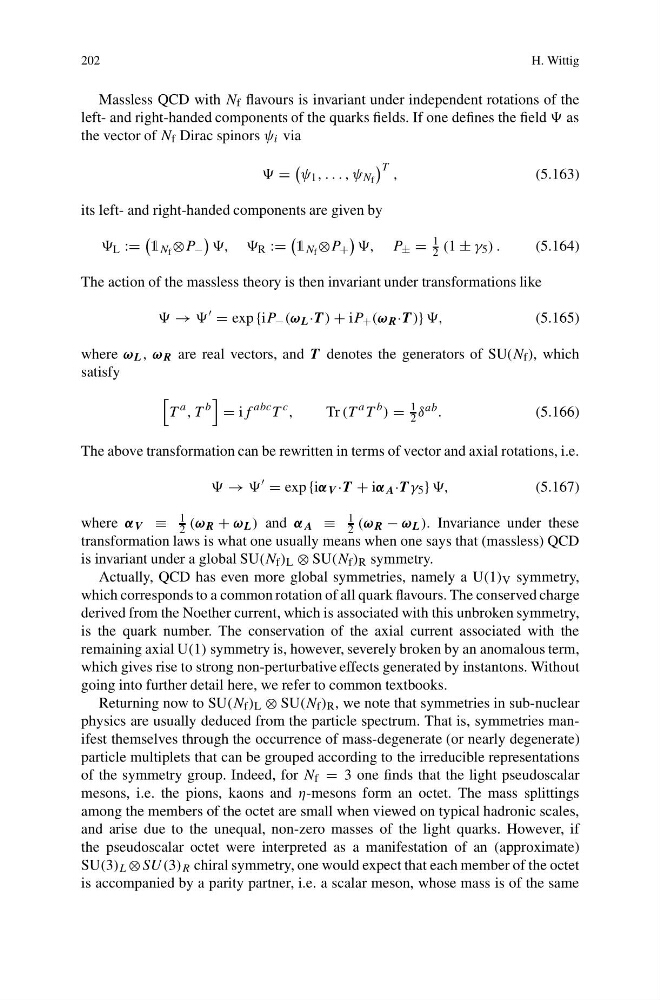
Massless QCD with N f flavours is invariant under independent rotations of the
left- and right-handed components of the quarks fields. If one defines the field as
the vector of N f Dirac spinors ψ i via
=
ψ 1 , . . . , ψ N f
T ,
(5.163)
its left- and right-handed components are given by
L :=
1 N f ⊗P −
, , R :=
1 N f ⊗P +
P ± =
1
2 (1 ± γ 5 ) .
(5.164)
The action of the massless theory is then invariant under transformations like
→
= exp {iP − (ω L ·T ) + iP + (ω R ·T )} ,
(5.165)
where ω L , ω R are real vectors, and T denotes the generators of SU(N f ), which
satisfy
T
a , T
b
= if
abc T
c ,
Tr (T
a T
b ) =
1
2 δ ab .
(5.166)
The above transformation can be rewritten in terms of vector and axial rotations, i.e.
→
= exp {iα V ·T + iα A ·T γ 5 } ,
(5.167)
where α V ≡
1
2 (ω R + ω L ) and α A ≡
1
2 (ω R − ω L ). Invariance under these
transformation laws is what one usually means when one says that (massless) QCD
is invariant under a global SU(N f ) L ⊗ SU(N f ) R symmetry.
Actually, QCD has even more global symmetries, namely a U(1) V symmetry,
which corresponds to a common rotation of all quark flavours. The conserved charge
derived from the Noether current, which is associated with this unbroken symmetry,
is the quark number. The conservation of the axial current associated with the
remaining axial U(1) symmetry is, however, severely broken by an anomalous term,
which gives rise to strong non-perturbative effects generated by instantons. Without
going into further detail here, we refer to common textbooks.
Returning now to SU(N f ) L ⊗ SU(N f ) R , we note that symmetries in sub-nuclear
physics are usually deduced from the particle spectrum. That is, symmetries manifest themselves through the occurrence of mass-degenerate (or nearly degenerate)
particle multiplets that can be grouped according to the irreducible representations
of the symmetry group. Indeed, for N f = 3 one finds that the light pseudoscalar
mesons, i.e. the pions, kaons and η-mesons form an octet. The mass splittings
among the members of the octet are small when viewed on typical hadronic scales,
and arise due to the unequal, non-zero masses of the light quarks. However, if
the pseudoscalar octet were interpreted as a manifestation of an (approximate)
SU(3) L ⊗SU (3) R chiral symmetry, one would expect that each member of the octet
is accompanied by a parity partner, i.e. a scalar meson, whose mass is of the same
H. Wittig
Massless QCD with N f flavours is invariant under independent rotations of the
left- and right-handed components of the quarks fields. If one defines the field as
the vector of N f Dirac spinors ψ i via
=
ψ 1 , . . . , ψ N f
T ,
(5.163)
its left- and right-handed components are given by
L :=
1 N f ⊗P −
, , R :=
1 N f ⊗P +
P ± =
1
2 (1 ± γ 5 ) .
(5.164)
The action of the massless theory is then invariant under transformations like
→
= exp {iP − (ω L ·T ) + iP + (ω R ·T )} ,
(5.165)
where ω L , ω R are real vectors, and T denotes the generators of SU(N f ), which
satisfy
T
a , T
b
= if
abc T
c ,
Tr (T
a T
b ) =
1
2 δ ab .
(5.166)
The above transformation can be rewritten in terms of vector and axial rotations, i.e.
→
= exp {iα V ·T + iα A ·T γ 5 } ,
(5.167)
where α V ≡
1
2 (ω R + ω L ) and α A ≡
1
2 (ω R − ω L ). Invariance under these
transformation laws is what one usually means when one says that (massless) QCD
is invariant under a global SU(N f ) L ⊗ SU(N f ) R symmetry.
Actually, QCD has even more global symmetries, namely a U(1) V symmetry,
which corresponds to a common rotation of all quark flavours. The conserved charge
derived from the Noether current, which is associated with this unbroken symmetry,
is the quark number. The conservation of the axial current associated with the
remaining axial U(1) symmetry is, however, severely broken by an anomalous term,
which gives rise to strong non-perturbative effects generated by instantons. Without
going into further detail here, we refer to common textbooks.
Returning now to SU(N f ) L ⊗ SU(N f ) R , we note that symmetries in sub-nuclear
physics are usually deduced from the particle spectrum. That is, symmetries manifest themselves through the occurrence of mass-degenerate (or nearly degenerate)
particle multiplets that can be grouped according to the irreducible representations
of the symmetry group. Indeed, for N f = 3 one finds that the light pseudoscalar
mesons, i.e. the pions, kaons and η-mesons form an octet. The mass splittings
among the members of the octet are small when viewed on typical hadronic scales,
and arise due to the unequal, non-zero masses of the light quarks. However, if
the pseudoscalar octet were interpreted as a manifestation of an (approximate)
SU(3) L ⊗SU (3) R chiral symmetry, one would expect that each member of the octet
is accompanied by a parity partner, i.e. a scalar meson, whose mass is of the same