

200
H. Wittig
Table 5.2 Results for the strange quark mass in the MS-scheme at μ = 2 GeV and for the ratio
m s / ˆ
m, in the continuum limit of the quenched approximation
Collaboration
Action Q
Renorm. m
(Q)
s [MeV] m s / ˆ
m
m
(r 0 )
s
[MeV]
SPQ cd R [93]
Wilson m K ∗ RI
105(9)(6)
24.3(2)(6) 95(9)(5)
CP-PACS [47]
Wilson m ρ
pert.
114(2)(
6
3 )
26.5(
5.1
3.4 )
98(2)(
6
3 )
ALPHA/UKQCD [35]
Clover f K
SF
97(4)
99(4)
JLQCD [94]
Stagg. m ρ
RI
106(7)
25.1(2.4) 95(6)
The table includes information on the fermionic action employed in the simulations, the quantity
Q that sets the scale, and the type of renormalization (RI/MOM, SF or tadpole improved
perturbation theory. The right-most column contains the results for the strange quark mass when
converted into a common hadronic scheme, in which the scale is set by Q = 1/r 0 , assuming that
r 0 = 0.5 fm
Estimates for the strange quark mass itself can be obtained in two ways: first, one
combines ˆ
M + M s with the ratio M s / ˆ
M = 24.4 ± 1.4 estimated in ChPT [38].
Alternatively, one might attempt to compute ˆ
M directly from lattice data, by
considering Eq. (5.116) for a pion. In this case, however, one relies on chiral
extrapolations, because of the difficulties involved when tuning the masses of the
light quarks towards the values of the physical up- and down-quark masses.
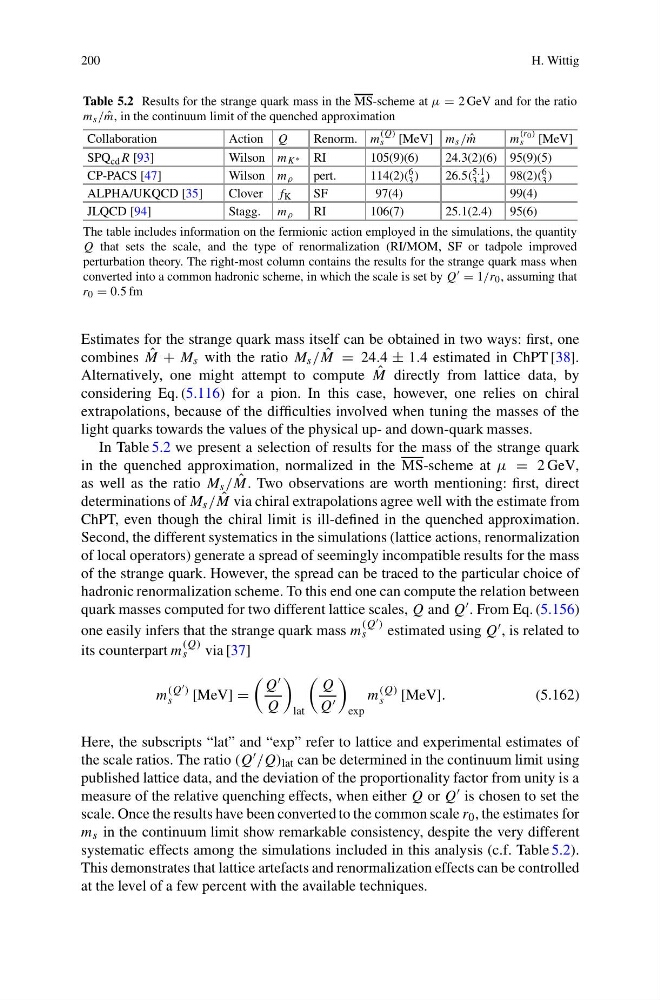
In Table 5.2 we present a selection of results for the mass of the strange quark
in the quenched approximation, normalized in the MS-scheme at μ = 2 GeV,
as well as the ratio M s / ˆ
M. Two observations are worth mentioning: first, direct
determinations of M s / ˆ
M via chiral extrapolations agree well with the estimate from
ChPT, even though the chiral limit is ill-defined in the quenched approximation.
Second, the different systematics in the simulations (lattice actions, renormalization
of local operators) generate a spread of seemingly incompatible results for the mass
of the strange quark. However, the spread can be traced to the particular choice of
hadronic renormalization scheme. To this end one can compute the relation between
quark masses computed for two different lattice scales, Q and Q . From Eq. (5.156)
one easily infers that the strange quark mass m
(Q )
s
estimated using Q , is related to
its counterpart m
(Q)
s
via [37]
m
(Q )
s
[MeV] =
Q
Q
lat
Q
Q
exp
m
(Q)
s [MeV].
(5.162)
Here, the subscripts “lat” and “exp” refer to lattice and experimental estimates of
the scale ratios. The ratio (Q /Q) lat can be determined in the continuum limit using
published lattice data, and the deviation of the proportionality factor from unity is a
measure of the relative quenching effects, when either Q or Q is chosen to set the
scale. Once the results have been converted to the common scale r 0 , the estimates for
m s in the continuum limit show remarkable consistency, despite the very different
systematic effects among the simulations included in this analysis (c.f. Table 5.2).
This demonstrates that lattice artefacts and renormalization effects can be controlled
at the level of a few percent with the available techniques.
H. Wittig
Table 5.2 Results for the strange quark mass in the MS-scheme at μ = 2 GeV and for the ratio
m s / ˆ
m, in the continuum limit of the quenched approximation
Collaboration
Action Q
Renorm. m
(Q)
s [MeV] m s / ˆ
m
m
(r 0 )
s
[MeV]
SPQ cd R [93]
Wilson m K ∗ RI
105(9)(6)
24.3(2)(6) 95(9)(5)
CP-PACS [47]
Wilson m ρ
pert.
114(2)(
6
3 )
26.5(
5.1
3.4 )
98(2)(
6
3 )
ALPHA/UKQCD [35]
Clover f K
SF
97(4)
99(4)
JLQCD [94]
Stagg. m ρ
RI
106(7)
25.1(2.4) 95(6)
The table includes information on the fermionic action employed in the simulations, the quantity
Q that sets the scale, and the type of renormalization (RI/MOM, SF or tadpole improved
perturbation theory. The right-most column contains the results for the strange quark mass when
converted into a common hadronic scheme, in which the scale is set by Q = 1/r 0 , assuming that
r 0 = 0.5 fm
Estimates for the strange quark mass itself can be obtained in two ways: first, one
combines ˆ
M + M s with the ratio M s / ˆ
M = 24.4 ± 1.4 estimated in ChPT [38].
Alternatively, one might attempt to compute ˆ
M directly from lattice data, by
considering Eq. (5.116) for a pion. In this case, however, one relies on chiral
extrapolations, because of the difficulties involved when tuning the masses of the
light quarks towards the values of the physical up- and down-quark masses.
In Table 5.2 we present a selection of results for the mass of the strange quark
in the quenched approximation, normalized in the MS-scheme at μ = 2 GeV,
as well as the ratio M s / ˆ
M. Two observations are worth mentioning: first, direct
determinations of M s / ˆ
M via chiral extrapolations agree well with the estimate from
ChPT, even though the chiral limit is ill-defined in the quenched approximation.
Second, the different systematics in the simulations (lattice actions, renormalization
of local operators) generate a spread of seemingly incompatible results for the mass
of the strange quark. However, the spread can be traced to the particular choice of
hadronic renormalization scheme. To this end one can compute the relation between
quark masses computed for two different lattice scales, Q and Q . From Eq. (5.156)
one easily infers that the strange quark mass m
(Q )
s
estimated using Q , is related to
its counterpart m
(Q)
s
via [37]
m
(Q )
s
[MeV] =
Q
Q
lat
Q
Q
exp
m
(Q)
s [MeV].
(5.162)
Here, the subscripts “lat” and “exp” refer to lattice and experimental estimates of
the scale ratios. The ratio (Q /Q) lat can be determined in the continuum limit using
published lattice data, and the deviation of the proportionality factor from unity is a
measure of the relative quenching effects, when either Q or Q is chosen to set the
scale. Once the results have been converted to the common scale r 0 , the estimates for
m s in the continuum limit show remarkable consistency, despite the very different
systematic effects among the simulations included in this analysis (c.f. Table 5.2).
This demonstrates that lattice artefacts and renormalization effects can be controlled
at the level of a few percent with the available techniques.