

5 QCD on the Lattice
179
= 6.0
= 6.2
= 6.4
Cornell
r r
/ 0
0.5
1.0
1.5
2.0
2.5
3.0
3
2
1
0
-1
-2
-3
-4
]
)
(
-
)
(
[
r
r
V
r
V 0
0
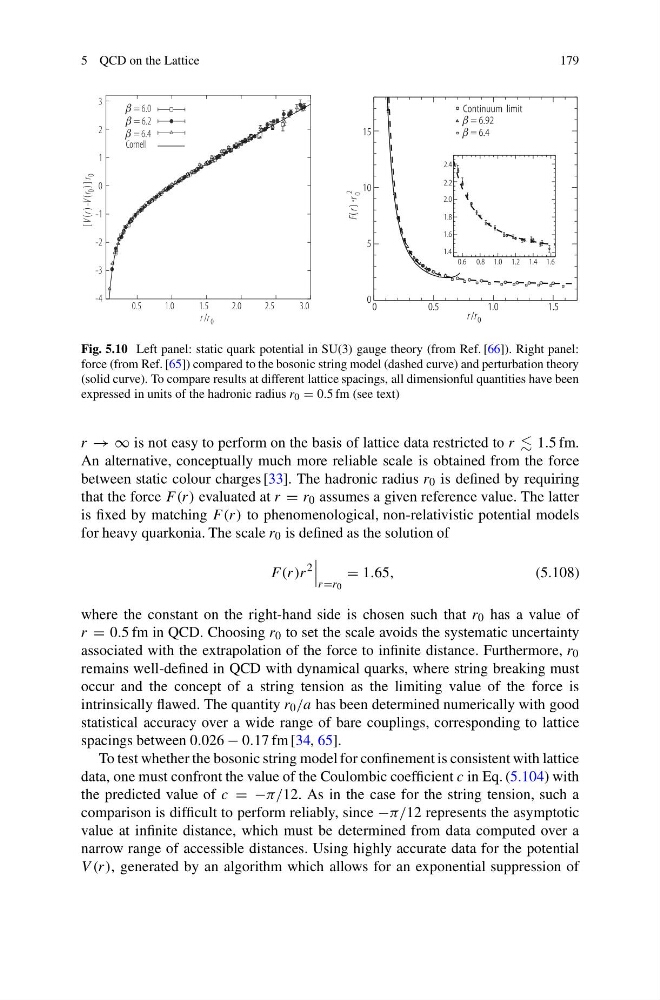
Fig. 5.10 Left panel: static quark potential in SU(3) gauge theory (from Ref. [66]). Right panel:
force (from Ref. [65]) compared to the bosonic string model (dashed curve) and perturbation theory
(solid curve). To compare results at different lattice spacings, all dimensionful quantities have been
expressed in units of the hadronic radius r 0 = 0.5 fm (see text)
r → ∞ is not easy to perform on the basis of lattice data restricted to r 1.5 fm.
An alternative, conceptually much more reliable scale is obtained from the force
between static colour charges [33]. The hadronic radius r 0 is defined by requiring
that the force F (r) evaluated at r = r 0 assumes a given reference value. The latter
is fixed by matching F (r) to phenomenological, non-relativistic potential models
for heavy quarkonia. The scale r 0 is defined as the solution of
F (r)r
2
r=r 0
= 1.65,
(5.108)
where the constant on the right-hand side is chosen such that r 0 has a value of
r = 0.5 fm in QCD. Choosing r 0 to set the scale avoids the systematic uncertainty
associated with the extrapolation of the force to infinite distance. Furthermore, r 0
remains well-defined in QCD with dynamical quarks, where string breaking must
occur and the concept of a string tension as the limiting value of the force is
intrinsically flawed. The quantity r 0 /a has been determined numerically with good
statistical accuracy over a wide range of bare couplings, corresponding to lattice
spacings between 0.026 − 0.17 fm [34, 65].
To test whether the bosonic string model for confinement is consistent with lattice
data, one must confront the value of the Coulombic coefficient c in Eq. (5.104) with
the predicted value of c = −π/12. As in the case for the string tension, such a
comparison is difficult to perform reliably, since −π/12 represents the asymptotic
value at infinite distance, which must be determined from data computed over a
narrow range of accessible distances. Using highly accurate data for the potential
V (r), generated by an algorithm which allows for an exponential suppression of
179
= 6.0
= 6.2
= 6.4
Cornell
r r
/ 0
0.5
1.0
1.5
2.0
2.5
3.0
3
2
1
0
-1
-2
-3
-4
]
)
(
-
)
(
[
r
r
V
r
V 0
0
Fig. 5.10 Left panel: static quark potential in SU(3) gauge theory (from Ref. [66]). Right panel:
force (from Ref. [65]) compared to the bosonic string model (dashed curve) and perturbation theory
(solid curve). To compare results at different lattice spacings, all dimensionful quantities have been
expressed in units of the hadronic radius r 0 = 0.5 fm (see text)
r → ∞ is not easy to perform on the basis of lattice data restricted to r 1.5 fm.
An alternative, conceptually much more reliable scale is obtained from the force
between static colour charges [33]. The hadronic radius r 0 is defined by requiring
that the force F (r) evaluated at r = r 0 assumes a given reference value. The latter
is fixed by matching F (r) to phenomenological, non-relativistic potential models
for heavy quarkonia. The scale r 0 is defined as the solution of
F (r)r
2
r=r 0
= 1.65,
(5.108)
where the constant on the right-hand side is chosen such that r 0 has a value of
r = 0.5 fm in QCD. Choosing r 0 to set the scale avoids the systematic uncertainty
associated with the extrapolation of the force to infinite distance. Furthermore, r 0
remains well-defined in QCD with dynamical quarks, where string breaking must
occur and the concept of a string tension as the limiting value of the force is
intrinsically flawed. The quantity r 0 /a has been determined numerically with good
statistical accuracy over a wide range of bare couplings, corresponding to lattice
spacings between 0.026 − 0.17 fm [34, 65].
To test whether the bosonic string model for confinement is consistent with lattice
data, one must confront the value of the Coulombic coefficient c in Eq. (5.104) with
the predicted value of c = −π/12. As in the case for the string tension, such a
comparison is difficult to perform reliably, since −π/12 represents the asymptotic
value at infinite distance, which must be determined from data computed over a
narrow range of accessible distances. Using highly accurate data for the potential
V (r), generated by an algorithm which allows for an exponential suppression of