

180
H. Wittig
statistical fluctuations at large r and t, it could be shown [67] that the quantity
c eff (r) =
1
2
r
3 d 2 V (r)
dr 2
(5.109)
indeed converges towards the predicted value of −π/12. This result confirms the
string picture of confinement and suggests that string-like behaviour already sets in
at rather small distances of r >
∼ 0.5 fm.
The incorporation of dynamical quarks should drastically change the string
picture beyond a characteristic scale r b , where due to q ¯
q pair creation string breaking occurs, since a two-meson state is energetically favoured over the flux-tube.
However, the static quark potential determined from Wilson loops on dynamical
configurations typically does not show any clear signs of flattening off, even at
distances as large as 1 fm, where one expects hadronization to set in. This is
attributed to the Wilson loop having little overlap onto the state of a broken
string, such that the spectral weight associated with the broken string is extremely
small. Therefore, extracting its energy reliably would require large Euclidean time
separations, for which the statistical signal is usually lost.
It was thus proposed to address this problem by constructing a matrix correlator
of Wilson loops supplemented by operators that directly project onto a two-meson
state, and to consider their cross-correlations with the unbroken flux-tube. This
strategy was first applied to Higgs models, i.e. non-Abelian gauge theory coupled
to bosonic matter fields (“scalar QCD”), which are computationally much more
efficient, whilst preserving the mechanism for string breaking to occur [68, 69]. The
method was later extended to QCD with two flavours of dynamical quarks [70].
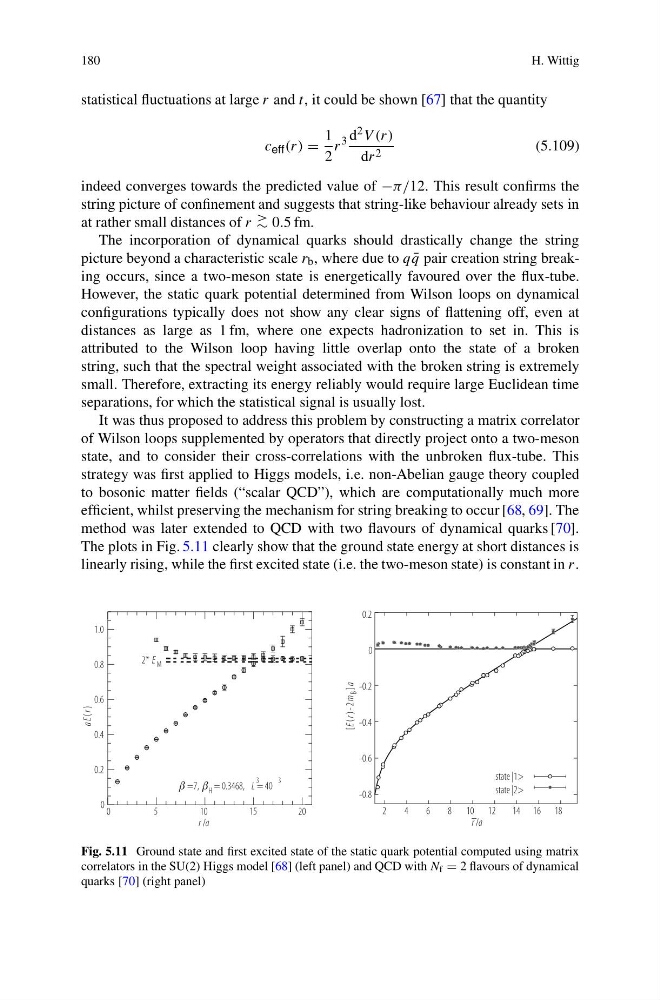
The plots in Fig. 5.11 clearly show that the ground state energy at short distances is
linearly rising, while the first excited state (i.e. the two-meson state) is constant in r.
r a
/
1.0
0.8
0.6
0.4
0.2
0 0
5
10
15
20
2* E M
=7, = 0.3468, = 40
H
3
3
L
r
E
a )
(
state |1>
state |2>
0.2
0
-0.2
-0.4
-0.6
-0.8
2
4
6
8 10 12
14 16 18
r a
/
]
2
-
)
(
[
a
m
r
E B
Fig. 5.11 Ground state and first excited state of the static quark potential computed using matrix
correlators in the SU(2) Higgs model [68] (left panel) and QCD with N f = 2 flavours of dynamical
quarks [70] (right panel)
H. Wittig
statistical fluctuations at large r and t, it could be shown [67] that the quantity
c eff (r) =
1
2
r
3 d 2 V (r)
dr 2
(5.109)
indeed converges towards the predicted value of −π/12. This result confirms the
string picture of confinement and suggests that string-like behaviour already sets in
at rather small distances of r >
∼ 0.5 fm.
The incorporation of dynamical quarks should drastically change the string
picture beyond a characteristic scale r b , where due to q ¯
q pair creation string breaking occurs, since a two-meson state is energetically favoured over the flux-tube.
However, the static quark potential determined from Wilson loops on dynamical
configurations typically does not show any clear signs of flattening off, even at
distances as large as 1 fm, where one expects hadronization to set in. This is
attributed to the Wilson loop having little overlap onto the state of a broken
string, such that the spectral weight associated with the broken string is extremely
small. Therefore, extracting its energy reliably would require large Euclidean time
separations, for which the statistical signal is usually lost.
It was thus proposed to address this problem by constructing a matrix correlator
of Wilson loops supplemented by operators that directly project onto a two-meson
state, and to consider their cross-correlations with the unbroken flux-tube. This
strategy was first applied to Higgs models, i.e. non-Abelian gauge theory coupled
to bosonic matter fields (“scalar QCD”), which are computationally much more
efficient, whilst preserving the mechanism for string breaking to occur [68, 69]. The
method was later extended to QCD with two flavours of dynamical quarks [70].
The plots in Fig. 5.11 clearly show that the ground state energy at short distances is
linearly rising, while the first excited state (i.e. the two-meson state) is constant in r.
r a
/
1.0
0.8
0.6
0.4
0.2
0 0
5
10
15
20
2* E M
=7, = 0.3468, = 40
H
3
3
L
r
E
a )
(
state |1>
state |2>
0.2
0
-0.2
-0.4
-0.6
-0.8
2
4
6
8 10 12
14 16 18
r a
/
]
2
-
)
(
[
a
m
r
E B
Fig. 5.11 Ground state and first excited state of the static quark potential computed using matrix
correlators in the SU(2) Higgs model [68] (left panel) and QCD with N f = 2 flavours of dynamical
quarks [70] (right panel)