

178
H. Wittig
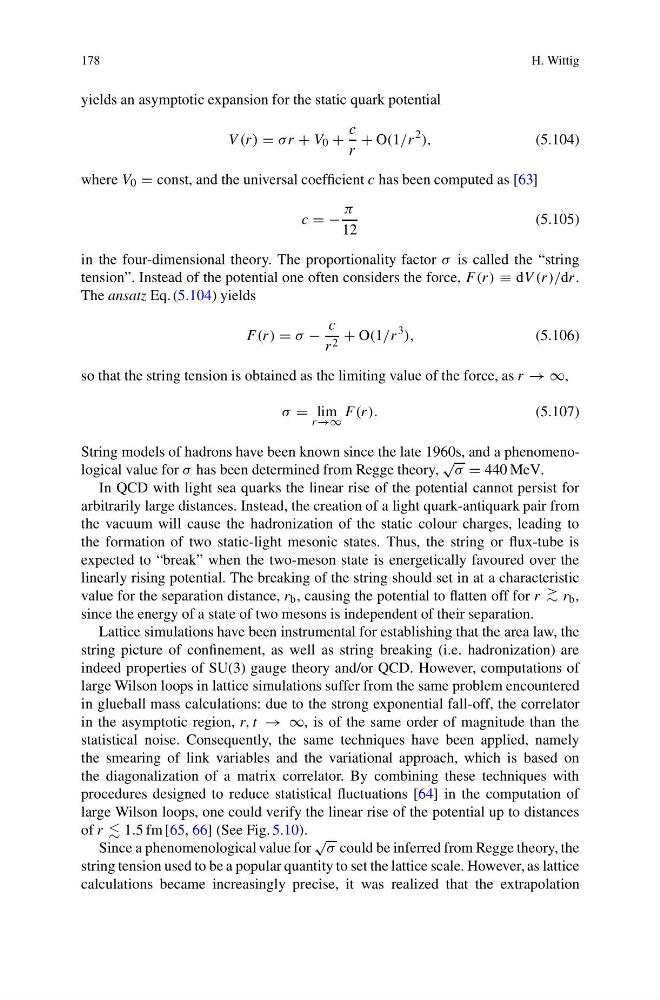
yields an asymptotic expansion for the static quark potential
V (r) = σ r + V 0 +
c
r
+ O(1/r
2 ),
(5.104)
where V 0 = const, and the universal coefficient c has been computed as [63]
c = −
π
12
(5.105)
in the four-dimensional theory. The proportionality factor σ is called the “string
tension”. Instead of the potential one often considers the force, F (r) ≡ dV (r)/dr.
The ansatz Eq. (5.104) yields
F (r) = σ −
c
r 2 + O(1/r
3 ),
(5.106)
so that the string tension is obtained as the limiting value of the force, as r → ∞,
σ = lim
r→∞
F (r).
(5.107)
String models of hadrons have been known since the late 1960s, and a phenomenological value for σ has been determined from Regge theory,
√
σ = 440 MeV.
In QCD with light sea quarks the linear rise of the potential cannot persist for
arbitrarily large distances. Instead, the creation of a light quark-antiquark pair from
the vacuum will cause the hadronization of the static colour charges, leading to
the formation of two static-light mesonic states. Thus, the string or flux-tube is
expected to “break” when the two-meson state is energetically favoured over the
linearly rising potential. The breaking of the string should set in at a characteristic
value for the separation distance, r b , causing the potential to flatten off for r >
∼ r b ,
since the energy of a state of two mesons is independent of their separation.
Lattice simulations have been instrumental for establishing that the area law, the
string picture of confinement, as well as string breaking (i.e. hadronization) are
indeed properties of SU(3) gauge theory and/or QCD. However, computations of
large Wilson loops in lattice simulations suffer from the same problem encountered
in glueball mass calculations: due to the strong exponential fall-off, the correlator
in the asymptotic region, r, t → ∞, is of the same order of magnitude than the
statistical noise. Consequently, the same techniques have been applied, namely
the smearing of link variables and the variational approach, which is based on
the diagonalization of a matrix correlator. By combining these techniques with
procedures designed to reduce statistical fluctuations [64] in the computation of
large Wilson loops, one could verify the linear rise of the potential up to distances
of r 1.5 fm [65, 66] (See Fig. 5.10).
Since a phenomenological value for
√
σ could be inferred from Regge theory, the
string tension used to be a popular quantity to set the lattice scale. However, as lattice
calculations became increasingly precise, it was realized that the extrapolation
H. Wittig
yields an asymptotic expansion for the static quark potential
V (r) = σ r + V 0 +
c
r
+ O(1/r
2 ),
(5.104)
where V 0 = const, and the universal coefficient c has been computed as [63]
c = −
π
12
(5.105)
in the four-dimensional theory. The proportionality factor σ is called the “string
tension”. Instead of the potential one often considers the force, F (r) ≡ dV (r)/dr.
The ansatz Eq. (5.104) yields
F (r) = σ −
c
r 2 + O(1/r
3 ),
(5.106)
so that the string tension is obtained as the limiting value of the force, as r → ∞,
σ = lim
r→∞
F (r).
(5.107)
String models of hadrons have been known since the late 1960s, and a phenomenological value for σ has been determined from Regge theory,
√
σ = 440 MeV.
In QCD with light sea quarks the linear rise of the potential cannot persist for
arbitrarily large distances. Instead, the creation of a light quark-antiquark pair from
the vacuum will cause the hadronization of the static colour charges, leading to
the formation of two static-light mesonic states. Thus, the string or flux-tube is
expected to “break” when the two-meson state is energetically favoured over the
linearly rising potential. The breaking of the string should set in at a characteristic
value for the separation distance, r b , causing the potential to flatten off for r >
∼ r b ,
since the energy of a state of two mesons is independent of their separation.
Lattice simulations have been instrumental for establishing that the area law, the
string picture of confinement, as well as string breaking (i.e. hadronization) are
indeed properties of SU(3) gauge theory and/or QCD. However, computations of
large Wilson loops in lattice simulations suffer from the same problem encountered
in glueball mass calculations: due to the strong exponential fall-off, the correlator
in the asymptotic region, r, t → ∞, is of the same order of magnitude than the
statistical noise. Consequently, the same techniques have been applied, namely
the smearing of link variables and the variational approach, which is based on
the diagonalization of a matrix correlator. By combining these techniques with
procedures designed to reduce statistical fluctuations [64] in the computation of
large Wilson loops, one could verify the linear rise of the potential up to distances
of r 1.5 fm [65, 66] (See Fig. 5.10).
Since a phenomenological value for
√
σ could be inferred from Regge theory, the
string tension used to be a popular quantity to set the lattice scale. However, as lattice
calculations became increasingly precise, it was realized that the extrapolation