

5 QCD on the Lattice
177
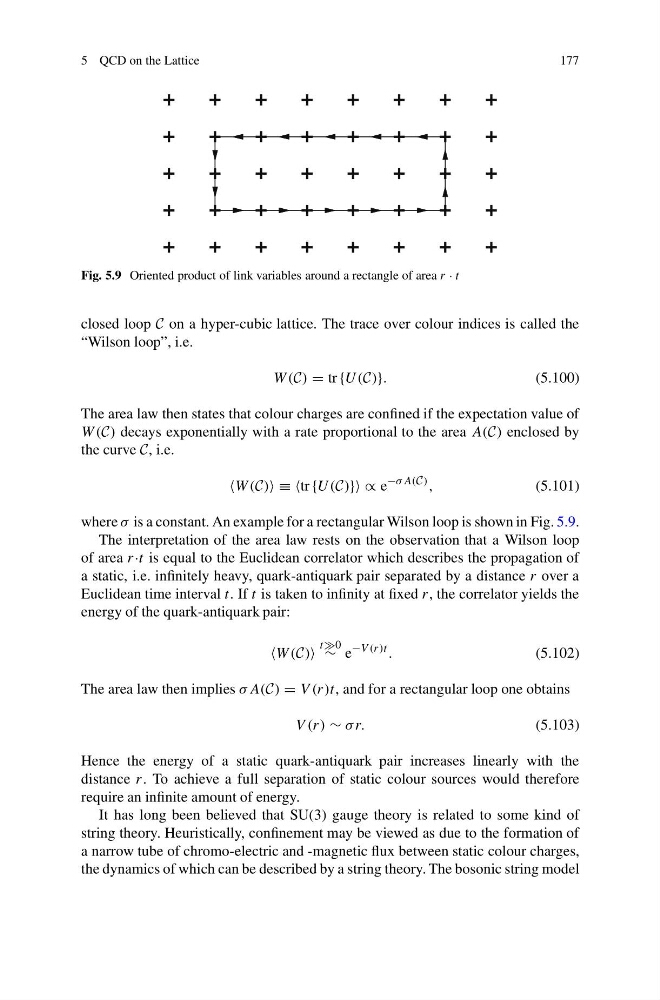
Fig. 5.9 Oriented product of link variables around a rectangle of area r · t
closed loop C on a hyper-cubic lattice. The trace over colour indices is called the
“Wilson loop”, i.e.
W (C) = tr {U(C)}.
(5.100)
The area law then states that colour charges are confined if the expectation value of
W (C) decays exponentially with a rate proportional to the area A(C) enclosed by
the curve C, i.e.
W (C) ≡ tr {U(C)} ∝ e
−σ A(C) ,
(5.101)
where σ is a constant. An example for a rectangular Wilson loop is shown in Fig. 5.9.
The interpretation of the area law rests on the observation that a Wilson loop
of area r·t is equal to the Euclidean correlator which describes the propagation of
a static, i.e. infinitely heavy, quark-antiquark pair separated by a distance r over a
Euclidean time interval t. If t is taken to infinity at fixed r, the correlator yields the
energy of the quark-antiquark pair:
W (C)
t 0
∼ e
−V (r)t .
(5.102)
The area law then implies σ A(C) = V (r)t, and for a rectangular loop one obtains
V (r) ∼ σ r.
(5.103)
Hence the energy of a static quark-antiquark pair increases linearly with the
distance r. To achieve a full separation of static colour sources would therefore
require an infinite amount of energy.
It has long been believed that SU(3) gauge theory is related to some kind of
string theory. Heuristically, confinement may be viewed as due to the formation of
a narrow tube of chromo-electric and -magnetic flux between static colour charges,
the dynamics of which can be described by a string theory. The bosonic string model
177
Fig. 5.9 Oriented product of link variables around a rectangle of area r · t
closed loop C on a hyper-cubic lattice. The trace over colour indices is called the
“Wilson loop”, i.e.
W (C) = tr {U(C)}.
(5.100)
The area law then states that colour charges are confined if the expectation value of
W (C) decays exponentially with a rate proportional to the area A(C) enclosed by
the curve C, i.e.
W (C) ≡ tr {U(C)} ∝ e
−σ A(C) ,
(5.101)
where σ is a constant. An example for a rectangular Wilson loop is shown in Fig. 5.9.
The interpretation of the area law rests on the observation that a Wilson loop
of area r·t is equal to the Euclidean correlator which describes the propagation of
a static, i.e. infinitely heavy, quark-antiquark pair separated by a distance r over a
Euclidean time interval t. If t is taken to infinity at fixed r, the correlator yields the
energy of the quark-antiquark pair:
W (C)
t 0
∼ e
−V (r)t .
(5.102)
The area law then implies σ A(C) = V (r)t, and for a rectangular loop one obtains
V (r) ∼ σ r.
(5.103)
Hence the energy of a static quark-antiquark pair increases linearly with the
distance r. To achieve a full separation of static colour sources would therefore
require an infinite amount of energy.
It has long been believed that SU(3) gauge theory is related to some kind of
string theory. Heuristically, confinement may be viewed as due to the formation of
a narrow tube of chromo-electric and -magnetic flux between static colour charges,
the dynamics of which can be described by a string theory. The bosonic string model