

176
H. Wittig
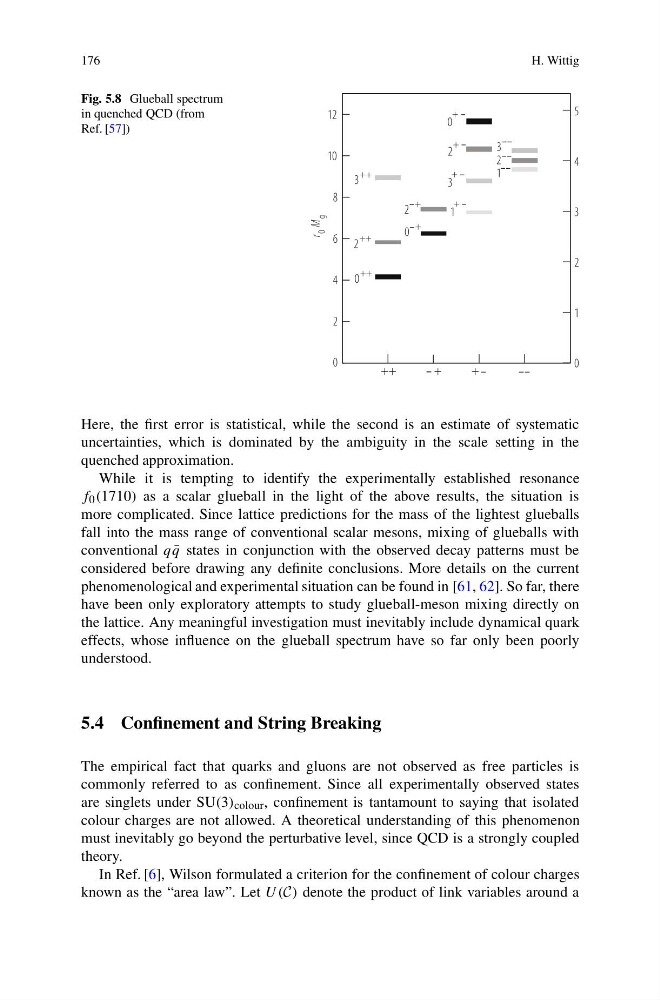
Fig. 5.8 Glueball spectrum
in quenched QCD (from
Ref. [57])
0
++
2
++
3
++
0 - +
2 - +
0
+ -
2
+ -
3
+ -
1
+ -
1 -2 -3 -12
10
8
6
4
2
0
++
- + + -
-5
4
3
2
1
0
M
r g
0
Here, the first error is statistical, while the second is an estimate of systematic
uncertainties, which is dominated by the ambiguity in the scale setting in the
quenched approximation.
While it is tempting to identify the experimentally established resonance
f 0 (1710) as a scalar glueball in the light of the above results, the situation is
more complicated. Since lattice predictions for the mass of the lightest glueballs
fall into the mass range of conventional scalar mesons, mixing of glueballs with
conventional q ¯
q states in conjunction with the observed decay patterns must be
considered before drawing any definite conclusions. More details on the current
phenomenological and experimental situation can be found in [61, 62]. So far, there
have been only exploratory attempts to study glueball-meson mixing directly on
the lattice. Any meaningful investigation must inevitably include dynamical quark
effects, whose influence on the glueball spectrum have so far only been poorly
understood.
5.4 Confinement and String Breaking
The empirical fact that quarks and gluons are not observed as free particles is
commonly referred to as confinement. Since all experimentally observed states
are singlets under SU(3) colour , confinement is tantamount to saying that isolated
colour charges are not allowed. A theoretical understanding of this phenomenon
must inevitably go beyond the perturbative level, since QCD is a strongly coupled
theory.
In Ref. [6], Wilson formulated a criterion for the confinement of colour charges
known as the “area law”. Let U(C) denote the product of link variables around a
H. Wittig
Fig. 5.8 Glueball spectrum
in quenched QCD (from
Ref. [57])
0
++
2
++
3
++
0 - +
2 - +
0
+ -
2
+ -
3
+ -
1
+ -
1 -2 -3 -12
10
8
6
4
2
0
++
- + + -
-5
4
3
2
1
0
M
r g
0
Here, the first error is statistical, while the second is an estimate of systematic
uncertainties, which is dominated by the ambiguity in the scale setting in the
quenched approximation.
While it is tempting to identify the experimentally established resonance
f 0 (1710) as a scalar glueball in the light of the above results, the situation is
more complicated. Since lattice predictions for the mass of the lightest glueballs
fall into the mass range of conventional scalar mesons, mixing of glueballs with
conventional q ¯
q states in conjunction with the observed decay patterns must be
considered before drawing any definite conclusions. More details on the current
phenomenological and experimental situation can be found in [61, 62]. So far, there
have been only exploratory attempts to study glueball-meson mixing directly on
the lattice. Any meaningful investigation must inevitably include dynamical quark
effects, whose influence on the glueball spectrum have so far only been poorly
understood.
5.4 Confinement and String Breaking
The empirical fact that quarks and gluons are not observed as free particles is
commonly referred to as confinement. Since all experimentally observed states
are singlets under SU(3) colour , confinement is tantamount to saying that isolated
colour charges are not allowed. A theoretical understanding of this phenomenon
must inevitably go beyond the perturbative level, since QCD is a strongly coupled
theory.
In Ref. [6], Wilson formulated a criterion for the confinement of colour charges
known as the “area law”. Let U(C) denote the product of link variables around a