

5 QCD on the Lattice
165
Due to these reasons, many simulations (quenched and unquenched) were
restricted to quark masses not much smaller than m s /2. This value translates
into a minimum mass of about 490 MeV in the pseudoscalar meson channel,
so that in these simulations the pion is as heavy as the physical kaon. In this
region of parameter space it is known empirically that a spatial lattice length
of 2–3 fm is sufficient to satisfy the first inequality in (5.79) and to rule out
significant finite volume effects. Moreover, an important analytic result derived by
Lüscher [36], implies that the asymptotic convergence to the result in infinite volume
is exponential.
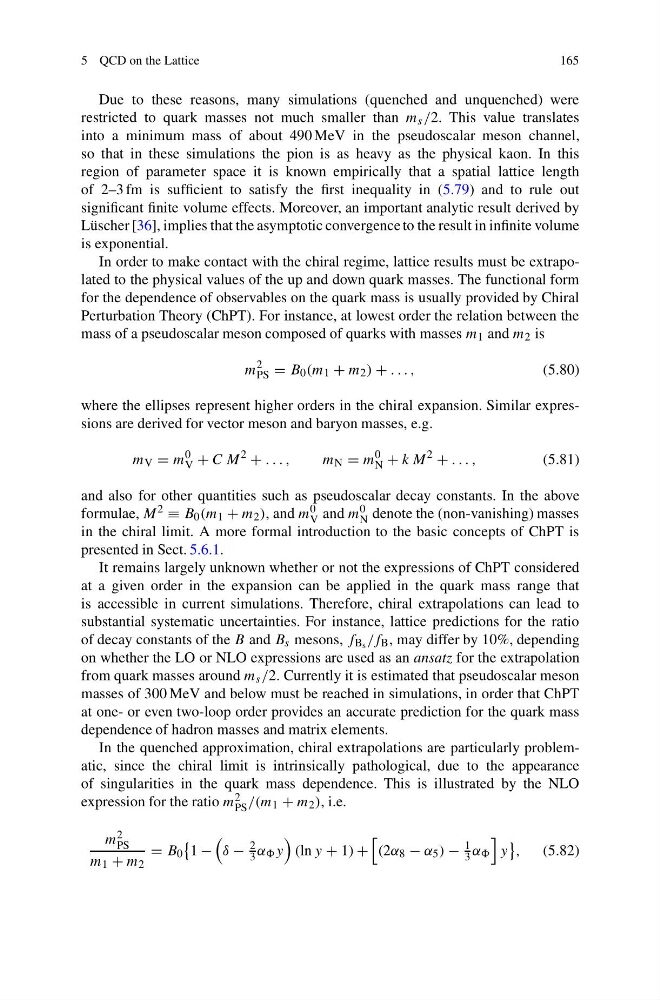
In order to make contact with the chiral regime, lattice results must be extrapolated to the physical values of the up and down quark masses. The functional form
for the dependence of observables on the quark mass is usually provided by Chiral
Perturbation Theory (ChPT). For instance, at lowest order the relation between the
mass of a pseudoscalar meson composed of quarks with masses m 1 and m 2 is
m
2
PS = B 0 (m 1 + m 2 ) + . . . ,
(5.80)
where the ellipses represent higher orders in the chiral expansion. Similar expressions are derived for vector meson and baryon masses, e.g.
m V = m
0
V + C M
2
+ . . . ,
m N = m
0
N + k M
2
+ . . . ,
(5.81)
and also for other quantities such as pseudoscalar decay constants. In the above
formulae, M 2 ≡ B 0 (m 1 + m 2 ), and m
0
V and m
0
N denote the (non-vanishing) masses
in the chiral limit. A more formal introduction to the basic concepts of ChPT is
presented in Sect. 5.6.1.
It remains largely unknown whether or not the expressions of ChPT considered
at a given order in the expansion can be applied in the quark mass range that
is accessible in current simulations. Therefore, chiral extrapolations can lead to
substantial systematic uncertainties. For instance, lattice predictions for the ratio
of decay constants of the B and B s mesons, f B s /f B , may differ by 10%, depending
on whether the LO or NLO expressions are used as an ansatz for the extrapolation
from quark masses around m s /2. Currently it is estimated that pseudoscalar meson
masses of 300 MeV and below must be reached in simulations, in order that ChPT
at one- or even two-loop order provides an accurate prediction for the quark mass
dependence of hadron masses and matrix elements.
In the quenched approximation, chiral extrapolations are particularly problematic, since the chiral limit is intrinsically pathological, due to the appearance
of singularities in the quark mass dependence. This is illustrated by the NLO
expression for the ratio m 2
PS /(m 1 + m 2 ), i.e.
m 2
PS
m 1 + m 2
= B 0
1 −
δ −
2
3 α y
(ln y + 1) +
(2α 8 − α 5 ) −
1
3 α
y
, (5.82)
165
Due to these reasons, many simulations (quenched and unquenched) were
restricted to quark masses not much smaller than m s /2. This value translates
into a minimum mass of about 490 MeV in the pseudoscalar meson channel,
so that in these simulations the pion is as heavy as the physical kaon. In this
region of parameter space it is known empirically that a spatial lattice length
of 2–3 fm is sufficient to satisfy the first inequality in (5.79) and to rule out
significant finite volume effects. Moreover, an important analytic result derived by
Lüscher [36], implies that the asymptotic convergence to the result in infinite volume
is exponential.
In order to make contact with the chiral regime, lattice results must be extrapolated to the physical values of the up and down quark masses. The functional form
for the dependence of observables on the quark mass is usually provided by Chiral
Perturbation Theory (ChPT). For instance, at lowest order the relation between the
mass of a pseudoscalar meson composed of quarks with masses m 1 and m 2 is
m
2
PS = B 0 (m 1 + m 2 ) + . . . ,
(5.80)
where the ellipses represent higher orders in the chiral expansion. Similar expressions are derived for vector meson and baryon masses, e.g.
m V = m
0
V + C M
2
+ . . . ,
m N = m
0
N + k M
2
+ . . . ,
(5.81)
and also for other quantities such as pseudoscalar decay constants. In the above
formulae, M 2 ≡ B 0 (m 1 + m 2 ), and m
0
V and m
0
N denote the (non-vanishing) masses
in the chiral limit. A more formal introduction to the basic concepts of ChPT is
presented in Sect. 5.6.1.
It remains largely unknown whether or not the expressions of ChPT considered
at a given order in the expansion can be applied in the quark mass range that
is accessible in current simulations. Therefore, chiral extrapolations can lead to
substantial systematic uncertainties. For instance, lattice predictions for the ratio
of decay constants of the B and B s mesons, f B s /f B , may differ by 10%, depending
on whether the LO or NLO expressions are used as an ansatz for the extrapolation
from quark masses around m s /2. Currently it is estimated that pseudoscalar meson
masses of 300 MeV and below must be reached in simulations, in order that ChPT
at one- or even two-loop order provides an accurate prediction for the quark mass
dependence of hadron masses and matrix elements.
In the quenched approximation, chiral extrapolations are particularly problematic, since the chiral limit is intrinsically pathological, due to the appearance
of singularities in the quark mass dependence. This is illustrated by the NLO
expression for the ratio m 2
PS /(m 1 + m 2 ), i.e.
m 2
PS
m 1 + m 2
= B 0
1 −
δ −
2
3 α y
(ln y + 1) +
(2α 8 − α 5 ) −
1
3 α
y
, (5.82)