

164
H. Wittig
with currently available methods and machines. These technical limitations are
usually translated into a systematic error, which is quoted alongside the statistical
one. The most important systematic effects are due to
• lattice artefacts (cutoff effects),
• finite volume effects, and
• extrapolations in the quark mass.
In order to have sufficient control over these effects, the simulation parameters must
be chosen such that the following inequalities are satisfied:
1
am had
L
a
,
m had a
−1 ,
(5.79)
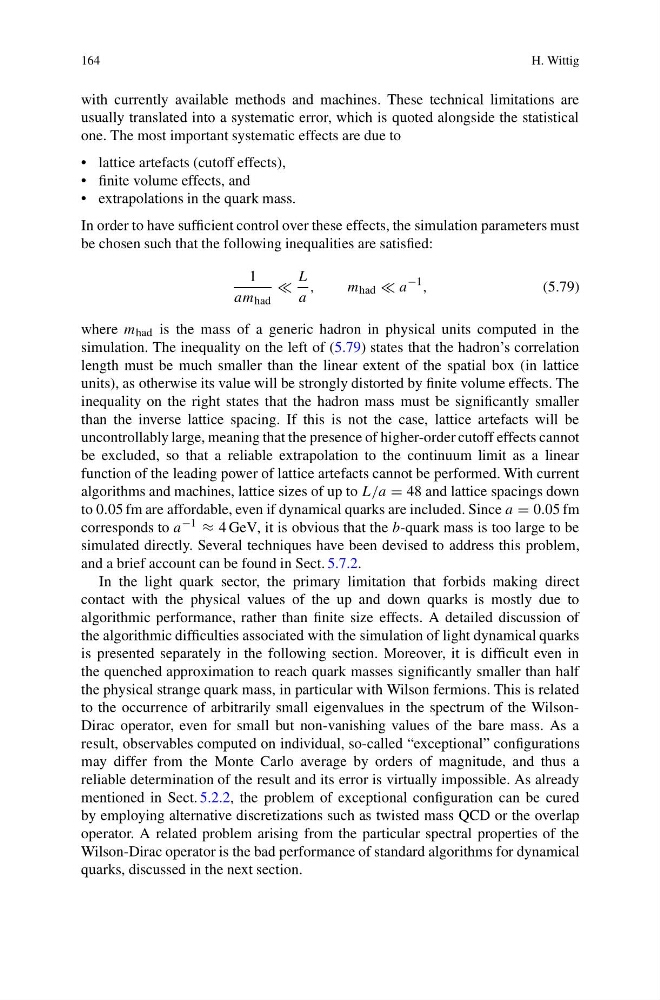
where m had is the mass of a generic hadron in physical units computed in the
simulation. The inequality on the left of (5.79) states that the hadron’s correlation
length must be much smaller than the linear extent of the spatial box (in lattice
units), as otherwise its value will be strongly distorted by finite volume effects. The
inequality on the right states that the hadron mass must be significantly smaller
than the inverse lattice spacing. If this is not the case, lattice artefacts will be
uncontrollably large, meaning that the presence of higher-order cutoff effects cannot
be excluded, so that a reliable extrapolation to the continuum limit as a linear
function of the leading power of lattice artefacts cannot be performed. With current
algorithms and machines, lattice sizes of up to L/a = 48 and lattice spacings down
to 0.05 fm are affordable, even if dynamical quarks are included. Since a = 0.05 fm
corresponds to a −1 ≈ 4 GeV, it is obvious that the b-quark mass is too large to be
simulated directly. Several techniques have been devised to address this problem,
and a brief account can be found in Sect. 5.7.2.
In the light quark sector, the primary limitation that forbids making direct
contact with the physical values of the up and down quarks is mostly due to
algorithmic performance, rather than finite size effects. A detailed discussion of
the algorithmic difficulties associated with the simulation of light dynamical quarks
is presented separately in the following section. Moreover, it is difficult even in
the quenched approximation to reach quark masses significantly smaller than half
the physical strange quark mass, in particular with Wilson fermions. This is related
to the occurrence of arbitrarily small eigenvalues in the spectrum of the WilsonDirac operator, even for small but non-vanishing values of the bare mass. As a
result, observables computed on individual, so-called “exceptional” configurations
may differ from the Monte Carlo average by orders of magnitude, and thus a
reliable determination of the result and its error is virtually impossible. As already
mentioned in Sect. 5.2.2, the problem of exceptional configuration can be cured
by employing alternative discretizations such as twisted mass QCD or the overlap
operator. A related problem arising from the particular spectral properties of the
Wilson-Dirac operator is the bad performance of standard algorithms for dynamical
quarks, discussed in the next section.
H. Wittig
with currently available methods and machines. These technical limitations are
usually translated into a systematic error, which is quoted alongside the statistical
one. The most important systematic effects are due to
• lattice artefacts (cutoff effects),
• finite volume effects, and
• extrapolations in the quark mass.
In order to have sufficient control over these effects, the simulation parameters must
be chosen such that the following inequalities are satisfied:
1
am had
L
a
,
m had a
−1 ,
(5.79)
where m had is the mass of a generic hadron in physical units computed in the
simulation. The inequality on the left of (5.79) states that the hadron’s correlation
length must be much smaller than the linear extent of the spatial box (in lattice
units), as otherwise its value will be strongly distorted by finite volume effects. The
inequality on the right states that the hadron mass must be significantly smaller
than the inverse lattice spacing. If this is not the case, lattice artefacts will be
uncontrollably large, meaning that the presence of higher-order cutoff effects cannot
be excluded, so that a reliable extrapolation to the continuum limit as a linear
function of the leading power of lattice artefacts cannot be performed. With current
algorithms and machines, lattice sizes of up to L/a = 48 and lattice spacings down
to 0.05 fm are affordable, even if dynamical quarks are included. Since a = 0.05 fm
corresponds to a −1 ≈ 4 GeV, it is obvious that the b-quark mass is too large to be
simulated directly. Several techniques have been devised to address this problem,
and a brief account can be found in Sect. 5.7.2.
In the light quark sector, the primary limitation that forbids making direct
contact with the physical values of the up and down quarks is mostly due to
algorithmic performance, rather than finite size effects. A detailed discussion of
the algorithmic difficulties associated with the simulation of light dynamical quarks
is presented separately in the following section. Moreover, it is difficult even in
the quenched approximation to reach quark masses significantly smaller than half
the physical strange quark mass, in particular with Wilson fermions. This is related
to the occurrence of arbitrarily small eigenvalues in the spectrum of the WilsonDirac operator, even for small but non-vanishing values of the bare mass. As a
result, observables computed on individual, so-called “exceptional” configurations
may differ from the Monte Carlo average by orders of magnitude, and thus a
reliable determination of the result and its error is virtually impossible. As already
mentioned in Sect. 5.2.2, the problem of exceptional configuration can be cured
by employing alternative discretizations such as twisted mass QCD or the overlap
operator. A related problem arising from the particular spectral properties of the
Wilson-Dirac operator is the bad performance of standard algorithms for dynamical
quarks, discussed in the next section.