

5 QCD on the Lattice
163
Q. If we further assume exact isospin symmetry we can then determine the value of
the bare isospin-symmetrized light quark mass ˆ
m =
1
2 (m u + m d ), by requiring that
m PS (m 1 , m 2 )
Q
=
m π
Q
exp
,
m 1 = m 2 ,
(5.77)
i.e. the value of ˆ
m is fixed by adjusting the input mass m 1 until m PS (m 1 , m 2 )/Q
coincides with the experimental result. We can extend this procedure to include
more massive flavours. The bare strange quark mass is found by tuning m 2 such that
m PS ( ˆ
m, m 2 )
Q
=
m K
Q
exp
.
(5.78)
Alternatively one can fix m s via the condition m V ( ˆ
m, m 2 )/Q = m ∗
K /Q| exp , where
m V denotes the mass in the vector channel. An example of a particular hadronic
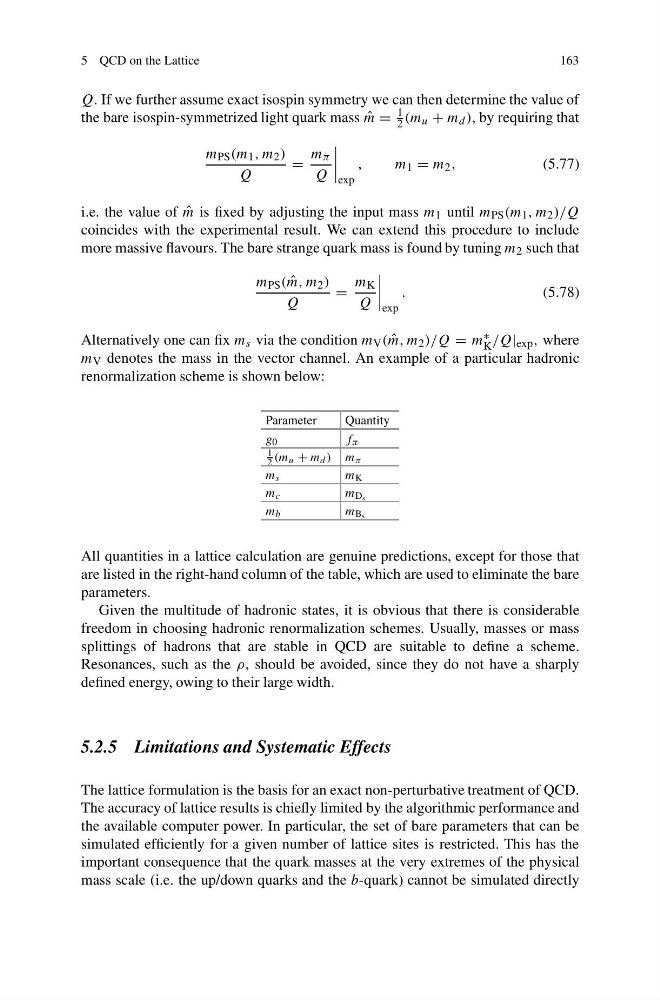
renormalization scheme is shown below:
Parameter
Quantity
g 0
f π
1
2 (m u + m d ) m π
m s
m K
m c
m Ds
m b
m Bs
All quantities in a lattice calculation are genuine predictions, except for those that
are listed in the right-hand column of the table, which are used to eliminate the bare
parameters.
Given the multitude of hadronic states, it is obvious that there is considerable
freedom in choosing hadronic renormalization schemes. Usually, masses or mass
splittings of hadrons that are stable in QCD are suitable to define a scheme.
Resonances, such as the ρ, should be avoided, since they do not have a sharply
defined energy, owing to their large width.
5.2.5 Limitations and Systematic Effects
The lattice formulation is the basis for an exact non-perturbative treatment of QCD.
The accuracy of lattice results is chiefly limited by the algorithmic performance and
the available computer power. In particular, the set of bare parameters that can be
simulated efficiently for a given number of lattice sites is restricted. This has the
important consequence that the quark masses at the very extremes of the physical
mass scale (i.e. the up/down quarks and the b-quark) cannot be simulated directly
163
Q. If we further assume exact isospin symmetry we can then determine the value of
the bare isospin-symmetrized light quark mass ˆ
m =
1
2 (m u + m d ), by requiring that
m PS (m 1 , m 2 )
Q
=
m π
Q
exp
,
m 1 = m 2 ,
(5.77)
i.e. the value of ˆ
m is fixed by adjusting the input mass m 1 until m PS (m 1 , m 2 )/Q
coincides with the experimental result. We can extend this procedure to include
more massive flavours. The bare strange quark mass is found by tuning m 2 such that
m PS ( ˆ
m, m 2 )
Q
=
m K
Q
exp
.
(5.78)
Alternatively one can fix m s via the condition m V ( ˆ
m, m 2 )/Q = m ∗
K /Q| exp , where
m V denotes the mass in the vector channel. An example of a particular hadronic
renormalization scheme is shown below:
Parameter
Quantity
g 0
f π
1
2 (m u + m d ) m π
m s
m K
m c
m Ds
m b
m Bs
All quantities in a lattice calculation are genuine predictions, except for those that
are listed in the right-hand column of the table, which are used to eliminate the bare
parameters.
Given the multitude of hadronic states, it is obvious that there is considerable
freedom in choosing hadronic renormalization schemes. Usually, masses or mass
splittings of hadrons that are stable in QCD are suitable to define a scheme.
Resonances, such as the ρ, should be avoided, since they do not have a sharply
defined energy, owing to their large width.
5.2.5 Limitations and Systematic Effects
The lattice formulation is the basis for an exact non-perturbative treatment of QCD.
The accuracy of lattice results is chiefly limited by the algorithmic performance and
the available computer power. In particular, the set of bare parameters that can be
simulated efficiently for a given number of lattice sites is restricted. This has the
important consequence that the quark masses at the very extremes of the physical
mass scale (i.e. the up/down quarks and the b-quark) cannot be simulated directly