

162
H. Wittig
0.90
0.85
0.80
0
0.002
0.004
0.006
0.008
0.010
a
2
2
[fm ]
)
+
( /F
M
M K
l
s
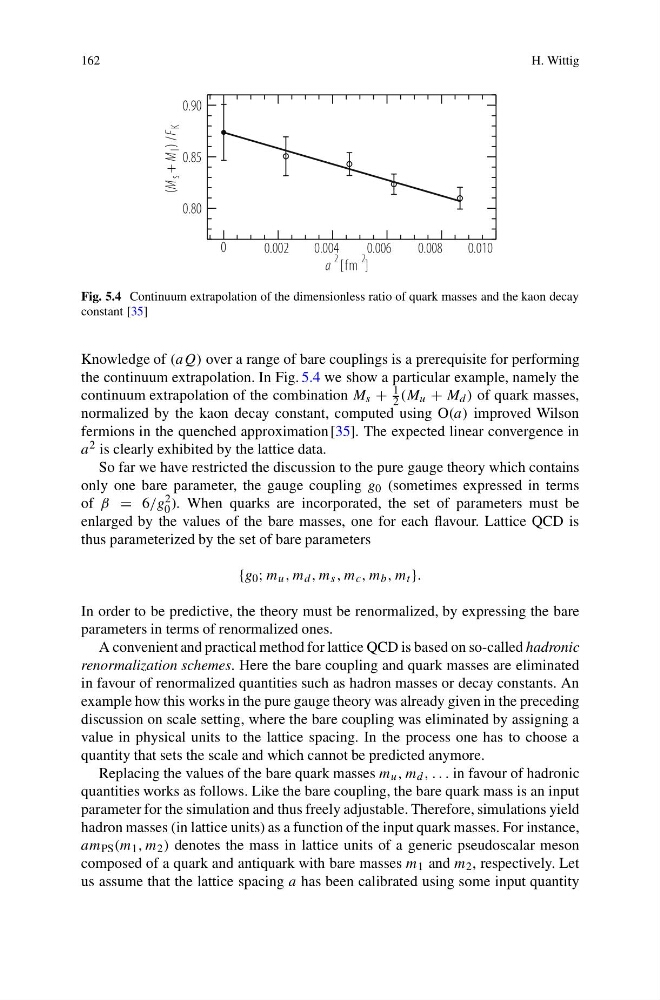
Fig. 5.4 Continuum extrapolation of the dimensionless ratio of quark masses and the kaon decay
constant [35]
Knowledge of (aQ) over a range of bare couplings is a prerequisite for performing
the continuum extrapolation. In Fig. 5.4 we show a particular example, namely the
continuum extrapolation of the combination M s +
1
2 (M u + M d ) of quark masses,
normalized by the kaon decay constant, computed using O(a) improved Wilson
fermions in the quenched approximation [35]. The expected linear convergence in
a 2 is clearly exhibited by the lattice data.
So far we have restricted the discussion to the pure gauge theory which contains
only one bare parameter, the gauge coupling g 0 (sometimes expressed in terms
of β = 6/g 2
0 ). When quarks are incorporated, the set of parameters must be
enlarged by the values of the bare masses, one for each flavour. Lattice QCD is
thus parameterized by the set of bare parameters
{g 0 ; m u , m d , m s , m c , m b , m t }.
In order to be predictive, the theory must be renormalized, by expressing the bare
parameters in terms of renormalized ones.
A convenient and practical method for lattice QCD is based on so-called hadronic
renormalization schemes. Here the bare coupling and quark masses are eliminated
in favour of renormalized quantities such as hadron masses or decay constants. An
example how this works in the pure gauge theory was already given in the preceding
discussion on scale setting, where the bare coupling was eliminated by assigning a
value in physical units to the lattice spacing. In the process one has to choose a
quantity that sets the scale and which cannot be predicted anymore.
Replacing the values of the bare quark masses m u , m d , . . . in favour of hadronic
quantities works as follows. Like the bare coupling, the bare quark mass is an input
parameter for the simulation and thus freely adjustable. Therefore, simulations yield
hadron masses (in lattice units) as a function of the input quark masses. For instance,
am PS (m 1 , m 2 ) denotes the mass in lattice units of a generic pseudoscalar meson
composed of a quark and antiquark with bare masses m 1 and m 2 , respectively. Let
us assume that the lattice spacing a has been calibrated using some input quantity
H. Wittig
0.90
0.85
0.80
0
0.002
0.004
0.006
0.008
0.010
a
2
2
[fm ]
)
+
( /F
M
M K
l
s
Fig. 5.4 Continuum extrapolation of the dimensionless ratio of quark masses and the kaon decay
constant [35]
Knowledge of (aQ) over a range of bare couplings is a prerequisite for performing
the continuum extrapolation. In Fig. 5.4 we show a particular example, namely the
continuum extrapolation of the combination M s +
1
2 (M u + M d ) of quark masses,
normalized by the kaon decay constant, computed using O(a) improved Wilson
fermions in the quenched approximation [35]. The expected linear convergence in
a 2 is clearly exhibited by the lattice data.
So far we have restricted the discussion to the pure gauge theory which contains
only one bare parameter, the gauge coupling g 0 (sometimes expressed in terms
of β = 6/g 2
0 ). When quarks are incorporated, the set of parameters must be
enlarged by the values of the bare masses, one for each flavour. Lattice QCD is
thus parameterized by the set of bare parameters
{g 0 ; m u , m d , m s , m c , m b , m t }.
In order to be predictive, the theory must be renormalized, by expressing the bare
parameters in terms of renormalized ones.
A convenient and practical method for lattice QCD is based on so-called hadronic
renormalization schemes. Here the bare coupling and quark masses are eliminated
in favour of renormalized quantities such as hadron masses or decay constants. An
example how this works in the pure gauge theory was already given in the preceding
discussion on scale setting, where the bare coupling was eliminated by assigning a
value in physical units to the lattice spacing. In the process one has to choose a
quantity that sets the scale and which cannot be predicted anymore.
Replacing the values of the bare quark masses m u , m d , . . . in favour of hadronic
quantities works as follows. Like the bare coupling, the bare quark mass is an input
parameter for the simulation and thus freely adjustable. Therefore, simulations yield
hadron masses (in lattice units) as a function of the input quark masses. For instance,
am PS (m 1 , m 2 ) denotes the mass in lattice units of a generic pseudoscalar meson
composed of a quark and antiquark with bare masses m 1 and m 2 , respectively. Let
us assume that the lattice spacing a has been calibrated using some input quantity