

166
H. Wittig
where B 0 , α 5 , α 8 , δ and α are low-energy constants. For notational convenience
we have introduced
y =
M 2
(4πF 0 ) 2 ,
M
2
= B 0 (m 1 + m 2 ),
(5.83)
where F 0 denotes the pion decay constant in the chiral limit. The low-energy
constants δ and α , which multiply the so-called “quenched chiral logarithms”,
have no counterpart in the unquenched case. Since δ has a non-zero value [37],
the quenched chiral logarithm in Eq. (5.82) gives rise to a singularity in the chiral
limit. For many applications, the singularity can be ignored, since its effect is
numerically small even at the physical pion mass. However, it signals that the
quenched approximation suffers from fundamental conceptual problems.
5.2.6 Simulations with Dynamical Quarks
Although one may argue that the quenched approximation describes hadronic
properties fairly well, it is clearly unsatisfactory, both from a conceptual point of
view, and also because it introduces an unknown systematic error. Below we shall
discuss some general issues relating to simulations with dynamical quarks. It must
be stressed that several different techniques how to treat the quark determinant of
Eq. (5.57) efficiently are currently being explored. A preferred or clearly superior
method has not emerged so far, and it is likely that some of the approaches presented
below may become obsolete in the years to come.
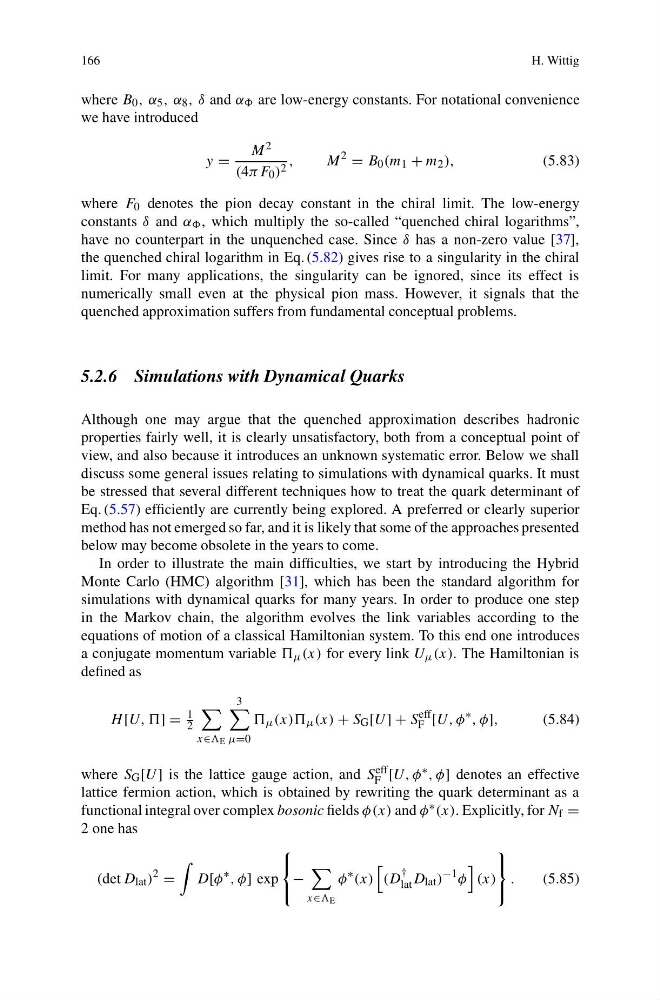
In order to illustrate the main difficulties, we start by introducing the Hybrid
Monte Carlo (HMC) algorithm [31], which has been the standard algorithm for
simulations with dynamical quarks for many years. In order to produce one step
in the Markov chain, the algorithm evolves the link variables according to the
equations of motion of a classical Hamiltonian system. To this end one introduces
a conjugate momentum variable μ (x) for every link U μ (x). The Hamiltonian is
defined as
H [U, ,] =
1
2
x∈ E
3
μ=0
μ (x)) μ (x) + S G [U ] + S
eff
F [U, φ
∗ , φ],
(5.84)
where S G [U ] is the lattice gauge action, and S eff
F [U, φ ∗ , φ] denotes an effective
lattice fermion action, which is obtained by rewriting the quark determinant as a
functional integral over complex bosonic fields φ(x) and φ ∗ (x). Explicitly, for N f =
2 one has
(det D lat )
2
=
D[φ
∗ , φ] exp
⎧
⎨
⎩
−
x∈ E
φ
∗ (x)
(D
†
lat D lat )
−1 φ
(x)
⎫
⎬
⎭
.
(5.85)
H. Wittig
where B 0 , α 5 , α 8 , δ and α are low-energy constants. For notational convenience
we have introduced
y =
M 2
(4πF 0 ) 2 ,
M
2
= B 0 (m 1 + m 2 ),
(5.83)
where F 0 denotes the pion decay constant in the chiral limit. The low-energy
constants δ and α , which multiply the so-called “quenched chiral logarithms”,
have no counterpart in the unquenched case. Since δ has a non-zero value [37],
the quenched chiral logarithm in Eq. (5.82) gives rise to a singularity in the chiral
limit. For many applications, the singularity can be ignored, since its effect is
numerically small even at the physical pion mass. However, it signals that the
quenched approximation suffers from fundamental conceptual problems.
5.2.6 Simulations with Dynamical Quarks
Although one may argue that the quenched approximation describes hadronic
properties fairly well, it is clearly unsatisfactory, both from a conceptual point of
view, and also because it introduces an unknown systematic error. Below we shall
discuss some general issues relating to simulations with dynamical quarks. It must
be stressed that several different techniques how to treat the quark determinant of
Eq. (5.57) efficiently are currently being explored. A preferred or clearly superior
method has not emerged so far, and it is likely that some of the approaches presented
below may become obsolete in the years to come.
In order to illustrate the main difficulties, we start by introducing the Hybrid
Monte Carlo (HMC) algorithm [31], which has been the standard algorithm for
simulations with dynamical quarks for many years. In order to produce one step
in the Markov chain, the algorithm evolves the link variables according to the
equations of motion of a classical Hamiltonian system. To this end one introduces
a conjugate momentum variable μ (x) for every link U μ (x). The Hamiltonian is
defined as
H [U, ,] =
1
2
x∈ E
3
μ=0
μ (x)) μ (x) + S G [U ] + S
eff
F [U, φ
∗ , φ],
(5.84)
where S G [U ] is the lattice gauge action, and S eff
F [U, φ ∗ , φ] denotes an effective
lattice fermion action, which is obtained by rewriting the quark determinant as a
functional integral over complex bosonic fields φ(x) and φ ∗ (x). Explicitly, for N f =
2 one has
(det D lat )
2
=
D[φ
∗ , φ] exp
⎧
⎨
⎩
−
x∈ E
φ
∗ (x)
(D
†
lat D lat )
−1 φ
(x)
⎫
⎬
⎭
.
(5.85)