

160
H. Wittig
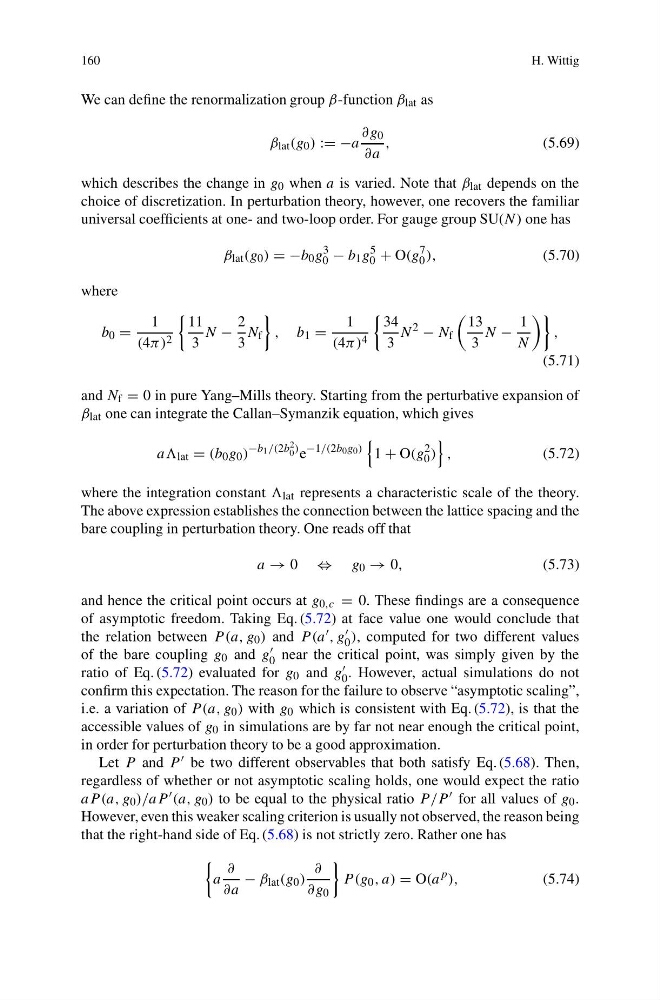
We can define the renormalization group β-function β lat as
β lat (g 0 ) := −a
∂g 0
∂a
,
(5.69)
which describes the change in g 0 when a is varied. Note that β lat depends on the
choice of discretization. In perturbation theory, however, one recovers the familiar
universal coefficients at one- and two-loop order. For gauge group SU(N) one has
β lat (g 0 ) = −b 0 g
3
0 − b 1 g
5
0 + O(g
7
0 ),
(5.70)
where
b 0 =
1
(4π) 2
11
3
N −
2
3
N f
, b 1 =
1
(4π) 4
34
3
N
2
− N f
13
3
N −
1
N
,
(5.71)
and N f = 0 in pure Yang–Mills theory. Starting from the perturbative expansion of
β lat one can integrate the Callan–Symanzik equation, which gives
aa lat = (b 0 g 0 )
−b 1 /(2b 2
0 ) e
−1/(2b 0 g 0 )
1 + O(g
2
0 )
,
(5.72)
where the integration constant lat represents a characteristic scale of the theory.
The above expression establishes the connection between the lattice spacing and the
bare coupling in perturbation theory. One reads off that
a → 0 ⇔ g 0 → 0,
(5.73)
and hence the critical point occurs at g 0,c = 0. These findings are a consequence
of asymptotic freedom. Taking Eq. (5.72) at face value one would conclude that
the relation between P (a, g 0 ) and P (a , g
0 ), computed for two different values
of the bare coupling g 0 and g
0 near the critical point, was simply given by the
ratio of Eq. (5.72) evaluated for g 0 and g
0 . However, actual simulations do not
confirm this expectation. The reason for the failure to observe “asymptotic scaling”,
i.e. a variation of P (a, g 0 ) with g 0 which is consistent with Eq. (5.72), is that the
accessible values of g 0 in simulations are by far not near enough the critical point,
in order for perturbation theory to be a good approximation.
Let P and P be two different observables that both satisfy Eq. (5.68). Then,
regardless of whether or not asymptotic scaling holds, one would expect the ratio
aP (a, g 0 )/aP (a, g 0 ) to be equal to the physical ratio P /P for all values of g 0 .
However, even this weaker scaling criterion is usually not observed, the reason being
that the right-hand side of Eq. (5.68) is not strictly zero. Rather one has
a
∂
∂a
− β lat (g 0 )
∂
∂g 0
P (g 0 , a) = O(a
p ),
(5.74)
H. Wittig
We can define the renormalization group β-function β lat as
β lat (g 0 ) := −a
∂g 0
∂a
,
(5.69)
which describes the change in g 0 when a is varied. Note that β lat depends on the
choice of discretization. In perturbation theory, however, one recovers the familiar
universal coefficients at one- and two-loop order. For gauge group SU(N) one has
β lat (g 0 ) = −b 0 g
3
0 − b 1 g
5
0 + O(g
7
0 ),
(5.70)
where
b 0 =
1
(4π) 2
11
3
N −
2
3
N f
, b 1 =
1
(4π) 4
34
3
N
2
− N f
13
3
N −
1
N
,
(5.71)
and N f = 0 in pure Yang–Mills theory. Starting from the perturbative expansion of
β lat one can integrate the Callan–Symanzik equation, which gives
aa lat = (b 0 g 0 )
−b 1 /(2b 2
0 ) e
−1/(2b 0 g 0 )
1 + O(g
2
0 )
,
(5.72)
where the integration constant lat represents a characteristic scale of the theory.
The above expression establishes the connection between the lattice spacing and the
bare coupling in perturbation theory. One reads off that
a → 0 ⇔ g 0 → 0,
(5.73)
and hence the critical point occurs at g 0,c = 0. These findings are a consequence
of asymptotic freedom. Taking Eq. (5.72) at face value one would conclude that
the relation between P (a, g 0 ) and P (a , g
0 ), computed for two different values
of the bare coupling g 0 and g
0 near the critical point, was simply given by the
ratio of Eq. (5.72) evaluated for g 0 and g
0 . However, actual simulations do not
confirm this expectation. The reason for the failure to observe “asymptotic scaling”,
i.e. a variation of P (a, g 0 ) with g 0 which is consistent with Eq. (5.72), is that the
accessible values of g 0 in simulations are by far not near enough the critical point,
in order for perturbation theory to be a good approximation.
Let P and P be two different observables that both satisfy Eq. (5.68). Then,
regardless of whether or not asymptotic scaling holds, one would expect the ratio
aP (a, g 0 )/aP (a, g 0 ) to be equal to the physical ratio P /P for all values of g 0 .
However, even this weaker scaling criterion is usually not observed, the reason being
that the right-hand side of Eq. (5.68) is not strictly zero. Rather one has
a
∂
∂a
− β lat (g 0 )
∂
∂g 0
P (g 0 , a) = O(a
p ),
(5.74)