

5 QCD on the Lattice
159
the space of bare parameters (β and κ, for example). 5 We shall now explain that
the continuum limit of QCD is associated with a critical point in the phase diagram,
which corresponds to a second-order phase transition. In the previous section we
have considered hadronic two-point correlation functions, and how the mass in a
given channel can be extracted from the asymptotic behaviour at large Euclidean
times. Actually, this procedure yields the dimensionless combination (aM), i.e. the
hadron mass in lattice units. In order to take the continuum limit, one must take
a → 0, while the physical mass M must remain constant. This implies
1
(aM)
≡ ξ → 0.
(5.65)
In other words, the correlation length ξ diverges in the continuum limit. In the
language of statistical physics, a divergent correlation length signals a secondorder phase transition. The existence of the continuum limit in lattice QCD is
therefore equivalent to the existence of a second-order transition in the space of
bare parameters.
For simplicity we shall now consider Yang–Mills theory on the lattice, which we
choose to describe by Wilson’s plaquette action and the bare coupling parameter
β ≡ 6/g 2
0 . The existence of a second-order phase transition corresponds to a critical
value of the bare gauge coupling, g 0,c . Furthermore, it implies that the bare coupling
g 0 and the lattice spacing a (or, equivalently, the correlation length ξ ) cannot be
varied independently when the continuum limit is approached. 6 In this way we may
regard the bare coupling as a function of the lattice spacing, g 0 (a), such that
lim
a→0
g 0 (a) = g 0,c .
(5.66)
Let P be an observable, computed for a particular value of g 0 , i.e. P = P (g 0 , a).
Since P is a physical quantity it must stay constant as the continuum limit is taken,
i.e.
a
d
da
P (g 0 , a) = 0.
(5.67)
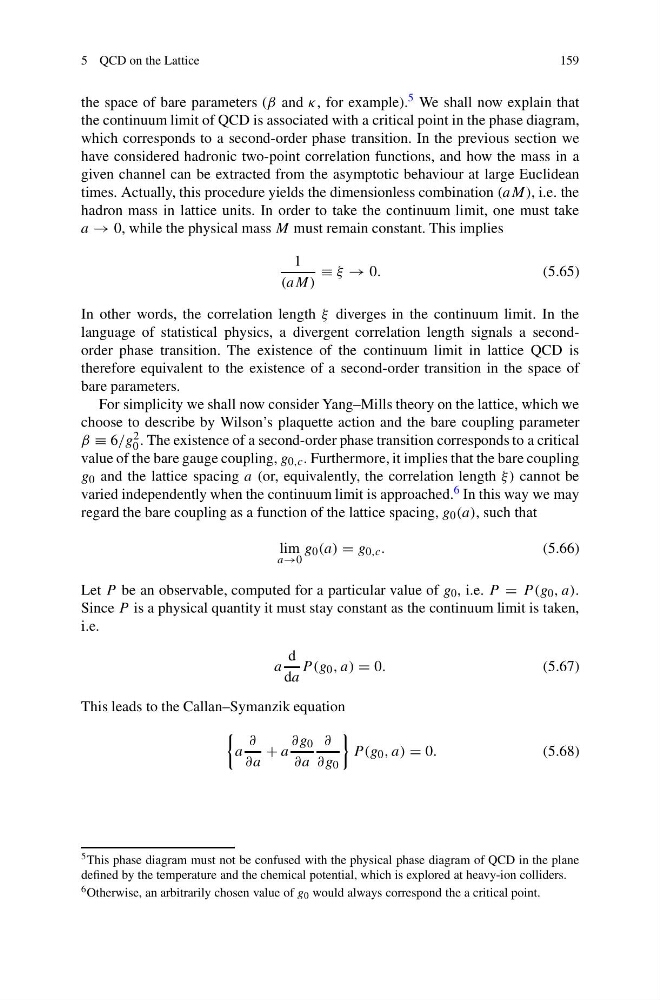
This leads to the Callan–Symanzik equation
a
∂
∂a
+ a
∂g 0
∂a
∂
∂g 0
P (g 0 , a) = 0.
(5.68)
5 This phase diagram must not be confused with the physical phase diagram of QCD in the plane
defined by the temperature and the chemical potential, which is explored at heavy-ion colliders.
6 Otherwise, an arbitrarily chosen value of g 0 would always correspond the a critical point.
159
the space of bare parameters (β and κ, for example). 5 We shall now explain that
the continuum limit of QCD is associated with a critical point in the phase diagram,
which corresponds to a second-order phase transition. In the previous section we
have considered hadronic two-point correlation functions, and how the mass in a
given channel can be extracted from the asymptotic behaviour at large Euclidean
times. Actually, this procedure yields the dimensionless combination (aM), i.e. the
hadron mass in lattice units. In order to take the continuum limit, one must take
a → 0, while the physical mass M must remain constant. This implies
1
(aM)
≡ ξ → 0.
(5.65)
In other words, the correlation length ξ diverges in the continuum limit. In the
language of statistical physics, a divergent correlation length signals a secondorder phase transition. The existence of the continuum limit in lattice QCD is
therefore equivalent to the existence of a second-order transition in the space of
bare parameters.
For simplicity we shall now consider Yang–Mills theory on the lattice, which we
choose to describe by Wilson’s plaquette action and the bare coupling parameter
β ≡ 6/g 2
0 . The existence of a second-order phase transition corresponds to a critical
value of the bare gauge coupling, g 0,c . Furthermore, it implies that the bare coupling
g 0 and the lattice spacing a (or, equivalently, the correlation length ξ ) cannot be
varied independently when the continuum limit is approached. 6 In this way we may
regard the bare coupling as a function of the lattice spacing, g 0 (a), such that
lim
a→0
g 0 (a) = g 0,c .
(5.66)
Let P be an observable, computed for a particular value of g 0 , i.e. P = P (g 0 , a).
Since P is a physical quantity it must stay constant as the continuum limit is taken,
i.e.
a
d
da
P (g 0 , a) = 0.
(5.67)
This leads to the Callan–Symanzik equation
a
∂
∂a
+ a
∂g 0
∂a
∂
∂g 0
P (g 0 , a) = 0.
(5.68)
5 This phase diagram must not be confused with the physical phase diagram of QCD in the plane
defined by the temperature and the chemical potential, which is explored at heavy-ion colliders.
6 Otherwise, an arbitrarily chosen value of g 0 would always correspond the a critical point.