

158
H. Wittig
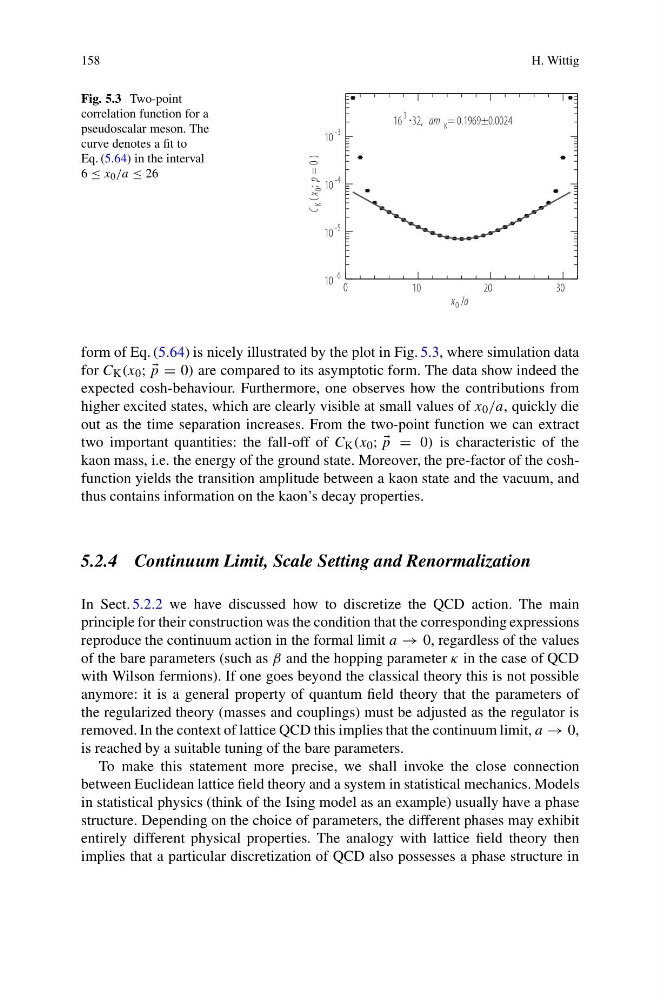
Fig. 5.3 Two-point
correlation function for a
pseudoscalar meson. The
curve denotes a fit to
Eq. (5.64) in the interval
6 ≤ x 0 /a ≤ 26
p
x C K 0
)
0
=
;
(
16 32,
= 0.1969±0.0024
3
K
am
10
10
10
10
-3
-4
-5
-6
0
10
20
30
x a
0 /
form of Eq. (5.64) is nicely illustrated by the plot in Fig. 5.3, where simulation data
for C K (x 0 ; ;
p = 0) are compared to its asymptotic form. The data show indeed the
expected cosh-behaviour. Furthermore, one observes how the contributions from
higher excited states, which are clearly visible at small values of x 0 /a, quickly die
out as the time separation increases. From the two-point function we can extract
two important quantities: the fall-off of C K (x 0 ; ;
p = 0) is characteristic of the
kaon mass, i.e. the energy of the ground state. Moreover, the pre-factor of the coshfunction yields the transition amplitude between a kaon state and the vacuum, and
thus contains information on the kaon’s decay properties.
5.2.4 Continuum Limit, Scale Setting and Renormalization
In Sect. 5.2.2 we have discussed how to discretize the QCD action. The main
principle for their construction was the condition that the corresponding expressions
reproduce the continuum action in the formal limit a → 0, regardless of the values
of the bare parameters (such as β and the hopping parameter κ in the case of QCD
with Wilson fermions). If one goes beyond the classical theory this is not possible
anymore: it is a general property of quantum field theory that the parameters of
the regularized theory (masses and couplings) must be adjusted as the regulator is
removed. In the context of lattice QCD this implies that the continuum limit, a → 0,
is reached by a suitable tuning of the bare parameters.
To make this statement more precise, we shall invoke the close connection
between Euclidean lattice field theory and a system in statistical mechanics. Models
in statistical physics (think of the Ising model as an example) usually have a phase
structure. Depending on the choice of parameters, the different phases may exhibit
entirely different physical properties. The analogy with lattice field theory then
implies that a particular discretization of QCD also possesses a phase structure in
H. Wittig
Fig. 5.3 Two-point
correlation function for a
pseudoscalar meson. The
curve denotes a fit to
Eq. (5.64) in the interval
6 ≤ x 0 /a ≤ 26
p
x C K 0
)
0
=
;
(
16 32,
= 0.1969±0.0024
3
K
am
10
10
10
10
-3
-4
-5
-6
0
10
20
30
x a
0 /
form of Eq. (5.64) is nicely illustrated by the plot in Fig. 5.3, where simulation data
for C K (x 0 ; ;
p = 0) are compared to its asymptotic form. The data show indeed the
expected cosh-behaviour. Furthermore, one observes how the contributions from
higher excited states, which are clearly visible at small values of x 0 /a, quickly die
out as the time separation increases. From the two-point function we can extract
two important quantities: the fall-off of C K (x 0 ; ;
p = 0) is characteristic of the
kaon mass, i.e. the energy of the ground state. Moreover, the pre-factor of the coshfunction yields the transition amplitude between a kaon state and the vacuum, and
thus contains information on the kaon’s decay properties.
5.2.4 Continuum Limit, Scale Setting and Renormalization
In Sect. 5.2.2 we have discussed how to discretize the QCD action. The main
principle for their construction was the condition that the corresponding expressions
reproduce the continuum action in the formal limit a → 0, regardless of the values
of the bare parameters (such as β and the hopping parameter κ in the case of QCD
with Wilson fermions). If one goes beyond the classical theory this is not possible
anymore: it is a general property of quantum field theory that the parameters of
the regularized theory (masses and couplings) must be adjusted as the regulator is
removed. In the context of lattice QCD this implies that the continuum limit, a → 0,
is reached by a suitable tuning of the bare parameters.
To make this statement more precise, we shall invoke the close connection
between Euclidean lattice field theory and a system in statistical mechanics. Models
in statistical physics (think of the Ising model as an example) usually have a phase
structure. Depending on the choice of parameters, the different phases may exhibit
entirely different physical properties. The analogy with lattice field theory then
implies that a particular discretization of QCD also possesses a phase structure in