

5 QCD on the Lattice
147
which explicitly demonstrates (for the free theory, at least) that the poles at p μ =
π/a receive additional contributions proportional to r/a, which is of order of the
cutoff for r = O(1). Although this procedure leads to a complete lifting of the
degeneracy, 1 it has a number of unwanted features: first, it should be noted that the
Wilson fermion action differs from the classical action in the continuum by terms
of order a, as a result of adding the counterterm proportional to r. By contrast, the
leading discretization effects of the Wilson plaquette action for Yang–Mills theory
are only O(a 2 ). The Wilson fermion formulation will thus have a reduced rate of
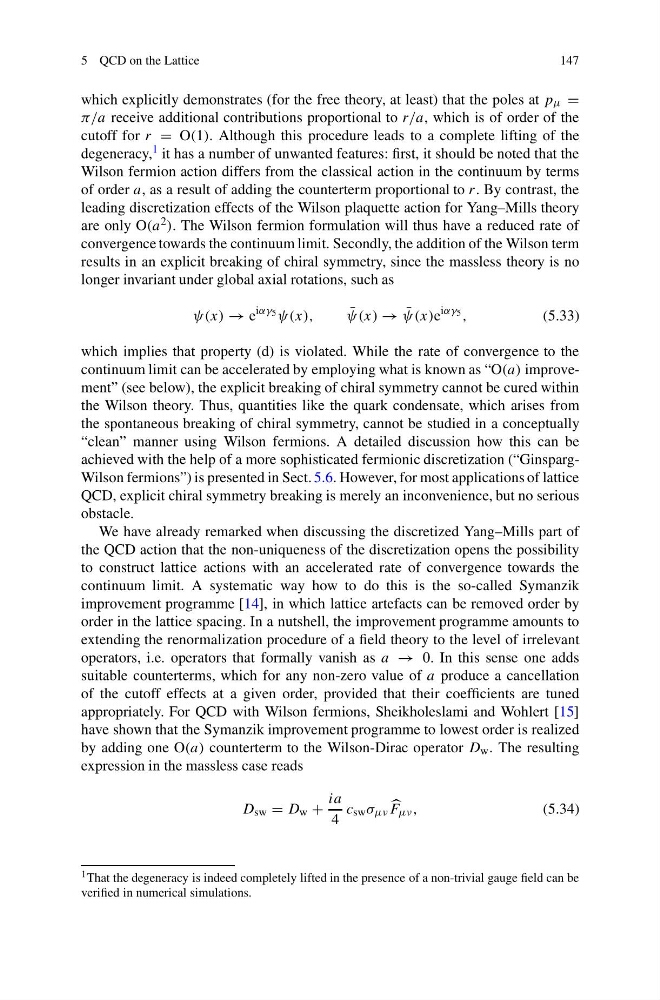
convergence towards the continuum limit. Secondly, the addition of the Wilson term
results in an explicit breaking of chiral symmetry, since the massless theory is no
longer invariant under global axial rotations, such as
ψ(x) → e
iαγ 5 ψ(x),
¯
ψ(x) → ¯
ψ(x)e
iαγ 5 ,
(5.33)
which implies that property (d) is violated. While the rate of convergence to the
continuum limit can be accelerated by employing what is known as “O(a) improvement” (see below), the explicit breaking of chiral symmetry cannot be cured within
the Wilson theory. Thus, quantities like the quark condensate, which arises from
the spontaneous breaking of chiral symmetry, cannot be studied in a conceptually
“clean” manner using Wilson fermions. A detailed discussion how this can be
achieved with the help of a more sophisticated fermionic discretization (“GinspargWilson fermions”) is presented in Sect. 5.6. However, for most applications of lattice
QCD, explicit chiral symmetry breaking is merely an inconvenience, but no serious
obstacle.
We have already remarked when discussing the discretized Yang–Mills part of
the QCD action that the non-uniqueness of the discretization opens the possibility
to construct lattice actions with an accelerated rate of convergence towards the
continuum limit. A systematic way how to do this is the so-called Symanzik
improvement programme [14], in which lattice artefacts can be removed order by
order in the lattice spacing. In a nutshell, the improvement programme amounts to
extending the renormalization procedure of a field theory to the level of irrelevant
operators, i.e. operators that formally vanish as a → 0. In this sense one adds
suitable counterterms, which for any non-zero value of a produce a cancellation
of the cutoff effects at a given order, provided that their coefficients are tuned
appropriately. For QCD with Wilson fermions, Sheikholeslami and Wohlert [15]
have shown that the Symanzik improvement programme to lowest order is realized
by adding one O(a) counterterm to the Wilson-Dirac operator D w . The resulting
expression in the massless case reads
D sw = D w +
ia
4
c sw σ μν
F μν ,
(5.34)
1 That the degeneracy is indeed completely lifted in the presence of a non-trivial gauge field can be
verified in numerical simulations.
147
which explicitly demonstrates (for the free theory, at least) that the poles at p μ =
π/a receive additional contributions proportional to r/a, which is of order of the
cutoff for r = O(1). Although this procedure leads to a complete lifting of the
degeneracy, 1 it has a number of unwanted features: first, it should be noted that the
Wilson fermion action differs from the classical action in the continuum by terms
of order a, as a result of adding the counterterm proportional to r. By contrast, the
leading discretization effects of the Wilson plaquette action for Yang–Mills theory
are only O(a 2 ). The Wilson fermion formulation will thus have a reduced rate of
convergence towards the continuum limit. Secondly, the addition of the Wilson term
results in an explicit breaking of chiral symmetry, since the massless theory is no
longer invariant under global axial rotations, such as
ψ(x) → e
iαγ 5 ψ(x),
¯
ψ(x) → ¯
ψ(x)e
iαγ 5 ,
(5.33)
which implies that property (d) is violated. While the rate of convergence to the
continuum limit can be accelerated by employing what is known as “O(a) improvement” (see below), the explicit breaking of chiral symmetry cannot be cured within
the Wilson theory. Thus, quantities like the quark condensate, which arises from
the spontaneous breaking of chiral symmetry, cannot be studied in a conceptually
“clean” manner using Wilson fermions. A detailed discussion how this can be
achieved with the help of a more sophisticated fermionic discretization (“GinspargWilson fermions”) is presented in Sect. 5.6. However, for most applications of lattice
QCD, explicit chiral symmetry breaking is merely an inconvenience, but no serious
obstacle.
We have already remarked when discussing the discretized Yang–Mills part of
the QCD action that the non-uniqueness of the discretization opens the possibility
to construct lattice actions with an accelerated rate of convergence towards the
continuum limit. A systematic way how to do this is the so-called Symanzik
improvement programme [14], in which lattice artefacts can be removed order by
order in the lattice spacing. In a nutshell, the improvement programme amounts to
extending the renormalization procedure of a field theory to the level of irrelevant
operators, i.e. operators that formally vanish as a → 0. In this sense one adds
suitable counterterms, which for any non-zero value of a produce a cancellation
of the cutoff effects at a given order, provided that their coefficients are tuned
appropriately. For QCD with Wilson fermions, Sheikholeslami and Wohlert [15]
have shown that the Symanzik improvement programme to lowest order is realized
by adding one O(a) counterterm to the Wilson-Dirac operator D w . The resulting
expression in the massless case reads
D sw = D w +
ia
4
c sw σ μν
F μν ,
(5.34)
1 That the degeneracy is indeed completely lifted in the presence of a non-trivial gauge field can be
verified in numerical simulations.