

146
H. Wittig
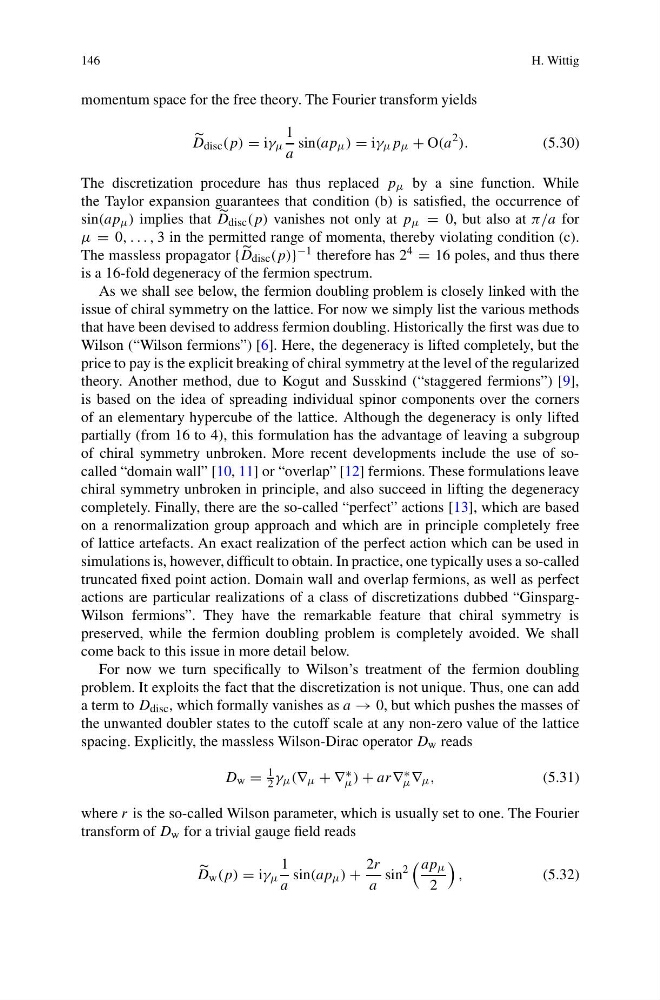
momentum space for the free theory. The Fourier transform yields
D disc (p) = iγ μ
1
a
sin(ap μ ) = iγ μ p μ + O(a
2 ).
(5.30)
The discretization procedure has thus replaced p μ by a sine function. While
the Taylor expansion guarantees that condition (b) is satisfied, the occurrence of
sin(ap μ ) implies that
D disc (p) vanishes not only at p μ = 0, but also at π/a for
μ = 0, . . . , 3 in the permitted range of momenta, thereby violating condition (c).
The massless propagator {
D disc (p)} −1 therefore has 2 4 = 16 poles, and thus there
is a 16-fold degeneracy of the fermion spectrum.
As we shall see below, the fermion doubling problem is closely linked with the
issue of chiral symmetry on the lattice. For now we simply list the various methods
that have been devised to address fermion doubling. Historically the first was due to
Wilson (“Wilson fermions”) [6]. Here, the degeneracy is lifted completely, but the
price to pay is the explicit breaking of chiral symmetry at the level of the regularized
theory. Another method, due to Kogut and Susskind (“staggered fermions”) [9],
is based on the idea of spreading individual spinor components over the corners
of an elementary hypercube of the lattice. Although the degeneracy is only lifted
partially (from 16 to 4), this formulation has the advantage of leaving a subgroup
of chiral symmetry unbroken. More recent developments include the use of socalled “domain wall” [10, 11] or “overlap” [12] fermions. These formulations leave
chiral symmetry unbroken in principle, and also succeed in lifting the degeneracy
completely. Finally, there are the so-called “perfect” actions [13], which are based
on a renormalization group approach and which are in principle completely free
of lattice artefacts. An exact realization of the perfect action which can be used in
simulations is, however, difficult to obtain. In practice, one typically uses a so-called
truncated fixed point action. Domain wall and overlap fermions, as well as perfect
actions are particular realizations of a class of discretizations dubbed “GinspargWilson fermions”. They have the remarkable feature that chiral symmetry is
preserved, while the fermion doubling problem is completely avoided. We shall
come back to this issue in more detail below.
For now we turn specifically to Wilson’s treatment of the fermion doubling
problem. It exploits the fact that the discretization is not unique. Thus, one can add
a term to D disc , which formally vanishes as a → 0, but which pushes the masses of
the unwanted doubler states to the cutoff scale at any non-zero value of the lattice
spacing. Explicitly, the massless Wilson-Dirac operator D w reads
D w =
1
2 γ μ (∇ μ + ∇ ∗
μ ) + ar∇ ∗
μ ∇ μ ,
(5.31)
where r is the so-called Wilson parameter, which is usually set to one. The Fourier
transform of D w for a trivial gauge field reads
D w (p) = iγ μ
1
a
sin(ap μ ) +
2r
a
sin
2
ap μ
2
,
(5.32)
H. Wittig
momentum space for the free theory. The Fourier transform yields
D disc (p) = iγ μ
1
a
sin(ap μ ) = iγ μ p μ + O(a
2 ).
(5.30)
The discretization procedure has thus replaced p μ by a sine function. While
the Taylor expansion guarantees that condition (b) is satisfied, the occurrence of
sin(ap μ ) implies that
D disc (p) vanishes not only at p μ = 0, but also at π/a for
μ = 0, . . . , 3 in the permitted range of momenta, thereby violating condition (c).
The massless propagator {
D disc (p)} −1 therefore has 2 4 = 16 poles, and thus there
is a 16-fold degeneracy of the fermion spectrum.
As we shall see below, the fermion doubling problem is closely linked with the
issue of chiral symmetry on the lattice. For now we simply list the various methods
that have been devised to address fermion doubling. Historically the first was due to
Wilson (“Wilson fermions”) [6]. Here, the degeneracy is lifted completely, but the
price to pay is the explicit breaking of chiral symmetry at the level of the regularized
theory. Another method, due to Kogut and Susskind (“staggered fermions”) [9],
is based on the idea of spreading individual spinor components over the corners
of an elementary hypercube of the lattice. Although the degeneracy is only lifted
partially (from 16 to 4), this formulation has the advantage of leaving a subgroup
of chiral symmetry unbroken. More recent developments include the use of socalled “domain wall” [10, 11] or “overlap” [12] fermions. These formulations leave
chiral symmetry unbroken in principle, and also succeed in lifting the degeneracy
completely. Finally, there are the so-called “perfect” actions [13], which are based
on a renormalization group approach and which are in principle completely free
of lattice artefacts. An exact realization of the perfect action which can be used in
simulations is, however, difficult to obtain. In practice, one typically uses a so-called
truncated fixed point action. Domain wall and overlap fermions, as well as perfect
actions are particular realizations of a class of discretizations dubbed “GinspargWilson fermions”. They have the remarkable feature that chiral symmetry is
preserved, while the fermion doubling problem is completely avoided. We shall
come back to this issue in more detail below.
For now we turn specifically to Wilson’s treatment of the fermion doubling
problem. It exploits the fact that the discretization is not unique. Thus, one can add
a term to D disc , which formally vanishes as a → 0, but which pushes the masses of
the unwanted doubler states to the cutoff scale at any non-zero value of the lattice
spacing. Explicitly, the massless Wilson-Dirac operator D w reads
D w =
1
2 γ μ (∇ μ + ∇ ∗
μ ) + ar∇ ∗
μ ∇ μ ,
(5.31)
where r is the so-called Wilson parameter, which is usually set to one. The Fourier
transform of D w for a trivial gauge field reads
D w (p) = iγ μ
1
a
sin(ap μ ) +
2r
a
sin
2
ap μ
2
,
(5.32)