

148
H. Wittig
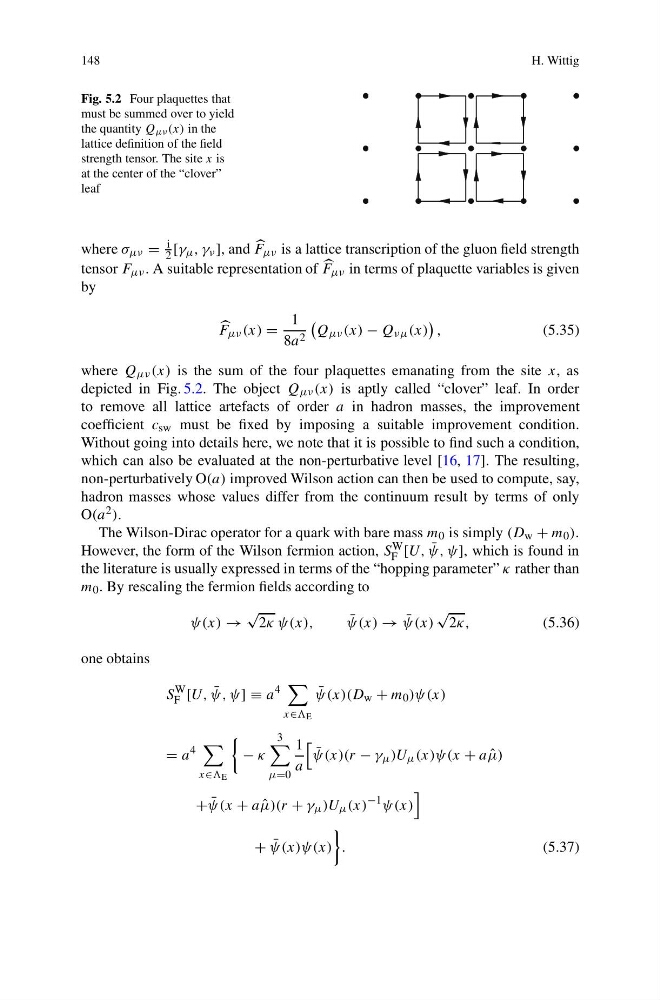
Fig. 5.2 Four plaquettes that
must be summed over to yield
the quantity Q μν (x) in the
lattice definition of the field
strength tensor. The site x is
at the center of the “clover”
leaf
where σ μν =
i
2 [γ μ , γ ν ], and
F μν is a lattice transcription of the gluon field strength
tensor F μν . A suitable representation of
F μν in terms of plaquette variables is given
by
F μν (x) =
1
8a 2
Q μν (x) − Q νμ (x)
,
(5.35)
where Q μν (x) is the sum of the four plaquettes emanating from the site x, as
depicted in Fig. 5.2. The object Q μν (x) is aptly called “clover” leaf. In order
to remove all lattice artefacts of order a in hadron masses, the improvement
coefficient c sw must be fixed by imposing a suitable improvement condition.
Without going into details here, we note that it is possible to find such a condition,
which can also be evaluated at the non-perturbative level [16, 17]. The resulting,
non-perturbatively O(a) improved Wilson action can then be used to compute, say,
hadron masses whose values differ from the continuum result by terms of only
O(a 2 ).
The Wilson-Dirac operator for a quark with bare mass m 0 is simply (D w + m 0 ).
However, the form of the Wilson fermion action, S W
F [U, ¯
ψ, ψ], which is found in
the literature is usually expressed in terms of the “hopping parameter” κ rather than
m 0 . By rescaling the fermion fields according to
ψ(x) →
√
2κ ψ(x),
¯
ψ(x) → ¯
ψ(x)
√
2κ,
(5.36)
one obtains
S
W
F [U, ¯
ψ, ψ] ≡ a
4
x∈ E
¯
ψ(x)(D w + m 0 )ψ(x)
= a
4
x∈ E
− κ
3
μ=0
1
a
¯
ψ(x)(r − γ μ )U μ (x)ψ(x + a ˆ
μ)
+ ¯
ψ(x + a ˆ
μ)(r + γ μ )U μ (x)
−1 ψ(x)
+ ¯
ψ(x)ψ(x)
.
(5.37)
H. Wittig
Fig. 5.2 Four plaquettes that
must be summed over to yield
the quantity Q μν (x) in the
lattice definition of the field
strength tensor. The site x is
at the center of the “clover”
leaf
where σ μν =
i
2 [γ μ , γ ν ], and
F μν is a lattice transcription of the gluon field strength
tensor F μν . A suitable representation of
F μν in terms of plaquette variables is given
by
F μν (x) =
1
8a 2
Q μν (x) − Q νμ (x)
,
(5.35)
where Q μν (x) is the sum of the four plaquettes emanating from the site x, as
depicted in Fig. 5.2. The object Q μν (x) is aptly called “clover” leaf. In order
to remove all lattice artefacts of order a in hadron masses, the improvement
coefficient c sw must be fixed by imposing a suitable improvement condition.
Without going into details here, we note that it is possible to find such a condition,
which can also be evaluated at the non-perturbative level [16, 17]. The resulting,
non-perturbatively O(a) improved Wilson action can then be used to compute, say,
hadron masses whose values differ from the continuum result by terms of only
O(a 2 ).
The Wilson-Dirac operator for a quark with bare mass m 0 is simply (D w + m 0 ).
However, the form of the Wilson fermion action, S W
F [U, ¯
ψ, ψ], which is found in
the literature is usually expressed in terms of the “hopping parameter” κ rather than
m 0 . By rescaling the fermion fields according to
ψ(x) →
√
2κ ψ(x),
¯
ψ(x) → ¯
ψ(x)
√
2κ,
(5.36)
one obtains
S
W
F [U, ¯
ψ, ψ] ≡ a
4
x∈ E
¯
ψ(x)(D w + m 0 )ψ(x)
= a
4
x∈ E
− κ
3
μ=0
1
a
¯
ψ(x)(r − γ μ )U μ (x)ψ(x + a ˆ
μ)
+ ¯
ψ(x + a ˆ
μ)(r + γ μ )U μ (x)
−1 ψ(x)
+ ¯
ψ(x)ψ(x)
.
(5.37)