

126
G. Altarelli and S. Forte
Before closing this section I would like to mention some very interesting
developments at the interface between string theory and QCD, twistor calculus. A
precursor work was the Parke-Taylor result in 1986 [69] on the amplitudes for n
incoming gluons with given helicities [70]. Inspired by dual models, they derived a
compact formula for the maximum non vanishing helicity violating amplitude (with
n−2 plus and 2 minus helicities) in terms of spinor products. Using the relation
between strings and gauge theories in twistor space Witten developed in ’03 [71]
a formalism in terms of effective vertices and propagators that allows to compute
all helicity amplitudes. The method, alternative to other modern techniques for the
evaluation of Feynman diagrams [73], leads to very compact results. Since then
rapid progress followed (for reviews, see [72]): for tree level processes powerful
recurrence relations were established [74], the method was extended to include
massless external fermions [75] and also external EW vector bosons [76] and Higgs
particles [77]. The level already attained is already important for multijet events at
the LHC. And the study of loop diagrams has been started. In summary, this road
looks new and promising.
4.6 Measurements of α s
Very precise and reliable measurements of α s (m 2
Z ) are obtained from e + e − colliders
(in particular LEP) and from deep inelastic scattering.
4.6.1 α s from e + e − Colliders
The main methods at e + e − colliders are: (a) Inclusive hadronic Z decay, R l , σ h , σ l ,
Z . (b) Inclusive hadronic τ decay. (c) Event shapes and jet rates.
As we have seen, for a quantity like R l we can write a general expression of the
form:
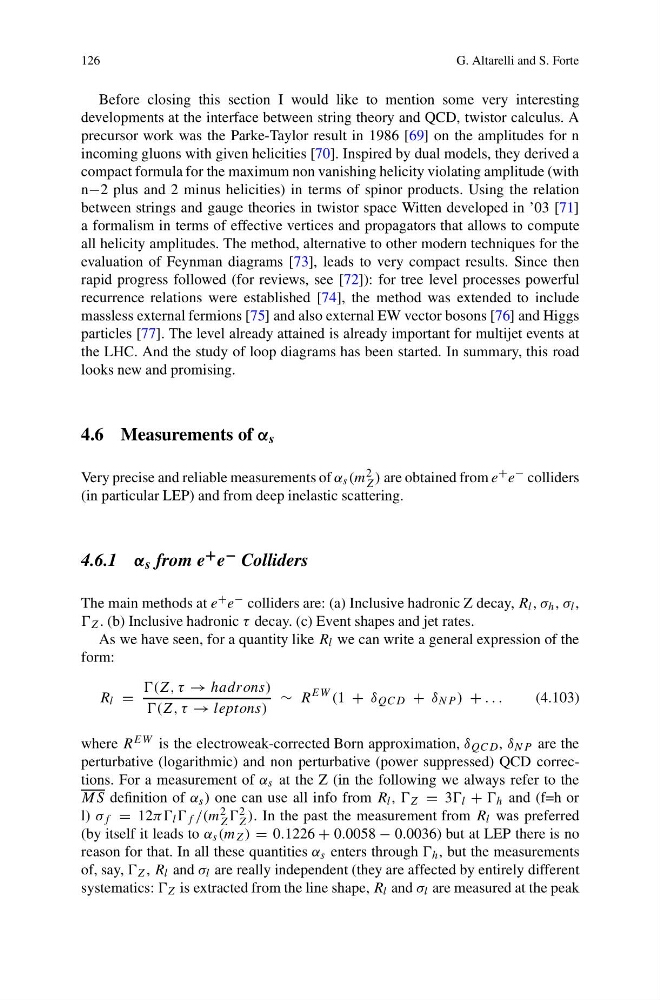
R l =
τ → hadrons)
τ → leptons)
∼ R
EW (1 + δ QCD + δ NP ) + . . .
(4.103)
where R EW is the electroweak-corrected Born approximation, δ QCD , δ NP are the
perturbative (logarithmic) and non perturbative (power suppressed) QCD corrections. For a measurement of α s at the Z (in the following we always refer to the
MS definition of α s ) one can use all info from R l , Z = 3 l + h and (f=h or
l) σ f = 12ππ l f /(m 2
Z 2
Z ). In the past the measurement from R l was preferred
(by itself it leads to α s (m Z ) = 0.1226 + 0.0058 − 0.0036) but at LEP there is no
reason for that. In all these quantities α s enters through h , but the measurements
of, say, Z , R l and σ l are really independent (they are affected by entirely different
systematics: Z is extracted from the line shape, R l and σ l are measured at the peak
G. Altarelli and S. Forte
Before closing this section I would like to mention some very interesting
developments at the interface between string theory and QCD, twistor calculus. A
precursor work was the Parke-Taylor result in 1986 [69] on the amplitudes for n
incoming gluons with given helicities [70]. Inspired by dual models, they derived a
compact formula for the maximum non vanishing helicity violating amplitude (with
n−2 plus and 2 minus helicities) in terms of spinor products. Using the relation
between strings and gauge theories in twistor space Witten developed in ’03 [71]
a formalism in terms of effective vertices and propagators that allows to compute
all helicity amplitudes. The method, alternative to other modern techniques for the
evaluation of Feynman diagrams [73], leads to very compact results. Since then
rapid progress followed (for reviews, see [72]): for tree level processes powerful
recurrence relations were established [74], the method was extended to include
massless external fermions [75] and also external EW vector bosons [76] and Higgs
particles [77]. The level already attained is already important for multijet events at
the LHC. And the study of loop diagrams has been started. In summary, this road
looks new and promising.
4.6 Measurements of α s
Very precise and reliable measurements of α s (m 2
Z ) are obtained from e + e − colliders
(in particular LEP) and from deep inelastic scattering.
4.6.1 α s from e + e − Colliders
The main methods at e + e − colliders are: (a) Inclusive hadronic Z decay, R l , σ h , σ l ,
Z . (b) Inclusive hadronic τ decay. (c) Event shapes and jet rates.
As we have seen, for a quantity like R l we can write a general expression of the
form:
R l =
τ → hadrons)
τ → leptons)
∼ R
EW (1 + δ QCD + δ NP ) + . . .
(4.103)
where R EW is the electroweak-corrected Born approximation, δ QCD , δ NP are the
perturbative (logarithmic) and non perturbative (power suppressed) QCD corrections. For a measurement of α s at the Z (in the following we always refer to the
MS definition of α s ) one can use all info from R l , Z = 3 l + h and (f=h or
l) σ f = 12ππ l f /(m 2
Z 2
Z ). In the past the measurement from R l was preferred
(by itself it leads to α s (m Z ) = 0.1226 + 0.0058 − 0.0036) but at LEP there is no
reason for that. In all these quantities α s enters through h , but the measurements
of, say, Z , R l and σ l are really independent (they are affected by entirely different
systematics: Z is extracted from the line shape, R l and σ l are measured at the peak