

4 QCD: The Theory of Strong Interactions
125
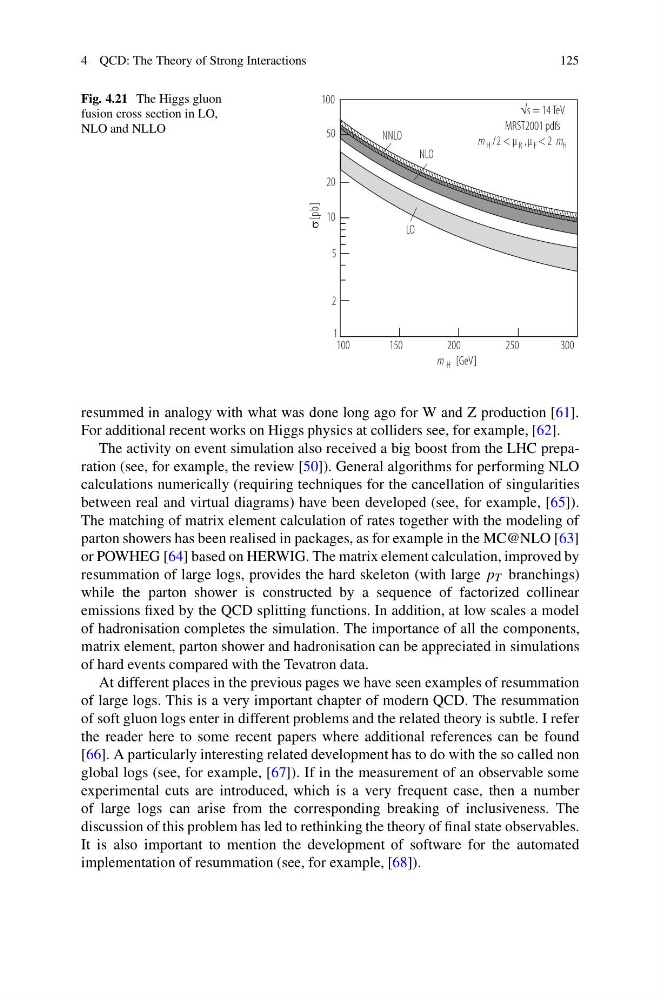
Fig. 4.21 The Higgs gluon
fusion cross section in LO,
NLO and NLLO
100
50
20
10
5
2
1
100
150
200
250
300
m [GeV]
H
NNLO
NLO
LO
MRST2001 pdfs
m /2 < µ µ < 2 m
H
R F
H
s = 14 TeV
V ]
b
p
[
,
resummed in analogy with what was done long ago for W and Z production [61].
For additional recent works on Higgs physics at colliders see, for example, [62].
The activity on event simulation also received a big boost from the LHC preparation (see, for example, the review [50]). General algorithms for performing NLO
calculations numerically (requiring techniques for the cancellation of singularities
between real and virtual diagrams) have been developed (see, for example, [65]).
The matching of matrix element calculation of rates together with the modeling of
parton showers has been realised in packages, as for example in the MC@NLO [63]
or POWHEG [64] based on HERWIG. The matrix element calculation, improved by
resummation of large logs, provides the hard skeleton (with large p T branchings)
while the parton shower is constructed by a sequence of factorized collinear
emissions fixed by the QCD splitting functions. In addition, at low scales a model
of hadronisation completes the simulation. The importance of all the components,
matrix element, parton shower and hadronisation can be appreciated in simulations
of hard events compared with the Tevatron data.
At different places in the previous pages we have seen examples of resummation
of large logs. This is a very important chapter of modern QCD. The resummation
of soft gluon logs enter in different problems and the related theory is subtle. I refer
the reader here to some recent papers where additional references can be found
[66]. A particularly interesting related development has to do with the so called non
global logs (see, for example, [67]). If in the measurement of an observable some
experimental cuts are introduced, which is a very frequent case, then a number
of large logs can arise from the corresponding breaking of inclusiveness. The
discussion of this problem has led to rethinking the theory of final state observables.
It is also important to mention the development of software for the automated
implementation of resummation (see, for example, [68]).
125
Fig. 4.21 The Higgs gluon
fusion cross section in LO,
NLO and NLLO
100
50
20
10
5
2
1
100
150
200
250
300
m [GeV]
H
NNLO
NLO
LO
MRST2001 pdfs
m /2 < µ µ < 2 m
H
R F
H
s = 14 TeV
V ]
b
p
[
,
resummed in analogy with what was done long ago for W and Z production [61].
For additional recent works on Higgs physics at colliders see, for example, [62].
The activity on event simulation also received a big boost from the LHC preparation (see, for example, the review [50]). General algorithms for performing NLO
calculations numerically (requiring techniques for the cancellation of singularities
between real and virtual diagrams) have been developed (see, for example, [65]).
The matching of matrix element calculation of rates together with the modeling of
parton showers has been realised in packages, as for example in the MC@NLO [63]
or POWHEG [64] based on HERWIG. The matrix element calculation, improved by
resummation of large logs, provides the hard skeleton (with large p T branchings)
while the parton shower is constructed by a sequence of factorized collinear
emissions fixed by the QCD splitting functions. In addition, at low scales a model
of hadronisation completes the simulation. The importance of all the components,
matrix element, parton shower and hadronisation can be appreciated in simulations
of hard events compared with the Tevatron data.
At different places in the previous pages we have seen examples of resummation
of large logs. This is a very important chapter of modern QCD. The resummation
of soft gluon logs enter in different problems and the related theory is subtle. I refer
the reader here to some recent papers where additional references can be found
[66]. A particularly interesting related development has to do with the so called non
global logs (see, for example, [67]). If in the measurement of an observable some
experimental cuts are introduced, which is a very frequent case, then a number
of large logs can arise from the corresponding breaking of inclusiveness. The
discussion of this problem has led to rethinking the theory of final state observables.
It is also important to mention the development of software for the automated
implementation of resummation (see, for example, [68]).