

4 QCD: The Theory of Strong Interactions
127
but R l does not depend on the absolute luminosity while σ l does).The most sensitive
single quantity is σ l . The combined value from the measurements at the Z (assuming
the validity of the SM and a light Higgs mass) is [78]:
α s (m Z ) = 0.119 ± 0.003
(4.104)
For a relatively light Higgs (even if not as light as from the fit to EW observables) the
final error is mainly experimental with a theoretical component from our ignorance
of m H , of higher orders in the QCD expansion [79] and also from uncertainties on
the Bhabha luminometer (which affect σ h,l ) [80]. By adding all other electroweak
precision electroweak tests (in particular m W ) one similarly finds [41]:
α s (m Z ) = 0.1185 ± 0.003
(4.105)
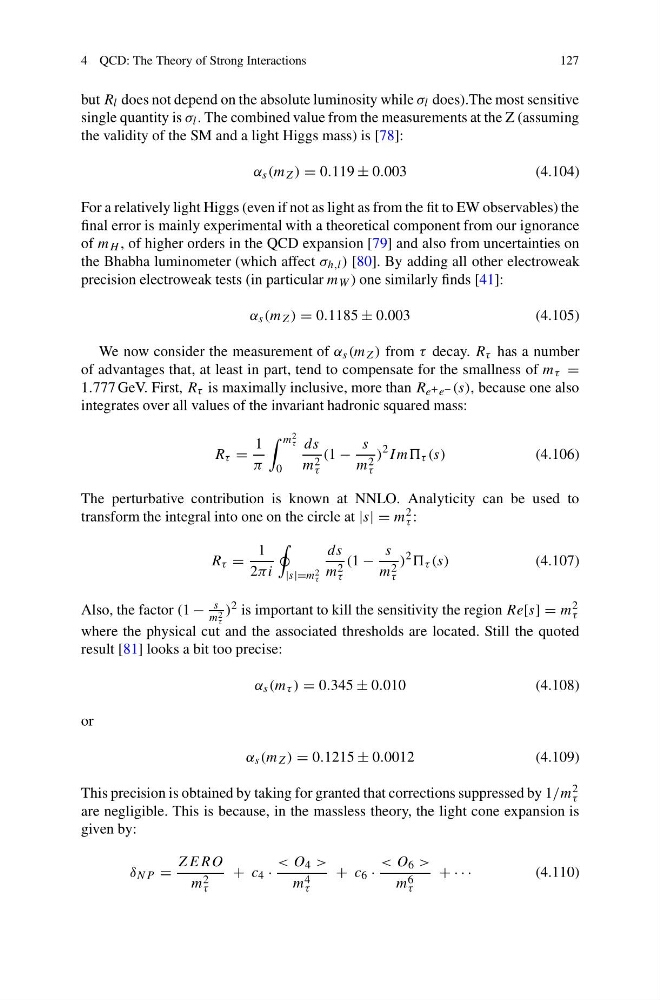
We now consider the measurement of α s (m Z ) from τ decay. R τ has a number
of advantages that, at least in part, tend to compensate for the smallness of m τ =
1.777 GeV. First, R τ is maximally inclusive, more than R e + e − (s), because one also
integrates over all values of the invariant hadronic squared mass:
R τ =
1
π
m 2
τ
0
ds
m 2
τ
(1 −
s
m 2
τ
)
2 I mm τ (s)
(4.106)
The perturbative contribution is known at NNLO. Analyticity can be used to
transform the integral into one on the circle at |s| = m 2
τ :
R τ =
1
2πi
|s|=m 2
τ
ds
m 2
τ
(1 −
s
m 2
τ
)
2 τ (s)
(4.107)
Also, the factor (1 −
s
m 2
τ
) 2 is important to kill the sensitivity the region Re[s] = m 2
τ
where the physical cut and the associated thresholds are located. Still the quoted
result [81] looks a bit too precise:
α s (m τ ) = 0.345 ± 0.010
(4.108)
or
α s (m Z ) = 0.1215 ± 0.0012
(4.109)
This precision is obtained by taking for granted that corrections suppressed by 1/m 2
τ
are negligible. This is because, in the massless theory, the light cone expansion is
given by:
δ NP =
ZERO
m 2
τ
+ c 4 ·
< O 4 >
m 4
τ
+ c 6 ·
< O 6 >
m 6
τ
+ · · ·
(4.110)
127
but R l does not depend on the absolute luminosity while σ l does).The most sensitive
single quantity is σ l . The combined value from the measurements at the Z (assuming
the validity of the SM and a light Higgs mass) is [78]:
α s (m Z ) = 0.119 ± 0.003
(4.104)
For a relatively light Higgs (even if not as light as from the fit to EW observables) the
final error is mainly experimental with a theoretical component from our ignorance
of m H , of higher orders in the QCD expansion [79] and also from uncertainties on
the Bhabha luminometer (which affect σ h,l ) [80]. By adding all other electroweak
precision electroweak tests (in particular m W ) one similarly finds [41]:
α s (m Z ) = 0.1185 ± 0.003
(4.105)
We now consider the measurement of α s (m Z ) from τ decay. R τ has a number
of advantages that, at least in part, tend to compensate for the smallness of m τ =
1.777 GeV. First, R τ is maximally inclusive, more than R e + e − (s), because one also
integrates over all values of the invariant hadronic squared mass:
R τ =
1
π
m 2
τ
0
ds
m 2
τ
(1 −
s
m 2
τ
)
2 I mm τ (s)
(4.106)
The perturbative contribution is known at NNLO. Analyticity can be used to
transform the integral into one on the circle at |s| = m 2
τ :
R τ =
1
2πi
|s|=m 2
τ
ds
m 2
τ
(1 −
s
m 2
τ
)
2 τ (s)
(4.107)
Also, the factor (1 −
s
m 2
τ
) 2 is important to kill the sensitivity the region Re[s] = m 2
τ
where the physical cut and the associated thresholds are located. Still the quoted
result [81] looks a bit too precise:
α s (m τ ) = 0.345 ± 0.010
(4.108)
or
α s (m Z ) = 0.1215 ± 0.0012
(4.109)
This precision is obtained by taking for granted that corrections suppressed by 1/m 2
τ
are negligible. This is because, in the massless theory, the light cone expansion is
given by:
δ NP =
ZERO
m 2
τ
+ c 4 ·
< O 4 >
m 4
τ
+ c 6 ·
< O 6 >
m 6
τ
+ · · ·
(4.110)