

110
G. Altarelli and S. Forte
were derived from the data on the electron and neutrino structure functions:
F ep = 4/9u(x) + 1/9d(x) + . . . .. ;
F en = 4/9d(x) + 1/9u(x) + . . . .
F νp = F ¯
νn = 2d(x) + . . . .. ;
F νn = F ¯
νp = 2u(x) + . . . .. (4.71)
where F ∼ 2F 1 ∼ F 2 /x and u(x), d(x) are the parton number densities in the
proton (with fraction x of the proton longitudinal momentum), which, in the scaling
limit, do not depend on Q 2 . The normalisation of the structure functions and the
parton densities are such that the charge relations hold:
1
0
[u(x) − ¯
u(x)]dx = 2,
1
0
[d(x) − ¯
d(x)]dx = 1,
1
0
[s(x) − ¯
s(x)]dx = 0
(4.72)
Also it was proven by experiment that at values of Q 2 of a few GeV 2 , in the scaling
region, about half of the nucleon momentum, given by the momentum sum rule:
1
0
[
i
(q i (x) + ¯
q i (x)) + g(x)]xdx = 1
(4.73)
is carried by neutral partons (gluons).
In QCD there are calculable log scaling violations induced by α s (t). The parton
rules just introduced can be summarised in the formula:
F (x, t) =
1
x
dy
q 0 (y)
y
σ point (
x
y
, α s (t)) + o(
1
Q 2 )
(4.74)
Before QCD corrections σ point = e 2 δ(x/y − 1) and F = e 2 q 0 (x) (here we denote
by e the charge of the quark in units of the positron charge, i.e. e = 2/3 for the
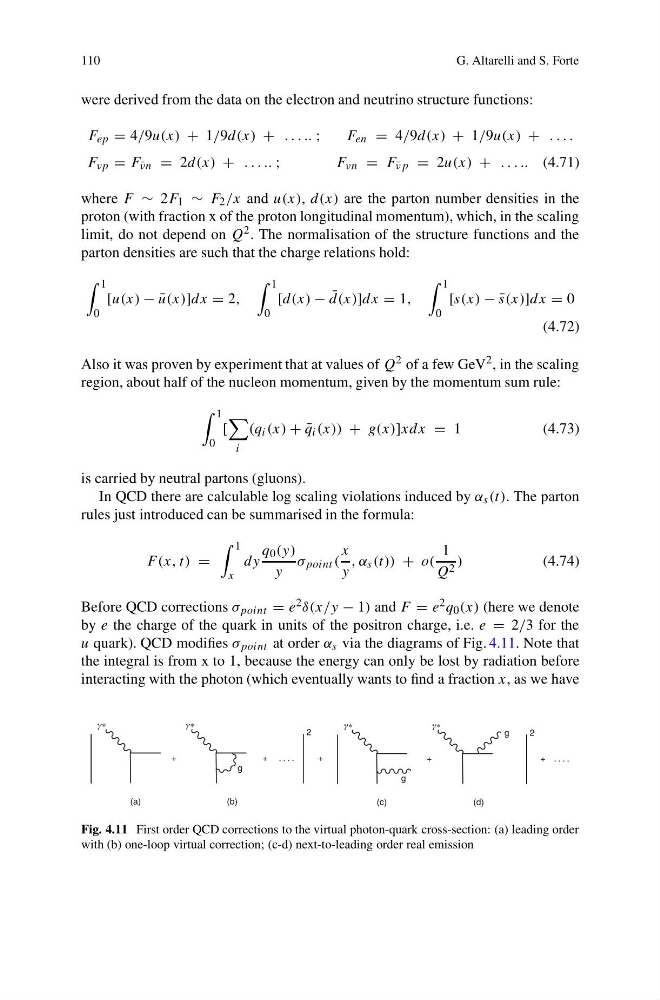
u quark). QCD modifies σ point at order α s via the diagrams of Fig. 4.11. Note that
the integral is from x to 1, because the energy can only be lost by radiation before
interacting with the photon (which eventually wants to find a fraction x, as we have
Fig. 4.11 First order QCD corrections to the virtual photon-quark cross-section: (a) leading order
with (b) one-loop virtual correction; (c-d) next-to-leading order real emission
G. Altarelli and S. Forte
were derived from the data on the electron and neutrino structure functions:
F ep = 4/9u(x) + 1/9d(x) + . . . .. ;
F en = 4/9d(x) + 1/9u(x) + . . . .
F νp = F ¯
νn = 2d(x) + . . . .. ;
F νn = F ¯
νp = 2u(x) + . . . .. (4.71)
where F ∼ 2F 1 ∼ F 2 /x and u(x), d(x) are the parton number densities in the
proton (with fraction x of the proton longitudinal momentum), which, in the scaling
limit, do not depend on Q 2 . The normalisation of the structure functions and the
parton densities are such that the charge relations hold:
1
0
[u(x) − ¯
u(x)]dx = 2,
1
0
[d(x) − ¯
d(x)]dx = 1,
1
0
[s(x) − ¯
s(x)]dx = 0
(4.72)
Also it was proven by experiment that at values of Q 2 of a few GeV 2 , in the scaling
region, about half of the nucleon momentum, given by the momentum sum rule:
1
0
[
i
(q i (x) + ¯
q i (x)) + g(x)]xdx = 1
(4.73)
is carried by neutral partons (gluons).
In QCD there are calculable log scaling violations induced by α s (t). The parton
rules just introduced can be summarised in the formula:
F (x, t) =
1
x
dy
q 0 (y)
y
σ point (
x
y
, α s (t)) + o(
1
Q 2 )
(4.74)
Before QCD corrections σ point = e 2 δ(x/y − 1) and F = e 2 q 0 (x) (here we denote
by e the charge of the quark in units of the positron charge, i.e. e = 2/3 for the
u quark). QCD modifies σ point at order α s via the diagrams of Fig. 4.11. Note that
the integral is from x to 1, because the energy can only be lost by radiation before
interacting with the photon (which eventually wants to find a fraction x, as we have
Fig. 4.11 First order QCD corrections to the virtual photon-quark cross-section: (a) leading order
with (b) one-loop virtual correction; (c-d) next-to-leading order real emission