

4 QCD: The Theory of Strong Interactions
111
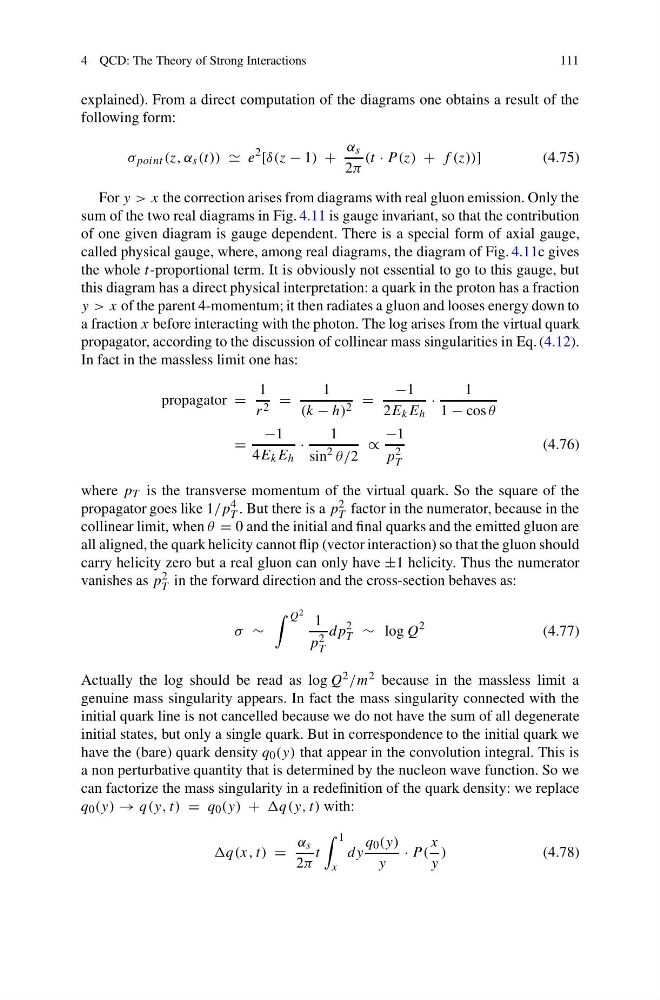
explained). From a direct computation of the diagrams one obtains a result of the
following form:
σ point (z, α s (t)) e
2
[δ(z − 1) +
α s
2π
(t · P (z) + f (z))]
(4.75)
For y > x the correction arises from diagrams with real gluon emission. Only the
sum of the two real diagrams in Fig. 4.11 is gauge invariant, so that the contribution
of one given diagram is gauge dependent. There is a special form of axial gauge,
called physical gauge, where, among real diagrams, the diagram of Fig. 4.11c gives
the whole t-proportional term. It is obviously not essential to go to this gauge, but
this diagram has a direct physical interpretation: a quark in the proton has a fraction
y > x of the parent 4-momentum; it then radiates a gluon and looses energy down to
a fraction x before interacting with the photon. The log arises from the virtual quark
propagator, according to the discussion of collinear mass singularities in Eq. (4.12).
In fact in the massless limit one has:
propagator =
1
r 2 =
1
(k − h) 2 =
−1
2E k E h
·
1
1 − cos θ
=
−1
4E k E h
·
1
sin
2 θ/2
∝
−1
p 2
T
(4.76)
where p T is the transverse momentum of the virtual quark. So the square of the
propagator goes like 1/p 4
T . But there is a p 2
T factor in the numerator, because in the
collinear limit, when θ = 0 and the initial and final quarks and the emitted gluon are
all aligned, the quark helicity cannot flip (vector interaction) so that the gluon should
carry helicity zero but a real gluon can only have ±1 helicity. Thus the numerator
vanishes as p 2
T in the forward direction and the cross-section behaves as:
σ ∼
Q 2 1
p 2
T
dp
2
T ∼ log Q
2
(4.77)
Actually the log should be read as log Q 2 /m 2 because in the massless limit a
genuine mass singularity appears. In fact the mass singularity connected with the
initial quark line is not cancelled because we do not have the sum of all degenerate
initial states, but only a single quark. But in correspondence to the initial quark we
have the (bare) quark density q 0 (y) that appear in the convolution integral. This is
a non perturbative quantity that is determined by the nucleon wave function. So we
can factorize the mass singularity in a redefinition of the quark density: we replace
q 0 (y) → q(y, t) = q 0 (y) + q(y, t) with:
q(x, t) =
α s
2π
t
1
x
dy
q 0 (y)
y
· P (
x
y
)
(4.78)
111
explained). From a direct computation of the diagrams one obtains a result of the
following form:
σ point (z, α s (t)) e
2
[δ(z − 1) +
α s
2π
(t · P (z) + f (z))]
(4.75)
For y > x the correction arises from diagrams with real gluon emission. Only the
sum of the two real diagrams in Fig. 4.11 is gauge invariant, so that the contribution
of one given diagram is gauge dependent. There is a special form of axial gauge,
called physical gauge, where, among real diagrams, the diagram of Fig. 4.11c gives
the whole t-proportional term. It is obviously not essential to go to this gauge, but
this diagram has a direct physical interpretation: a quark in the proton has a fraction
y > x of the parent 4-momentum; it then radiates a gluon and looses energy down to
a fraction x before interacting with the photon. The log arises from the virtual quark
propagator, according to the discussion of collinear mass singularities in Eq. (4.12).
In fact in the massless limit one has:
propagator =
1
r 2 =
1
(k − h) 2 =
−1
2E k E h
·
1
1 − cos θ
=
−1
4E k E h
·
1
sin
2 θ/2
∝
−1
p 2
T
(4.76)
where p T is the transverse momentum of the virtual quark. So the square of the
propagator goes like 1/p 4
T . But there is a p 2
T factor in the numerator, because in the
collinear limit, when θ = 0 and the initial and final quarks and the emitted gluon are
all aligned, the quark helicity cannot flip (vector interaction) so that the gluon should
carry helicity zero but a real gluon can only have ±1 helicity. Thus the numerator
vanishes as p 2
T in the forward direction and the cross-section behaves as:
σ ∼
Q 2 1
p 2
T
dp
2
T ∼ log Q
2
(4.77)
Actually the log should be read as log Q 2 /m 2 because in the massless limit a
genuine mass singularity appears. In fact the mass singularity connected with the
initial quark line is not cancelled because we do not have the sum of all degenerate
initial states, but only a single quark. But in correspondence to the initial quark we
have the (bare) quark density q 0 (y) that appear in the convolution integral. This is
a non perturbative quantity that is determined by the nucleon wave function. So we
can factorize the mass singularity in a redefinition of the quark density: we replace
q 0 (y) → q(y, t) = q 0 (y) + q(y, t) with:
q(x, t) =
α s
2π
t
1
x
dy
q 0 (y)
y
· P (
x
y
)
(4.78)