

4 QCD: The Theory of Strong Interactions
109
The complications of the hadron spectrum could be explained in terms of the
quantum numbers of spin 1/2, fractionally charged, u, d and s quarks. The notion
of colour was introduced to reconcile the observed spectrum with Fermi statistics.
But confinement that forbids the observation of free quarks was a clear obstacle
towards the acceptance of quarks as real constituents and not just as fictitious
entities describing some mathematical pattern (a doubt expressed even by GellMann at the time). The early measurements at SLAC of DIS dissipated all doubts:
the observation of Bjorken scaling and the success of the “naive” (not so much after
all) parton model of Feynman imposed quarks as the basic fields for describing the
nucleon structure (parton quarks).
In the language of Bjorken and Feynman the virtual γ (or, in general, any
gauge boson) sees the quark partons inside the nucleon target as quasi-free, because
their (Lorentz dilated) QCD interaction time is much longer than τ γ ∼ 1/Q, the
duration of the virtual photon interaction. Since the virtual photon 4-momentum
is spacelike, we can go to a Lorentz frame where E γ = 0 (Breit frame). In this
frame q = (E γ = 0; 0, 0, Q) and the nucleon momentum, neglecting the mass
m << Q, is p = (Q/2x; 0, 0, −Q/2x) (note that this correctly gives q 2 = −Q 2
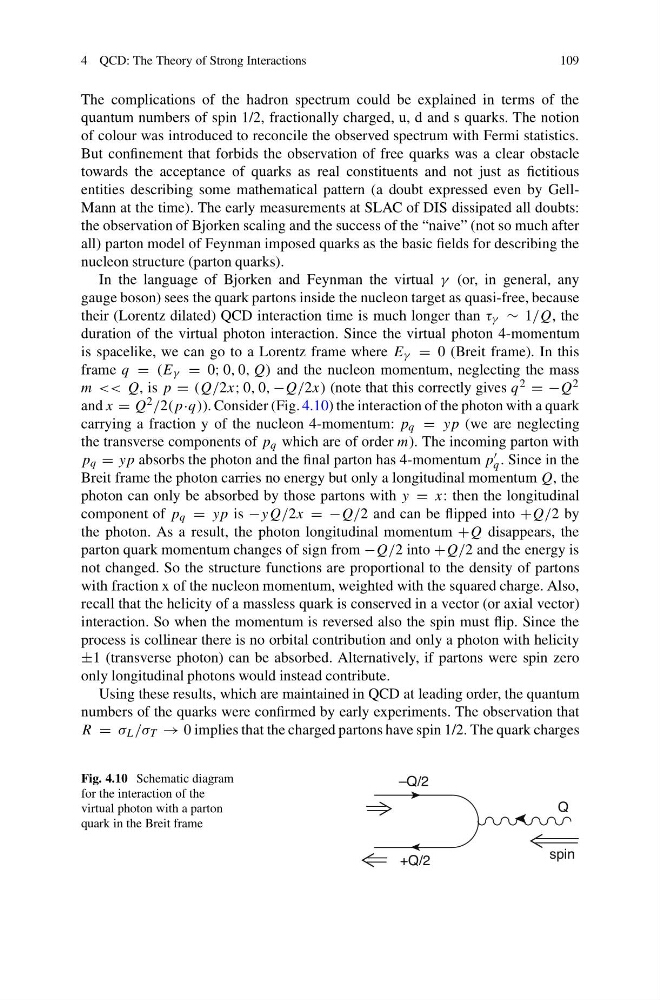
and x = Q 2 /2(p·q)). Consider (Fig. 4.10) the interaction of the photon with a quark
carrying a fraction y of the nucleon 4-momentum: p q = yp (we are neglecting
the transverse components of p q which are of order m). The incoming parton with
p q = yp absorbs the photon and the final parton has 4-momentum p
q . Since in the
Breit frame the photon carries no energy but only a longitudinal momentum Q, the
photon can only be absorbed by those partons with y = x: then the longitudinal
component of p q = yp is −yQ/2x = −Q/2 and can be flipped into +Q/2 by
the photon. As a result, the photon longitudinal momentum +Q disappears, the
parton quark momentum changes of sign from −Q/2 into +Q/2 and the energy is
not changed. So the structure functions are proportional to the density of partons
with fraction x of the nucleon momentum, weighted with the squared charge. Also,
recall that the helicity of a massless quark is conserved in a vector (or axial vector)
interaction. So when the momentum is reversed also the spin must flip. Since the
process is collinear there is no orbital contribution and only a photon with helicity
±1 (transverse photon) can be absorbed. Alternatively, if partons were spin zero
only longitudinal photons would instead contribute.
Using these results, which are maintained in QCD at leading order, the quantum
numbers of the quarks were confirmed by early experiments. The observation that
R = σ L /σ T → 0 implies that the charged partons have spin 1/2. The quark charges
Fig. 4.10 Schematic diagram
for the interaction of the
virtual photon with a parton
quark in the Breit frame
–Q/2
+Q/2
Q
spin
109
The complications of the hadron spectrum could be explained in terms of the
quantum numbers of spin 1/2, fractionally charged, u, d and s quarks. The notion
of colour was introduced to reconcile the observed spectrum with Fermi statistics.
But confinement that forbids the observation of free quarks was a clear obstacle
towards the acceptance of quarks as real constituents and not just as fictitious
entities describing some mathematical pattern (a doubt expressed even by GellMann at the time). The early measurements at SLAC of DIS dissipated all doubts:
the observation of Bjorken scaling and the success of the “naive” (not so much after
all) parton model of Feynman imposed quarks as the basic fields for describing the
nucleon structure (parton quarks).
In the language of Bjorken and Feynman the virtual γ (or, in general, any
gauge boson) sees the quark partons inside the nucleon target as quasi-free, because
their (Lorentz dilated) QCD interaction time is much longer than τ γ ∼ 1/Q, the
duration of the virtual photon interaction. Since the virtual photon 4-momentum
is spacelike, we can go to a Lorentz frame where E γ = 0 (Breit frame). In this
frame q = (E γ = 0; 0, 0, Q) and the nucleon momentum, neglecting the mass
m << Q, is p = (Q/2x; 0, 0, −Q/2x) (note that this correctly gives q 2 = −Q 2
and x = Q 2 /2(p·q)). Consider (Fig. 4.10) the interaction of the photon with a quark
carrying a fraction y of the nucleon 4-momentum: p q = yp (we are neglecting
the transverse components of p q which are of order m). The incoming parton with
p q = yp absorbs the photon and the final parton has 4-momentum p
q . Since in the
Breit frame the photon carries no energy but only a longitudinal momentum Q, the
photon can only be absorbed by those partons with y = x: then the longitudinal
component of p q = yp is −yQ/2x = −Q/2 and can be flipped into +Q/2 by
the photon. As a result, the photon longitudinal momentum +Q disappears, the
parton quark momentum changes of sign from −Q/2 into +Q/2 and the energy is
not changed. So the structure functions are proportional to the density of partons
with fraction x of the nucleon momentum, weighted with the squared charge. Also,
recall that the helicity of a massless quark is conserved in a vector (or axial vector)
interaction. So when the momentum is reversed also the spin must flip. Since the
process is collinear there is no orbital contribution and only a photon with helicity
±1 (transverse photon) can be absorbed. Alternatively, if partons were spin zero
only longitudinal photons would instead contribute.
Using these results, which are maintained in QCD at leading order, the quantum
numbers of the quarks were confirmed by early experiments. The observation that
R = σ L /σ T → 0 implies that the charged partons have spin 1/2. The quark charges
Fig. 4.10 Schematic diagram
for the interaction of the
virtual photon with a parton
quark in the Breit frame
–Q/2
+Q/2
Q
spin