

106
G. Altarelli and S. Forte
Here I (x 2 ), E(x 2 ),. . . , c n (x 2 ) are c-number singular functions, O n is a string of
local operators. E(x 2 ) is the singularity of free field theory, I (x 2 ) and c n (x 2 )
contain powers of log μ 2 x 2 in interaction. Some O n are already present in free field
theory, other ones appear when interactions are switched on. Given that (Q 2 ) is
related to the Fourier transform of the vacuum expectation value of the product
of currents, less singular terms in x 2 lead to power suppressed terms in 1/Q 2 . The
perturbative terms come from I (x 2 ) which is the leading twist term. The logarithmic
scaling violations induced by the running coupling are the logs in I (x 2 ).
4.5.2 The Final State in e + e − Annihilation
Experiments on e + e − annihilation at high energy provide a remarkable possibility
of systematically testing the distinct signatures predicted by QCD for the structure of
the final state averaged over a large number of events. Typical of asymptotic freedom
is the hierarchy of configurations emerging as a consequence of the smallness of
α s (Q 2 ). When all corrections of order α s (Q 2 ) are neglected one recovers the naive
parton model prediction for the final state: almost collinear events with two backto-back jets with limited transverse momentum and an angular distribution as (1 +
cos 2 θ) with respect to the beam axis (typical of spin 1/2 parton quarks: scalar quarks
would lead to a sin
2 θ distribution). At order α s (Q 2 ) a tail of events is predicted
to appear with large transverse momentum p T ∼ Q/2 with respect to the thrust
axis (the axis that maximizes the sum of the absolute values of the longitudinal
momenta of the final state particles). This small fraction of events with large p T
mostly consists of three-jet events with an almost planar topology. The skeleton of a
three-jet event, at leading order in α s (Q 2 ), is formed by three hard partons q ¯
qg, the
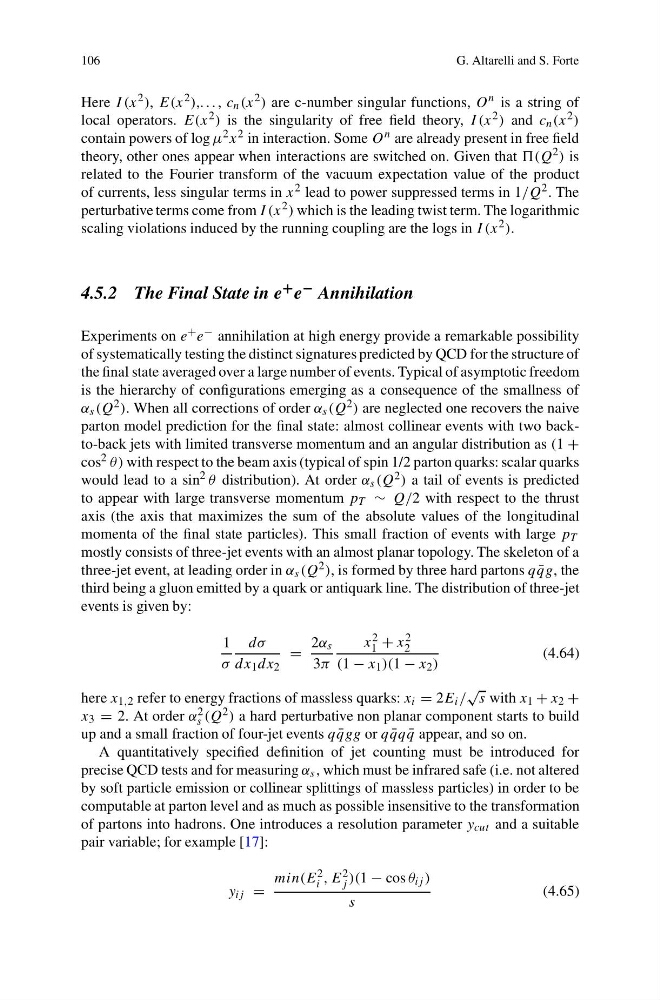
third being a gluon emitted by a quark or antiquark line. The distribution of three-jet
events is given by:
1
σ
dσ
dx 1 dx 2
=
2α s
3π
x 2
1 + x 2
2
(1 − x 1 )(1 − x 2 )
(4.64)
here x 1,2 refer to energy fractions of massless quarks: x i = 2E i /
√
s with x 1 + x 2 +
x 3 = 2. At order α 2
s (Q 2 ) a hard perturbative non planar component starts to build
up and a small fraction of four-jet events q ¯
qgg or q ¯
qq ¯
q appear, and so on.
A quantitatively specified definition of jet counting must be introduced for
precise QCD tests and for measuring α s , which must be infrared safe (i.e. not altered
by soft particle emission or collinear splittings of massless particles) in order to be
computable at parton level and as much as possible insensitive to the transformation
of partons into hadrons. One introduces a resolution parameter y cut and a suitable
pair variable; for example [17]:
y ij =
min(E 2
i , E 2
j )(1 − cos θ ij )
s
(4.65)
G. Altarelli and S. Forte
Here I (x 2 ), E(x 2 ),. . . , c n (x 2 ) are c-number singular functions, O n is a string of
local operators. E(x 2 ) is the singularity of free field theory, I (x 2 ) and c n (x 2 )
contain powers of log μ 2 x 2 in interaction. Some O n are already present in free field
theory, other ones appear when interactions are switched on. Given that (Q 2 ) is
related to the Fourier transform of the vacuum expectation value of the product
of currents, less singular terms in x 2 lead to power suppressed terms in 1/Q 2 . The
perturbative terms come from I (x 2 ) which is the leading twist term. The logarithmic
scaling violations induced by the running coupling are the logs in I (x 2 ).
4.5.2 The Final State in e + e − Annihilation
Experiments on e + e − annihilation at high energy provide a remarkable possibility
of systematically testing the distinct signatures predicted by QCD for the structure of
the final state averaged over a large number of events. Typical of asymptotic freedom
is the hierarchy of configurations emerging as a consequence of the smallness of
α s (Q 2 ). When all corrections of order α s (Q 2 ) are neglected one recovers the naive
parton model prediction for the final state: almost collinear events with two backto-back jets with limited transverse momentum and an angular distribution as (1 +
cos 2 θ) with respect to the beam axis (typical of spin 1/2 parton quarks: scalar quarks
would lead to a sin
2 θ distribution). At order α s (Q 2 ) a tail of events is predicted
to appear with large transverse momentum p T ∼ Q/2 with respect to the thrust
axis (the axis that maximizes the sum of the absolute values of the longitudinal
momenta of the final state particles). This small fraction of events with large p T
mostly consists of three-jet events with an almost planar topology. The skeleton of a
three-jet event, at leading order in α s (Q 2 ), is formed by three hard partons q ¯
qg, the
third being a gluon emitted by a quark or antiquark line. The distribution of three-jet
events is given by:
1
σ
dσ
dx 1 dx 2
=
2α s
3π
x 2
1 + x 2
2
(1 − x 1 )(1 − x 2 )
(4.64)
here x 1,2 refer to energy fractions of massless quarks: x i = 2E i /
√
s with x 1 + x 2 +
x 3 = 2. At order α 2
s (Q 2 ) a hard perturbative non planar component starts to build
up and a small fraction of four-jet events q ¯
qgg or q ¯
qq ¯
q appear, and so on.
A quantitatively specified definition of jet counting must be introduced for
precise QCD tests and for measuring α s , which must be infrared safe (i.e. not altered
by soft particle emission or collinear splittings of massless particles) in order to be
computable at parton level and as much as possible insensitive to the transformation
of partons into hadrons. One introduces a resolution parameter y cut and a suitable
pair variable; for example [17]:
y ij =
min(E 2
i , E 2
j )(1 − cos θ ij )
s
(4.65)