

4 QCD: The Theory of Strong Interactions
107
The particles i,j belong to different jets for y ij > y cut . Clearly the number of jets
becomes a function of y cut : there are more jets for smaller y cut . Measurements of
α s (Q 2 ) have been performed starting from jet multiplicities, the largest error coming
from the necessity of correcting for non-perturbative hadronisation effects.
4.5.3 Deep Inelastic Scattering
Deep Inelastic Scattering (DIS) processes have played and still play a very important
role for our understanding of QCD and of nucleon structure. This set of processes
actually provides us with a rich laboratory for theory and experiment. There are
several structure functions that can be studied, F i (x, Q 2 ), each a function of two
variables. This is true separately for different beams and targets and different
polarizations. Depending on the charges of l and l’ (see Eq. (4.13)) we can have
neutral currents (γ ,Z) or charged currents in the l-l’ channel (Fig. 4.6). In the past
DIS processes were crucial for establishing QCD as the theory of strong interactions
and quarks and gluons as the QCD partons. At present DIS remains very important
for quantitative studies and tests of QCD. The theory of scaling violations for totally
inclusive DIS structure functions, based on operator expansion or diagrammatic
techniques and renormalisation group methods, is crystal clear and the predicted
Q 2 dependence can be tested at each value of x. The measurement of quark and
gluon densities in the nucleon, as functions of x at some reference value of Q 2 ,
which is an essential starting point for the calculation of all relevant hadronic hard
processes, is performed in DIS processes. At the same time one measures α s (Q 2 )
and the DIS values of the running coupling can be compared with those obtained
from other processes. At all times new theoretical challenges arise from the study of
DIS processes. Recent examples are the so-called “spin crisis” in polarized DIS and
the behaviour of singlet structure functions at small x as revealed by HERA data. In
the following we will review the past successes and the present open problems in
the physics of DIS.
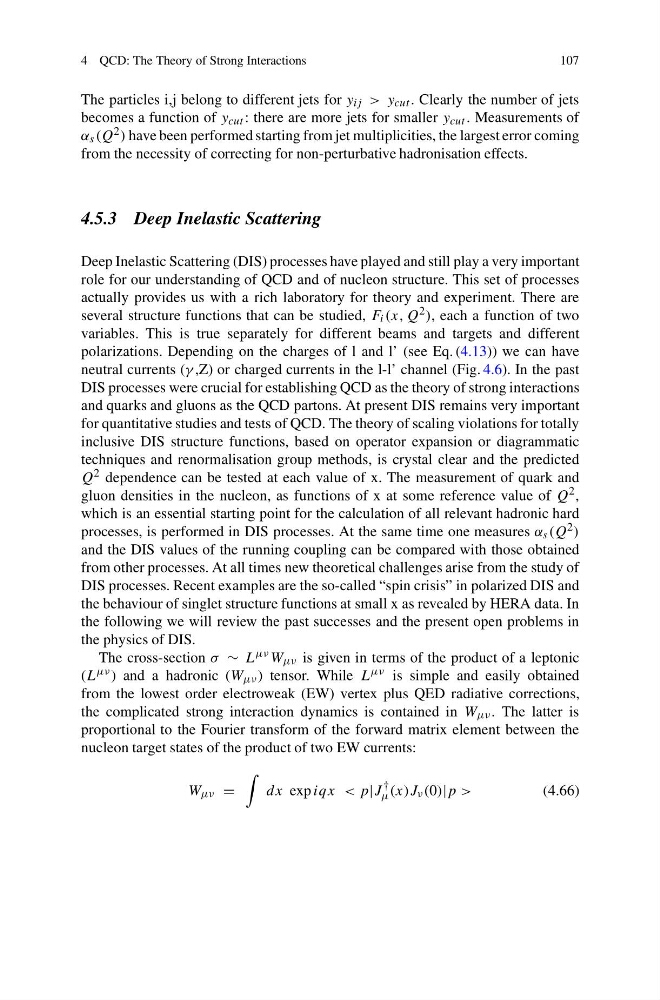
The cross-section σ ∼ L μν W μν is given in terms of the product of a leptonic
(L μν ) and a hadronic (W μν ) tensor. While L μν is simple and easily obtained
from the lowest order electroweak (EW) vertex plus QED radiative corrections,
the complicated strong interaction dynamics is contained in W μν . The latter is
proportional to the Fourier transform of the forward matrix element between the
nucleon target states of the product of two EW currents:
W μν =
dx exp iqx < p|J
†
μ (x)J ν (0)|p >
(4.66)
107
The particles i,j belong to different jets for y ij > y cut . Clearly the number of jets
becomes a function of y cut : there are more jets for smaller y cut . Measurements of
α s (Q 2 ) have been performed starting from jet multiplicities, the largest error coming
from the necessity of correcting for non-perturbative hadronisation effects.
4.5.3 Deep Inelastic Scattering
Deep Inelastic Scattering (DIS) processes have played and still play a very important
role for our understanding of QCD and of nucleon structure. This set of processes
actually provides us with a rich laboratory for theory and experiment. There are
several structure functions that can be studied, F i (x, Q 2 ), each a function of two
variables. This is true separately for different beams and targets and different
polarizations. Depending on the charges of l and l’ (see Eq. (4.13)) we can have
neutral currents (γ ,Z) or charged currents in the l-l’ channel (Fig. 4.6). In the past
DIS processes were crucial for establishing QCD as the theory of strong interactions
and quarks and gluons as the QCD partons. At present DIS remains very important
for quantitative studies and tests of QCD. The theory of scaling violations for totally
inclusive DIS structure functions, based on operator expansion or diagrammatic
techniques and renormalisation group methods, is crystal clear and the predicted
Q 2 dependence can be tested at each value of x. The measurement of quark and
gluon densities in the nucleon, as functions of x at some reference value of Q 2 ,
which is an essential starting point for the calculation of all relevant hadronic hard
processes, is performed in DIS processes. At the same time one measures α s (Q 2 )
and the DIS values of the running coupling can be compared with those obtained
from other processes. At all times new theoretical challenges arise from the study of
DIS processes. Recent examples are the so-called “spin crisis” in polarized DIS and
the behaviour of singlet structure functions at small x as revealed by HERA data. In
the following we will review the past successes and the present open problems in
the physics of DIS.
The cross-section σ ∼ L μν W μν is given in terms of the product of a leptonic
(L μν ) and a hadronic (W μν ) tensor. While L μν is simple and easily obtained
from the lowest order electroweak (EW) vertex plus QED radiative corrections,
the complicated strong interaction dynamics is contained in W μν . The latter is
proportional to the Fourier transform of the forward matrix element between the
nucleon target states of the product of two EW currents:
W μν =
dx exp iqx < p|J
†
μ (x)J ν (0)|p >
(4.66)