

28
2 Results and Discussion
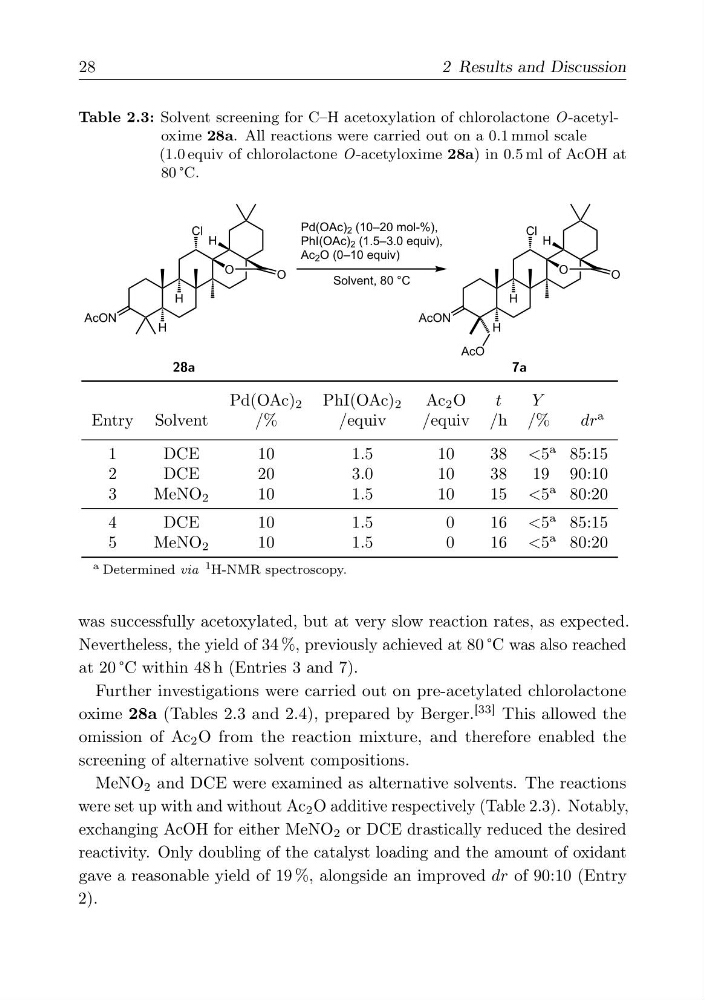
Table 2.3: Solvent screening for C–H acetoxylation of chlorolactone O -acetyloxime 28a. All reactions were carried out on a 0.1 mmol scale
(1.0 equiv of chlorolactone O -acetyloxime 28a) in 0.5 ml of AcOH at
80 °C.
AcON
H
H
O
H
Cl
O
H
AcO
H
O
H
Cl
O
AcON
Solvent, 80 °C
Pd(OAc) 2 (10–20 mol-%),
PhI(OAc) 2 (1.5–3.0 equiv),
Ac 2 O (0–10 equiv)
28a
7a
Entry Solvent
Pd(OAc) 2
/%
PhI(OAc) 2
/equiv
Ac 2 O
/equiv
t
/h
Y
/%
dr
a
1
DCE
10
1.5
10
38 <5
a 85:15
2
DCE
20
3.0
10
38
19 90:10
3
MeNO 2
10
1.5
10
15 <5
a 80:20
4
DCE
10
1.5
0
16 <5
a 85:15
5
MeNO 2
10
1.5
0
16 <5
a 80:20
a Determined via
1
H-NMR spectroscopy.
was successfully acetoxylated, but at very slow reaction rates, as expected.
Nevertheless, the yield of 34 %, previously achieved at 80 °C was also reached
at 20 °C within 48 h (Entries 3 and 7).
Further investigations were carried out on pre-acetylated chlorolactone
oxime 28a (Tables 2.3 and 2.4), prepared by Berger.
[33] This allowed the
omission of Ac 2 O from the reaction mixture, and therefore enabled the
screening of alternative solvent compositions.
MeNO 2 and DCE were examined as alternative solvents. The reactions
were set up with and without Ac 2 O additive respectively (Table 2.3). Notably,
exchanging AcOH for either MeNO 2 or DCE drastically reduced the desired
reactivity. Only doubling of the catalyst loading and the amount of oxidant
gave a reasonable yield of 19 %, alongside an improved dr of 90:10 (Entry
2).
2 Results and Discussion
Table 2.3: Solvent screening for C–H acetoxylation of chlorolactone O -acetyloxime 28a. All reactions were carried out on a 0.1 mmol scale
(1.0 equiv of chlorolactone O -acetyloxime 28a) in 0.5 ml of AcOH at
80 °C.
AcON
H
H
O
H
Cl
O
H
AcO
H
O
H
Cl
O
AcON
Solvent, 80 °C
Pd(OAc) 2 (10–20 mol-%),
PhI(OAc) 2 (1.5–3.0 equiv),
Ac 2 O (0–10 equiv)
28a
7a
Entry Solvent
Pd(OAc) 2
/%
PhI(OAc) 2
/equiv
Ac 2 O
/equiv
t
/h
Y
/%
dr
a
1
DCE
10
1.5
10
38 <5
a 85:15
2
DCE
20
3.0
10
38
19 90:10
3
MeNO 2
10
1.5
10
15 <5
a 80:20
4
DCE
10
1.5
0
16 <5
a 85:15
5
MeNO 2
10
1.5
0
16 <5
a 80:20
a Determined via
1
H-NMR spectroscopy.
was successfully acetoxylated, but at very slow reaction rates, as expected.
Nevertheless, the yield of 34 %, previously achieved at 80 °C was also reached
at 20 °C within 48 h (Entries 3 and 7).
Further investigations were carried out on pre-acetylated chlorolactone
oxime 28a (Tables 2.3 and 2.4), prepared by Berger.
[33] This allowed the
omission of Ac 2 O from the reaction mixture, and therefore enabled the
screening of alternative solvent compositions.
MeNO 2 and DCE were examined as alternative solvents. The reactions
were set up with and without Ac 2 O additive respectively (Table 2.3). Notably,
exchanging AcOH for either MeNO 2 or DCE drastically reduced the desired
reactivity. Only doubling of the catalyst loading and the amount of oxidant
gave a reasonable yield of 19 %, alongside an improved dr of 90:10 (Entry
2).