

2.3 Optimisation of the Synthetic Sequence
29
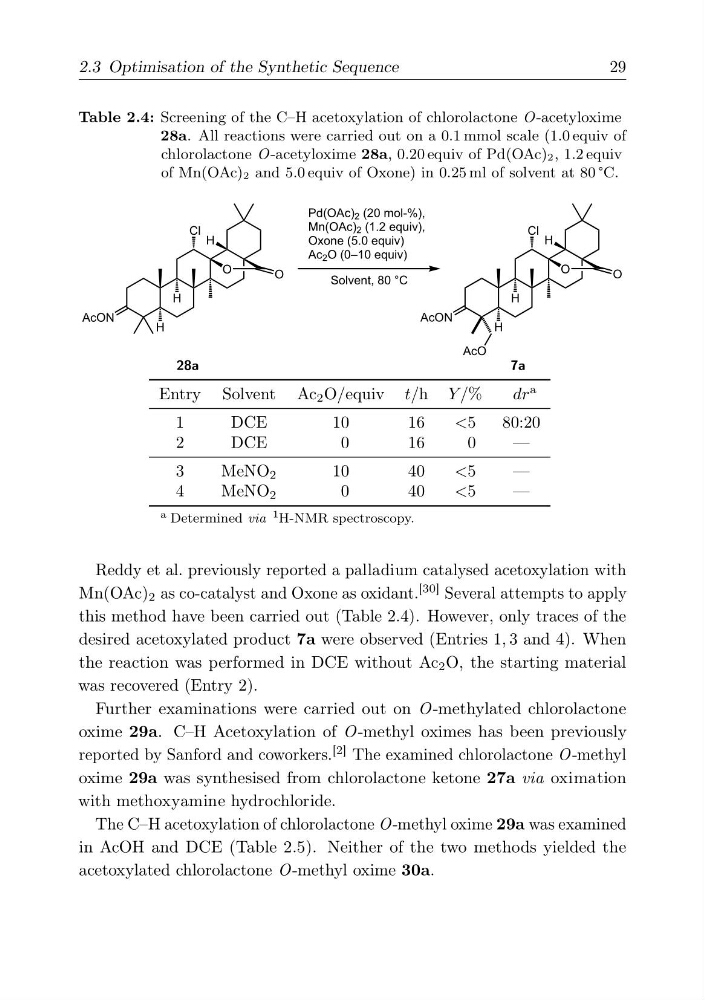
Table 2.4: Screening of the C–H acetoxylation of chlorolactone O -acetyloxime
28a. All reactions were carried out on a 0.1 mmol scale (1.0 equiv of
chlorolactone O -acetyloxime 28a, 0.20 equiv of Pd(OAc)2, 1.2 equiv
of Mn(OAc)2 and 5.0 equiv of Oxone) in 0.25 ml of solvent at 80 °C.
AcON
H
H
O
H
Cl
O
H
AcO
H
O
H
Cl
O
AcON
Solvent, 80 °C
Pd(OAc) 2 (20 mol-%),
Mn(OAc) 2 (1.2 equiv),
Oxone (5.0 equiv)
Ac 2 O (0–10 equiv)
28a
7a
Entry Solvent Ac 2 O/equiv t/h Y /%
dr
a
1
DCE
10
16
<5
80:20
2
DCE
0
16
0
—
3
MeNO 2
10
40
<5
—
4
MeNO 2
0
4 0
<5
—
a Determined via
1
H-NMR spectroscopy.
Reddy et al. previously reported a palladium catalysed acetoxylation with
Mn(OAc) 2 as co-catalyst and Oxone as oxidant.
[30] Several attempts to apply
this method have been carried out (Table 2.4). However, only traces of the
desired acetoxylated product 7a were observed (Entries 1, 3 and 4). When
the reaction was performed in DCE without Ac 2 O, the starting material
was recovered (Entry 2).
Further examinations were carried out on O -methylated chlorolactone
oxime 29a. C–H Acetoxylation of O -methyl oximes has been previously
reported by Sanford and coworkers.
[2] The examined chlorolactone O -methyl
oxime 29a was synthesised from chlorolactone ketone 27a via oximation
with methoxyamine hydrochloride.
The C–H acetoxylation of chlorolactone O -methyl oxime 29a was examined
in AcOH and DCE (Table 2.5). Neither of the two methods yielded the
acetoxylated chlorolactone O -methyl oxime 30a.
29
Table 2.4: Screening of the C–H acetoxylation of chlorolactone O -acetyloxime
28a. All reactions were carried out on a 0.1 mmol scale (1.0 equiv of
chlorolactone O -acetyloxime 28a, 0.20 equiv of Pd(OAc)2, 1.2 equiv
of Mn(OAc)2 and 5.0 equiv of Oxone) in 0.25 ml of solvent at 80 °C.
AcON
H
H
O
H
Cl
O
H
AcO
H
O
H
Cl
O
AcON
Solvent, 80 °C
Pd(OAc) 2 (20 mol-%),
Mn(OAc) 2 (1.2 equiv),
Oxone (5.0 equiv)
Ac 2 O (0–10 equiv)
28a
7a
Entry Solvent Ac 2 O/equiv t/h Y /%
dr
a
1
DCE
10
16
<5
80:20
2
DCE
0
16
0
—
3
MeNO 2
10
40
<5
—
4
MeNO 2
0
4 0
<5
—
a Determined via
1
H-NMR spectroscopy.
Reddy et al. previously reported a palladium catalysed acetoxylation with
Mn(OAc) 2 as co-catalyst and Oxone as oxidant.
[30] Several attempts to apply
this method have been carried out (Table 2.4). However, only traces of the
desired acetoxylated product 7a were observed (Entries 1, 3 and 4). When
the reaction was performed in DCE without Ac 2 O, the starting material
was recovered (Entry 2).
Further examinations were carried out on O -methylated chlorolactone
oxime 29a. C–H Acetoxylation of O -methyl oximes has been previously
reported by Sanford and coworkers.
[2] The examined chlorolactone O -methyl
oxime 29a was synthesised from chlorolactone ketone 27a via oximation
with methoxyamine hydrochloride.
The C–H acetoxylation of chlorolactone O -methyl oxime 29a was examined
in AcOH and DCE (Table 2.5). Neither of the two methods yielded the
acetoxylated chlorolactone O -methyl oxime 30a.