

2.3 Optimisation of the Synthetic Sequence
25
NH
O
O
N
N
N
OH
HO
OH
N
O
O
N
N
N
O
O
O
Cl
Cl
Cl
+
+
Cl
3
3
Scheme 2.15: Proposed chlorination of succinimide.
these steps has reported yields. Treatment with hydroxylamine hydrochloride gave the oxime 6b in 91 % yield from bromolactone ketone 27b.
Alternative conditions for lactonisation and oxidation have been reported
by Elsayed et al. and Rivero-Chan et al., respectively. The former used N -bromosuccinimide (NBS) to form bromolactone alcohol 26b in a yield of 76 %.
[45]
The latter synthesised bromolactone ketone 27b via Jones oxidation.
[41]
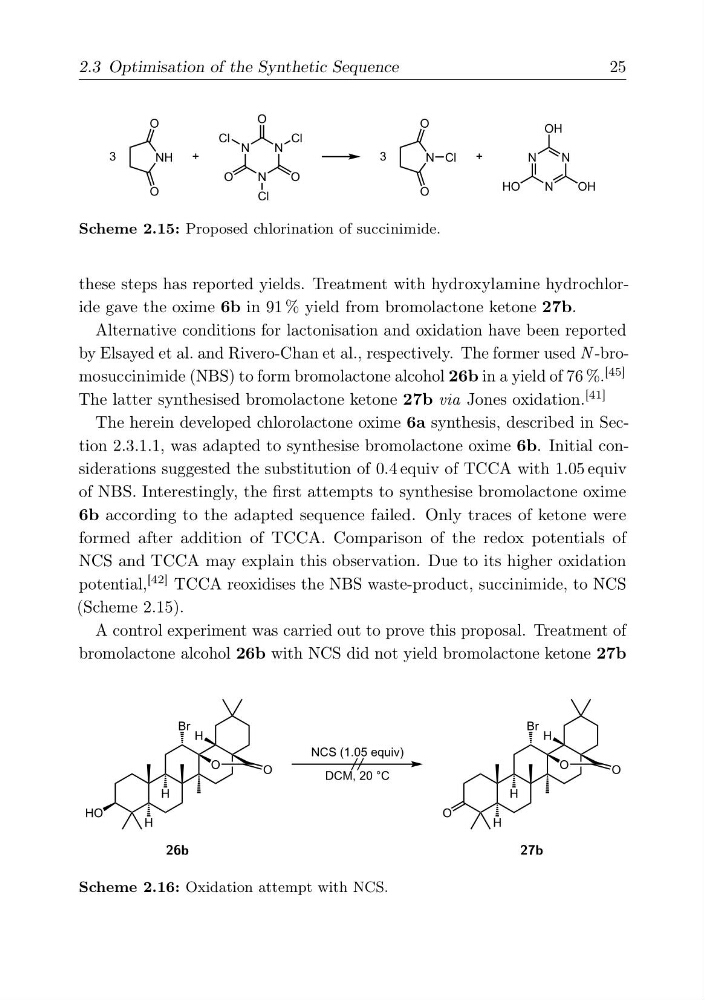
The herein developed chlorolactone oxime 6a synthesis, described in Section 2.3.1.1, was adapted to synthesise bromolactone oxime 6b. Initial considerations suggested the substitution of 0.4 equiv of TCCA with 1.05 equiv
of NBS. Interestingly, the first attempts to synthesise bromolactone oxime
6b according to the adapted sequence failed. Only traces of ketone were
formed after addition of TCCA. Comparison of the redox potentials of
NCS and TCCA may explain this observation. Due to its higher oxidation
potential,
[42] TCCA reoxidises the NBS waste-product, succinimide, to NCS
(Scheme 2.15).
A control experiment was carried out to prove this proposal. Treatment of
bromolactone alcohol 26b with NCS did not yield bromolactone ketone 27b
HO
H
H
O
H
O
H
H
O
H
Br
O
Br
O
NCS (1.05 equiv)
DCM, 20 °C
26b
27b
Scheme 2.16: Oxidation attempt with NCS.
25
NH
O
O
N
N
N
OH
HO
OH
N
O
O
N
N
N
O
O
O
Cl
Cl
Cl
+
+
Cl
3
3
Scheme 2.15: Proposed chlorination of succinimide.
these steps has reported yields. Treatment with hydroxylamine hydrochloride gave the oxime 6b in 91 % yield from bromolactone ketone 27b.
Alternative conditions for lactonisation and oxidation have been reported
by Elsayed et al. and Rivero-Chan et al., respectively. The former used N -bromosuccinimide (NBS) to form bromolactone alcohol 26b in a yield of 76 %.
[45]
The latter synthesised bromolactone ketone 27b via Jones oxidation.
[41]
The herein developed chlorolactone oxime 6a synthesis, described in Section 2.3.1.1, was adapted to synthesise bromolactone oxime 6b. Initial considerations suggested the substitution of 0.4 equiv of TCCA with 1.05 equiv
of NBS. Interestingly, the first attempts to synthesise bromolactone oxime
6b according to the adapted sequence failed. Only traces of ketone were
formed after addition of TCCA. Comparison of the redox potentials of
NCS and TCCA may explain this observation. Due to its higher oxidation
potential,
[42] TCCA reoxidises the NBS waste-product, succinimide, to NCS
(Scheme 2.15).
A control experiment was carried out to prove this proposal. Treatment of
bromolactone alcohol 26b with NCS did not yield bromolactone ketone 27b
HO
H
H
O
H
O
H
H
O
H
Br
O
Br
O
NCS (1.05 equiv)
DCM, 20 °C
26b
27b
Scheme 2.16: Oxidation attempt with NCS.