

2.3 Optimisation of the Synthetic Sequence
23
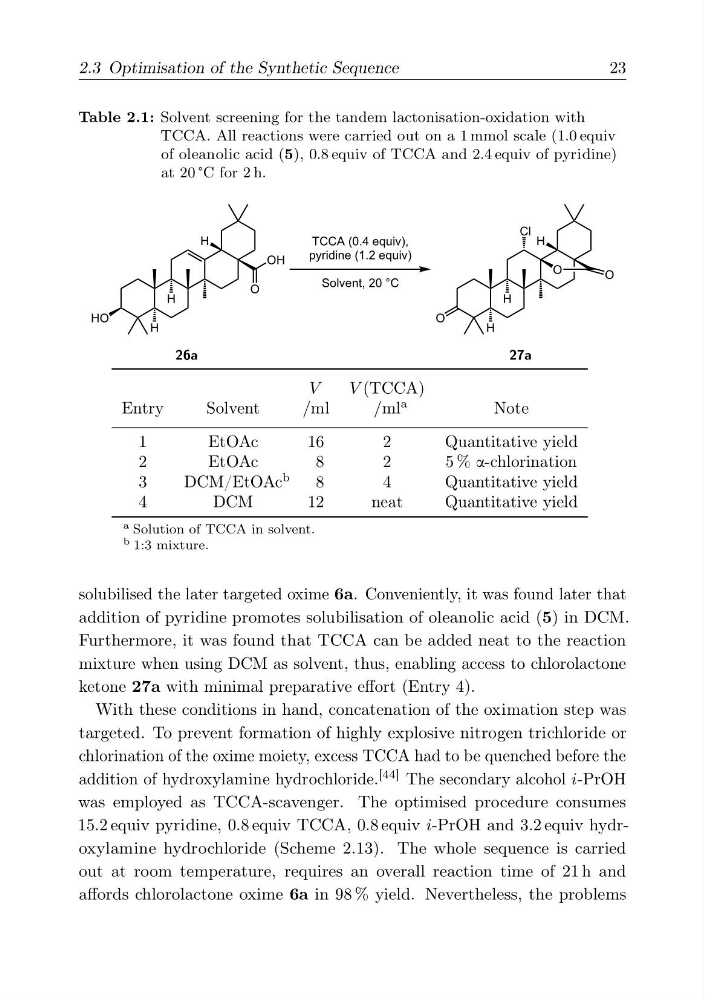
Table 2.1: Solvent screening for the tandem lactonisation-oxidation with
TCCA. All reactions were carried out on a 1 mmol scale (1.0 equiv
of oleanolic acid (5), 0.8 equiv of TCCA and 2.4 equiv of pyridine)
at 20 °C for 2 h.
HO
H
H
O
H
O
H
H
O
H
Cl
O
OH
TCCA (0.4 equiv),
pyridine (1.2 equiv)
Solvent, 20 °C
26a
27a
Entry
Solvent
V
/ml
V (TCCA)
/ml
a
Note
1
EtOAc
16
2
Quantitative yield
2
EtOAc
8
2
5 % α-chlorination
3
DCM/EtOAc
b
8
4
Quantitative yield
4
DCM
12
neat
Quantitative yield
a Solution of TCCA in solvent.
b 1:3 mixture.
solubilised the later targeted oxime 6a. Conveniently, it was found later that
addition of pyridine promotes solubilisation of oleanolic acid (5) in DCM.
Furthermore, it was found that TCCA can be added neat to the reaction
mixture when using DCM as solvent, thus, enabling access to chlorolactone
ketone 27a with minimal preparative effort (Entry 4).
With these conditions in hand, concatenation of the oximation step was
targeted. To prevent formation of highly explosive nitrogen trichloride or
chlorination of the oxime moiety, excess TCCA had to be quenched before the
addition of hydroxylamine hydrochloride.
[44] The secondary alcohol i-PrOH
was employed as TCCA-scavenger. The optimised procedure consumes
15.2 equiv pyridine, 0.8 equiv TCCA, 0.8 equiv i-PrOH and 3.2 equiv hydroxylamine hydrochloride (Scheme 2.13). The whole sequence is carried
out at room temperature, requires an overall reaction time of 21 h and
affords chlorolactone oxime 6a in 98 % yield. Nevertheless, the problems
23
Table 2.1: Solvent screening for the tandem lactonisation-oxidation with
TCCA. All reactions were carried out on a 1 mmol scale (1.0 equiv
of oleanolic acid (5), 0.8 equiv of TCCA and 2.4 equiv of pyridine)
at 20 °C for 2 h.
HO
H
H
O
H
O
H
H
O
H
Cl
O
OH
TCCA (0.4 equiv),
pyridine (1.2 equiv)
Solvent, 20 °C
26a
27a
Entry
Solvent
V
/ml
V (TCCA)
/ml
a
Note
1
EtOAc
16
2
Quantitative yield
2
EtOAc
8
2
5 % α-chlorination
3
DCM/EtOAc
b
8
4
Quantitative yield
4
DCM
12
neat
Quantitative yield
a Solution of TCCA in solvent.
b 1:3 mixture.
solubilised the later targeted oxime 6a. Conveniently, it was found later that
addition of pyridine promotes solubilisation of oleanolic acid (5) in DCM.
Furthermore, it was found that TCCA can be added neat to the reaction
mixture when using DCM as solvent, thus, enabling access to chlorolactone
ketone 27a with minimal preparative effort (Entry 4).
With these conditions in hand, concatenation of the oximation step was
targeted. To prevent formation of highly explosive nitrogen trichloride or
chlorination of the oxime moiety, excess TCCA had to be quenched before the
addition of hydroxylamine hydrochloride.
[44] The secondary alcohol i-PrOH
was employed as TCCA-scavenger. The optimised procedure consumes
15.2 equiv pyridine, 0.8 equiv TCCA, 0.8 equiv i-PrOH and 3.2 equiv hydroxylamine hydrochloride (Scheme 2.13). The whole sequence is carried
out at room temperature, requires an overall reaction time of 21 h and
affords chlorolactone oxime 6a in 98 % yield. Nevertheless, the problems