

22
2 Results and Discussion
HO
H
H
O
H
O
H
H
O
H
Cl
O
EtOAc, 20 °C
(quant)
(iib)
Cl
O
TCCA (0.4 equiv),
pyridine (1.2 eq)
26a
27a
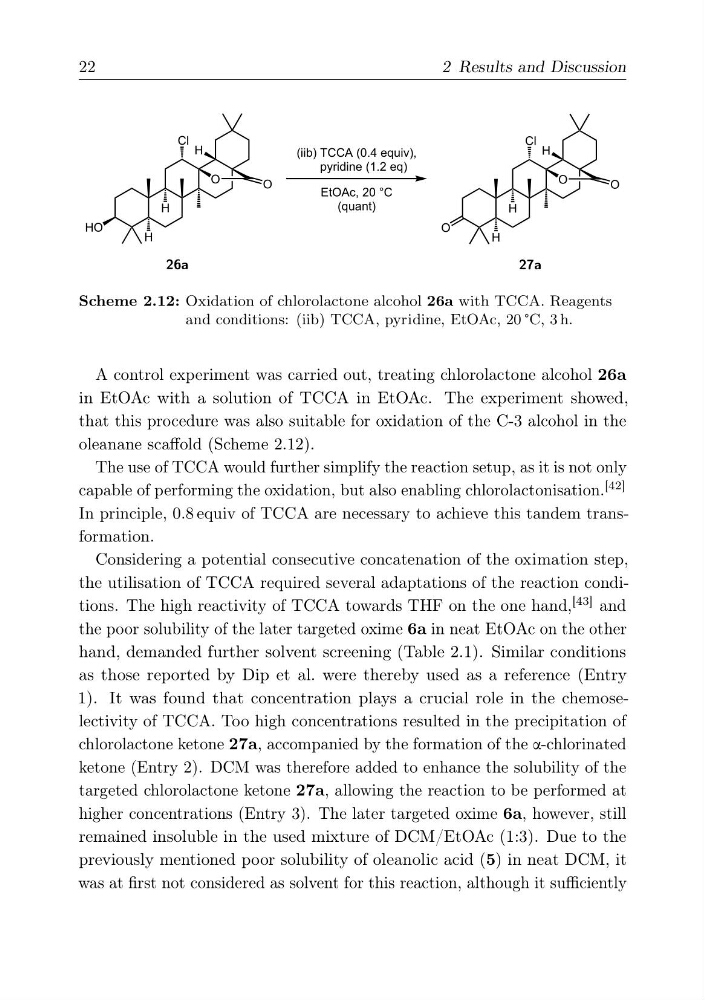
Scheme 2.12: Oxidation of chlorolactone alcohol 26a with TCCA. Reagents
and conditions: (iib) TCCA, pyridine, EtOAc, 20 °C, 3 h.
A control experiment was carried out, treating chlorolactone alcohol 26a
in EtOAc with a solution of TCCA in EtOAc. The experiment showed,
that this procedure was also suitable for oxidation of the C-3 alcohol in the
oleanane scaffold (Scheme 2.12).
The use of TCCA would further simplify the reaction setup, as it is not only
capable of performing the oxidation, but also enabling chlorolactonisation.
[42]
In principle, 0.8 equiv of TCCA are necessary to achieve this tandem transformation.
Considering a potential consecutive concatenation of the oximation step,
the utilisation of TCCA required several adaptations of the reaction conditions. The high reactivity of TCCA towards THF on the one hand,
[43] and
the poor solubility of the later targeted oxime 6a in neat EtOAc on the other
hand, demanded further solvent screening (Table 2.1). Similar conditions
as those reported by Dip et al. were thereby used as a reference (Entry
1). It was found that concentration plays a crucial role in the chemoselectivity of TCCA. Too high concentrations resulted in the precipitation of
chlorolactone ketone 27a, accompanied by the formation of the α-chlorinated
ketone (Entry 2). DCM was therefore added to enhance the solubility of the
targeted chlorolactone ketone 27a, allowing the reaction to be performed at
higher concentrations (Entry 3). The later targeted oxime 6a, however, still
remained insoluble in the used mixture of DCM/EtOAc (1:3). Due to the
previously mentioned poor solubility of oleanolic acid (5) in neat DCM, it
was at first not considered as solvent for this reaction, although it sufficiently
2 Results and Discussion
HO
H
H
O
H
O
H
H
O
H
Cl
O
EtOAc, 20 °C
(quant)
(iib)
Cl
O
TCCA (0.4 equiv),
pyridine (1.2 eq)
26a
27a
Scheme 2.12: Oxidation of chlorolactone alcohol 26a with TCCA. Reagents
and conditions: (iib) TCCA, pyridine, EtOAc, 20 °C, 3 h.
A control experiment was carried out, treating chlorolactone alcohol 26a
in EtOAc with a solution of TCCA in EtOAc. The experiment showed,
that this procedure was also suitable for oxidation of the C-3 alcohol in the
oleanane scaffold (Scheme 2.12).
The use of TCCA would further simplify the reaction setup, as it is not only
capable of performing the oxidation, but also enabling chlorolactonisation.
[42]
In principle, 0.8 equiv of TCCA are necessary to achieve this tandem transformation.
Considering a potential consecutive concatenation of the oximation step,
the utilisation of TCCA required several adaptations of the reaction conditions. The high reactivity of TCCA towards THF on the one hand,
[43] and
the poor solubility of the later targeted oxime 6a in neat EtOAc on the other
hand, demanded further solvent screening (Table 2.1). Similar conditions
as those reported by Dip et al. were thereby used as a reference (Entry
1). It was found that concentration plays a crucial role in the chemoselectivity of TCCA. Too high concentrations resulted in the precipitation of
chlorolactone ketone 27a, accompanied by the formation of the α-chlorinated
ketone (Entry 2). DCM was therefore added to enhance the solubility of the
targeted chlorolactone ketone 27a, allowing the reaction to be performed at
higher concentrations (Entry 3). The later targeted oxime 6a, however, still
remained insoluble in the used mixture of DCM/EtOAc (1:3). Due to the
previously mentioned poor solubility of oleanolic acid (5) in neat DCM, it
was at first not considered as solvent for this reaction, although it sufficiently