

2.3 Optimisation of the Synthetic Sequence
19
HO
H
H
OH
O
H
O
H
H
O
H
Cl
O
THF, 60 °C
(quant)
(IIa)
(b)
NCS (1.05 equiv)
PCC (2.00 equiv)
5
27a
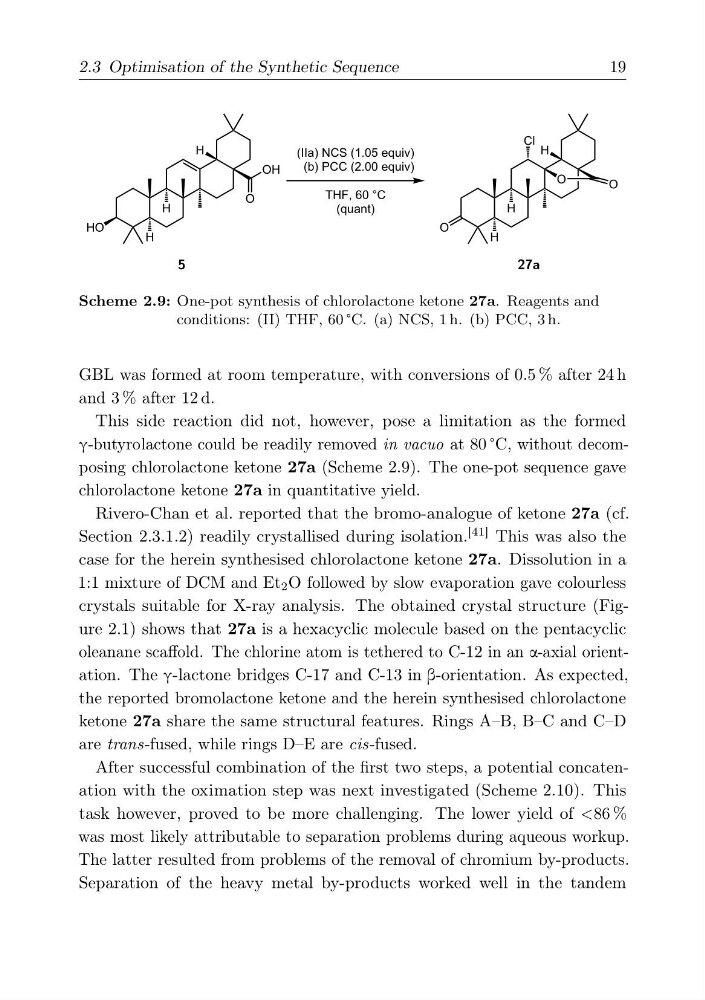
Scheme 2.9: One-pot synthesis of chlorolactone ketone 27a. Reagents and
conditions: (II) THF, 60 °C. (a) NCS, 1 h. (b) PCC, 3 h.
GBL was formed at room temperature, with conversions of 0.5 % after 24 h
and 3 % after 12 d.
This side reaction did not, however, pose a limitation as the formed
γ-butyrolactone could be readily removed in vacuo at 80 °C, without decomposing chlorolactone ketone 27a (Scheme 2.9). The one-pot sequence gave
chlorolactone ketone 27a in quantitative yield.
Rivero-Chan et al. reported that the bromo-analogue of ketone 27a (cf.
Section 2.3.1.2) readily crystallised during isolation.
[41] This was also the
case for the herein synthesised chlorolactone ketone 27a. Dissolution in a
1:1 mixture of DCM and Et 2 O followed by slow evaporation gave colourless
crystals suitable for X-ray analysis. The obtained crystal structure (Figure 2.1) shows that 27a is a hexacyclic molecule based on the pentacyclic
oleanane scaffold. The chlorine atom is tethered to C-12 in an α-axial orientation. The γ-lactone bridges C-17 and C-13 in β-orientation. As expected,
the reported bromolactone ketone and the herein synthesised chlorolactone
ketone 27a share the same structural features. Rings A–B, B–C and C–D
are trans-fused, while rings D–E are cis-fused.
After successful combination of the first two steps, a potential concatenation with the oximation step was next investigated (Scheme 2.10). This
task however, proved to be more challenging. The lower yield of <86 %
was most likely attributable to separation problems during aqueous workup.
The latter resulted from problems of the removal of chromium by-products.
Separation of the heavy metal by-products worked well in the tandem
19
HO
H
H
OH
O
H
O
H
H
O
H
Cl
O
THF, 60 °C
(quant)
(IIa)
(b)
NCS (1.05 equiv)
PCC (2.00 equiv)
5
27a
Scheme 2.9: One-pot synthesis of chlorolactone ketone 27a. Reagents and
conditions: (II) THF, 60 °C. (a) NCS, 1 h. (b) PCC, 3 h.
GBL was formed at room temperature, with conversions of 0.5 % after 24 h
and 3 % after 12 d.
This side reaction did not, however, pose a limitation as the formed
γ-butyrolactone could be readily removed in vacuo at 80 °C, without decomposing chlorolactone ketone 27a (Scheme 2.9). The one-pot sequence gave
chlorolactone ketone 27a in quantitative yield.
Rivero-Chan et al. reported that the bromo-analogue of ketone 27a (cf.
Section 2.3.1.2) readily crystallised during isolation.
[41] This was also the
case for the herein synthesised chlorolactone ketone 27a. Dissolution in a
1:1 mixture of DCM and Et 2 O followed by slow evaporation gave colourless
crystals suitable for X-ray analysis. The obtained crystal structure (Figure 2.1) shows that 27a is a hexacyclic molecule based on the pentacyclic
oleanane scaffold. The chlorine atom is tethered to C-12 in an α-axial orientation. The γ-lactone bridges C-17 and C-13 in β-orientation. As expected,
the reported bromolactone ketone and the herein synthesised chlorolactone
ketone 27a share the same structural features. Rings A–B, B–C and C–D
are trans-fused, while rings D–E are cis-fused.
After successful combination of the first two steps, a potential concatenation with the oximation step was next investigated (Scheme 2.10). This
task however, proved to be more challenging. The lower yield of <86 %
was most likely attributable to separation problems during aqueous workup.
The latter resulted from problems of the removal of chromium by-products.
Separation of the heavy metal by-products worked well in the tandem