

18
2 Results and Discussion
2.3 Optimisation of the Synthetic Sequence
2.3.1 Halolactone Oxime
2.3.1.1 Chlorolactone Oxime
As multiple single steps consume not only more solvents, but also more
time during necessary aqueous workup, possible multi-step one-pot reactions
are preferred.
[37,38] To optimise the synthesis of chlorolactone oxime 6a
(Section 2.2.1.1) in terms of step economy, the initial 3-step sequence was
examined.
Analysing the first two steps, no conflicting reactivity was anticipated
between the chlorination by-product, succinimide, and PCC. Furthermore,
oxidation with chromium(VI) in DMF has been reported previously.
[39]
However, it was found that the oxidation in DMF proceeds much slower.
Even when using 3 equiv of oxidant and heating to 80 °C the reaction did
not reach full conversion in a less than 24 h. Trace amounts of residual DMF
further complicated the removal of chromium(IV) waste-products. When
using DCM as solvent, these can normally be removed by precipitation with
Et 2 O and subsequent filtration through Florisil.
[40] Nevertheless, the use
of DCM as alternative solvent was not considered as it does not solubilise
oleanolic acid (5).
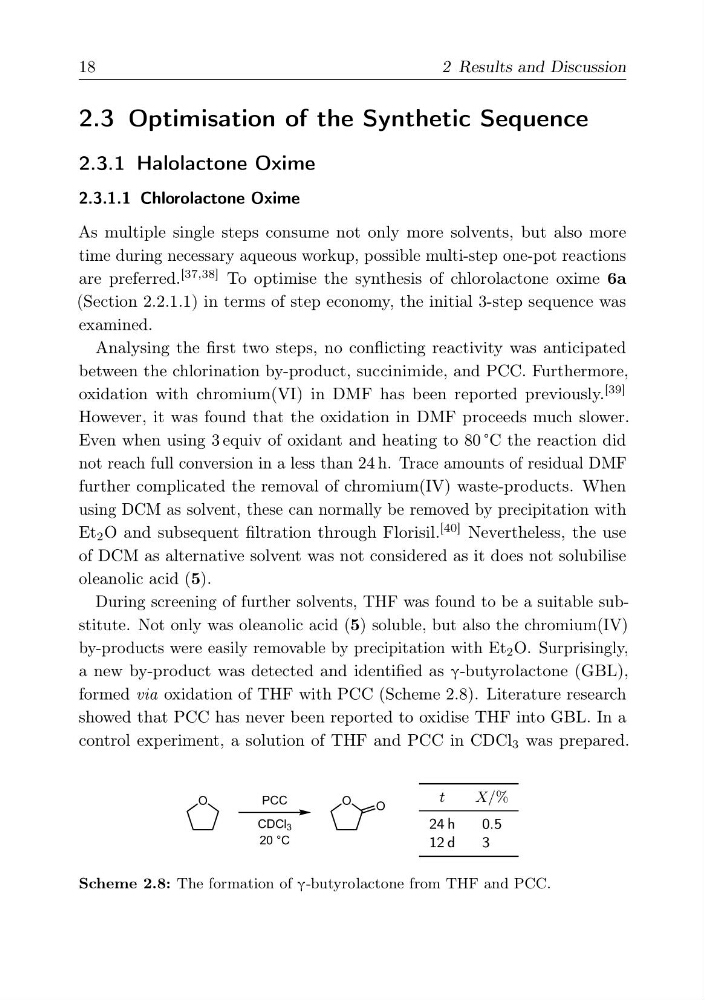
During screening of further solvents, THF was found to be a suitable substitute. Not only was oleanolic acid (5) soluble, but also the chromium(IV)
by-products were easily removable by precipitation with Et 2 O. Surprisingly,
a new by-product was detected and identified as γ-butyrolactone (GBL),
formed via oxidation of THF with PCC (Scheme 2.8). Literature research
showed that PCC has never been reported to oxidise THF into GBL. In a
control experiment, a solution of THF and PCC in CDCl 3 was prepared.
O
O
O
PCC
20 °C
CDCl 3
t
X/%
24 h
0.5
12 d
3
Scheme 2.8: The formation of γ-butyrolactone from THF and PCC.
2 Results and Discussion
2.3 Optimisation of the Synthetic Sequence
2.3.1 Halolactone Oxime
2.3.1.1 Chlorolactone Oxime
As multiple single steps consume not only more solvents, but also more
time during necessary aqueous workup, possible multi-step one-pot reactions
are preferred.
[37,38] To optimise the synthesis of chlorolactone oxime 6a
(Section 2.2.1.1) in terms of step economy, the initial 3-step sequence was
examined.
Analysing the first two steps, no conflicting reactivity was anticipated
between the chlorination by-product, succinimide, and PCC. Furthermore,
oxidation with chromium(VI) in DMF has been reported previously.
[39]
However, it was found that the oxidation in DMF proceeds much slower.
Even when using 3 equiv of oxidant and heating to 80 °C the reaction did
not reach full conversion in a less than 24 h. Trace amounts of residual DMF
further complicated the removal of chromium(IV) waste-products. When
using DCM as solvent, these can normally be removed by precipitation with
Et 2 O and subsequent filtration through Florisil.
[40] Nevertheless, the use
of DCM as alternative solvent was not considered as it does not solubilise
oleanolic acid (5).
During screening of further solvents, THF was found to be a suitable substitute. Not only was oleanolic acid (5) soluble, but also the chromium(IV)
by-products were easily removable by precipitation with Et 2 O. Surprisingly,
a new by-product was detected and identified as γ-butyrolactone (GBL),
formed via oxidation of THF with PCC (Scheme 2.8). Literature research
showed that PCC has never been reported to oxidise THF into GBL. In a
control experiment, a solution of THF and PCC in CDCl 3 was prepared.
O
O
O
PCC
20 °C
CDCl 3
t
X/%
24 h
0.5
12 d
3
Scheme 2.8: The formation of γ-butyrolactone from THF and PCC.