

16
2 Results and Discussion
2.2.2 C–H Activation at position C-23
2.2.2.1 Palladium Catalysed C–H Acetoxylation
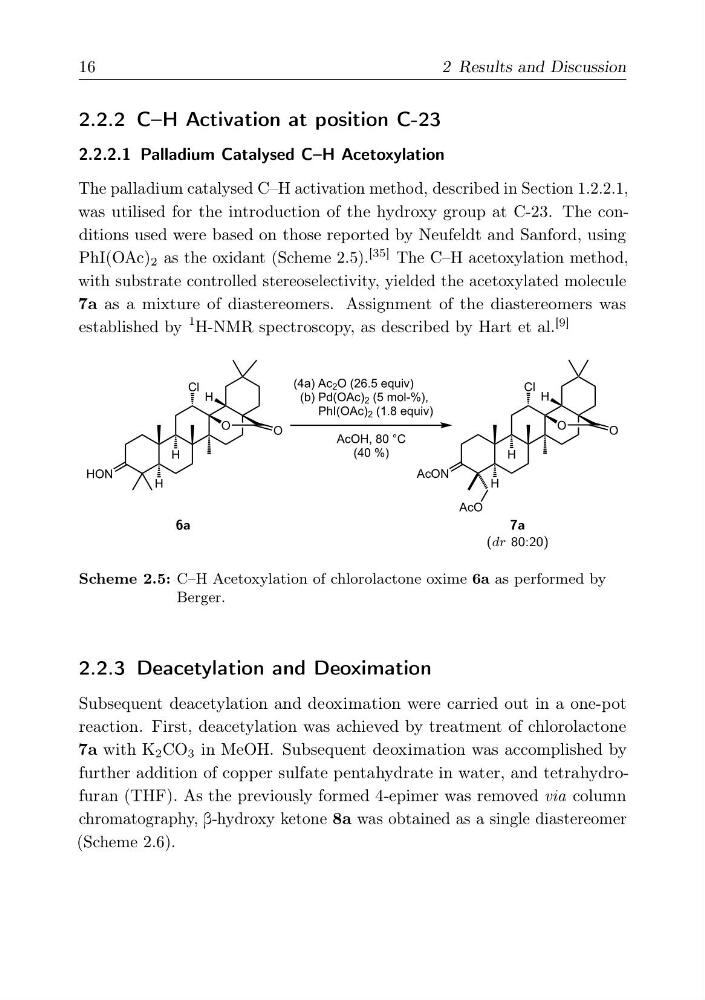
The palladium catalysed C–H activation method, described in Section 1.2.2.1,
was utilised for the introduction of the hydroxy group at C-23. The conditions used were based on those reported by Neufeldt and Sanford, using
PhI(OAc) 2 as the oxidant (Scheme 2.5).
[35] The C–H acetoxylation method,
with substrate controlled stereoselectivity, yielded the acetoxylated molecule
7a as a mixture of diastereomers. Assignment of the diastereomers was
established by
1 H-NMR spectroscopy, as described by Hart et al.
[9]
H
AcOH, 80 °C
(40 %)
H
O
H
Cl
O
H
H
O
H
Cl
O
HON
AcON
AcO
(4a)
(b)
Ac 2 O (26.5 equiv)
Pd(OAc) 2 (5 mol-%),
PhI(OAc) 2 (1.8 equiv)
6a
7a
(dr 80:20)
Scheme 2.5: C–H Acetoxylation of chlorolactone oxime 6a as performed by
Berger.
2.2.3 Deacetylation and Deoximation
Subsequent deacetylation and deoximation were carried out in a one-pot
reaction. First, deacetylation was achieved by treatment of chlorolactone
7a with K 2 CO 3 in MeOH. Subsequent deoximation was accomplished by
further addition of copper sulfate pentahydrate in water, and tetrahydrofuran (THF). As the previously formed 4-epimer was removed via column
chromatography, β-hydroxy ketone 8a was obtained as a single diastereomer
(Scheme 2.6).
2 Results and Discussion
2.2.2 C–H Activation at position C-23
2.2.2.1 Palladium Catalysed C–H Acetoxylation
The palladium catalysed C–H activation method, described in Section 1.2.2.1,
was utilised for the introduction of the hydroxy group at C-23. The conditions used were based on those reported by Neufeldt and Sanford, using
PhI(OAc) 2 as the oxidant (Scheme 2.5).
[35] The C–H acetoxylation method,
with substrate controlled stereoselectivity, yielded the acetoxylated molecule
7a as a mixture of diastereomers. Assignment of the diastereomers was
established by
1 H-NMR spectroscopy, as described by Hart et al.
[9]
H
AcOH, 80 °C
(40 %)
H
O
H
Cl
O
H
H
O
H
Cl
O
HON
AcON
AcO
(4a)
(b)
Ac 2 O (26.5 equiv)
Pd(OAc) 2 (5 mol-%),
PhI(OAc) 2 (1.8 equiv)
6a
7a
(dr 80:20)
Scheme 2.5: C–H Acetoxylation of chlorolactone oxime 6a as performed by
Berger.
2.2.3 Deacetylation and Deoximation
Subsequent deacetylation and deoximation were carried out in a one-pot
reaction. First, deacetylation was achieved by treatment of chlorolactone
7a with K 2 CO 3 in MeOH. Subsequent deoximation was accomplished by
further addition of copper sulfate pentahydrate in water, and tetrahydrofuran (THF). As the previously formed 4-epimer was removed via column
chromatography, β-hydroxy ketone 8a was obtained as a single diastereomer
(Scheme 2.6).