

2.2 Preliminary Results
15
80 °C (Scheme 2.2). After aqueous workup, the obtained chlorolactone 26a
was used without further purification.
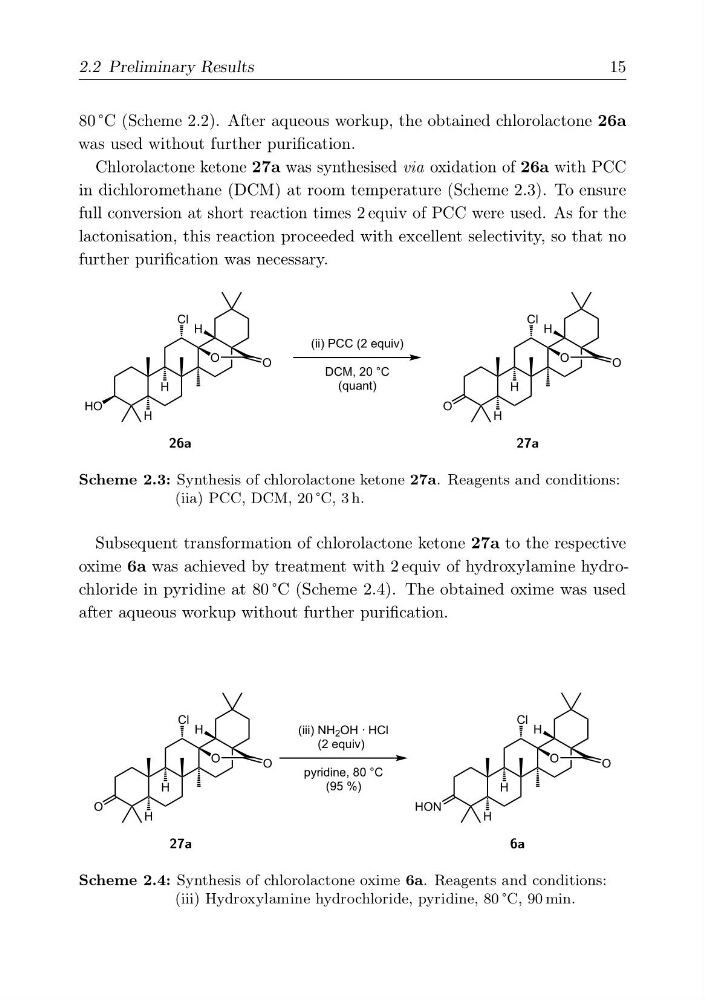
Chlorolactone ketone 27a was synthesised via oxidation of 26a with PCC
in dichloromethane (DCM) at room temperature (Scheme 2.3). To ensure
full conversion at short reaction times 2 equiv of PCC were used. As for the
lactonisation, this reaction proceeded with excellent selectivity, so that no
further purification was necessary.
HO
H
H
O
H
O
H
H
O
H
Cl
O
DCM, 20 °C
(quant)
(ii) PCC (2 equiv)
Cl
O
26a
27a
Scheme 2.3: Synthesis of chlorolactone ketone 27a. Reagents and conditions:
(iia) PCC, DCM, 20 °C, 3 h.
Subsequent transformation of chlorolactone ketone 27a to the respective
oxime 6a was achieved by treatment with 2 equiv of hydroxylamine hydrochloride in pyridine at 80 °C (Scheme 2.4). The obtained oxime was used
after aqueous workup without further purification.
O
H
H
O
H
H
H
O
H
Cl
O
pyridine, 80 °C
(95 %)
(iii)
Cl
O
HON
NH 2 OH · HCl
(2 equiv)
27a
6a
Scheme 2.4: Synthesis of chlorolactone oxime 6a. Reagents and conditions:
(iii) Hydroxylamine hydrochloride, pyridine, 80 °C, 90 min.
15
80 °C (Scheme 2.2). After aqueous workup, the obtained chlorolactone 26a
was used without further purification.
Chlorolactone ketone 27a was synthesised via oxidation of 26a with PCC
in dichloromethane (DCM) at room temperature (Scheme 2.3). To ensure
full conversion at short reaction times 2 equiv of PCC were used. As for the
lactonisation, this reaction proceeded with excellent selectivity, so that no
further purification was necessary.
HO
H
H
O
H
O
H
H
O
H
Cl
O
DCM, 20 °C
(quant)
(ii) PCC (2 equiv)
Cl
O
26a
27a
Scheme 2.3: Synthesis of chlorolactone ketone 27a. Reagents and conditions:
(iia) PCC, DCM, 20 °C, 3 h.
Subsequent transformation of chlorolactone ketone 27a to the respective
oxime 6a was achieved by treatment with 2 equiv of hydroxylamine hydrochloride in pyridine at 80 °C (Scheme 2.4). The obtained oxime was used
after aqueous workup without further purification.
O
H
H
O
H
H
H
O
H
Cl
O
pyridine, 80 °C
(95 %)
(iii)
Cl
O
HON
NH 2 OH · HCl
(2 equiv)
27a
6a
Scheme 2.4: Synthesis of chlorolactone oxime 6a. Reagents and conditions:
(iii) Hydroxylamine hydrochloride, pyridine, 80 °C, 90 min.