

14
2 Results and Discussion
2.2 Preliminary Results
Part of the results described in this chapter were obtained in collaboration with Martin Berger, MSc. His preliminary results are summarised in
Sections 2.2.1–2.2.4.
[33]
2.2.1 Halolactone Oxime
The low yield of the debenzylation step in the synthesis reported by Wen
et al. (Section 1.1.3) suggested that an alternative protecting group would be
necessary. Moreover, Berger found incompatibilities between the C-12 olefin
moiety and reaction conditions needed towards the synthesis of terminolic
acid (33d). These two problems led to the utilisation of a halolactone group,
which can be considered as a 2-in-1 protection of the carboxylic acid and the
olefin moiety. Due to an increased C–X bond stability and the consequent
robustness through the synthetic sequence,
[34] the use of a chlorolactone
protection was preferred over a bromolactone protection.
2.2.1.1 Chlorolactone Oxime
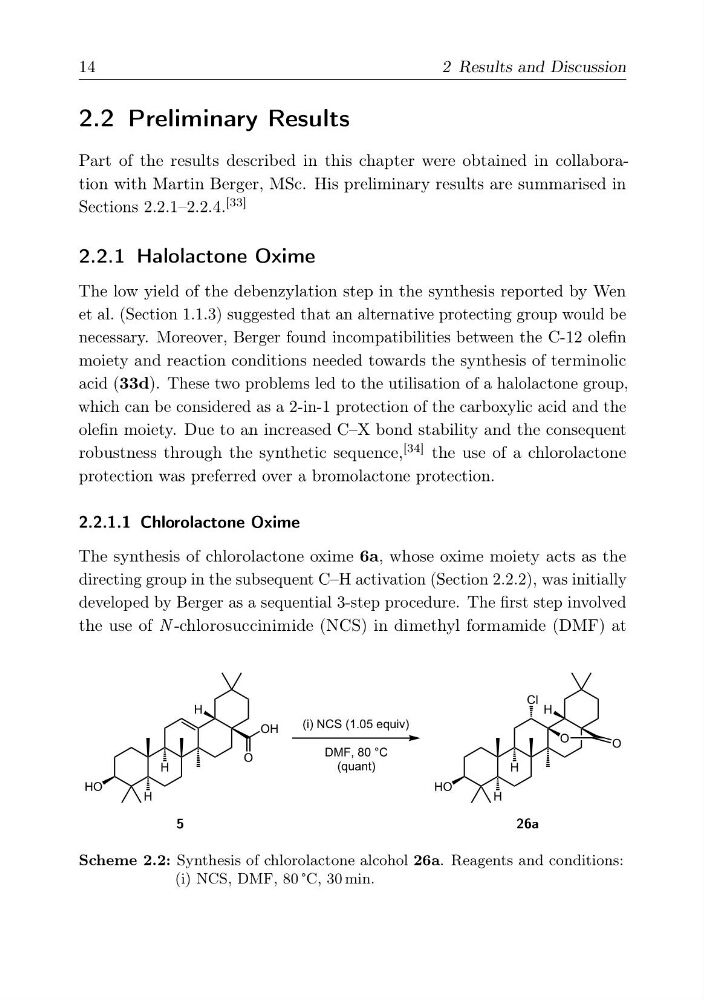
The synthesis of chlorolactone oxime 6a, whose oxime moiety acts as the
directing group in the subsequent C–H activation (Section 2.2.2), was initially
developed by Berger as a sequential 3-step procedure. The first step involved
the use of N -chlorosuccinimide (NCS) in dimethyl formamide (DMF) at
HO
H
H
OH
O
H
HO
H
H
O
H
Cl
O
DMF, 80 °C
(quant)
(i) NCS (1.05 equiv)
5
26a
Scheme 2.2: Synthesis of chlorolactone alcohol 26a. Reagents and conditions:
(i) NCS, DMF, 80 °C, 30 min.
2 Results and Discussion
2.2 Preliminary Results
Part of the results described in this chapter were obtained in collaboration with Martin Berger, MSc. His preliminary results are summarised in
Sections 2.2.1–2.2.4.
[33]
2.2.1 Halolactone Oxime
The low yield of the debenzylation step in the synthesis reported by Wen
et al. (Section 1.1.3) suggested that an alternative protecting group would be
necessary. Moreover, Berger found incompatibilities between the C-12 olefin
moiety and reaction conditions needed towards the synthesis of terminolic
acid (33d). These two problems led to the utilisation of a halolactone group,
which can be considered as a 2-in-1 protection of the carboxylic acid and the
olefin moiety. Due to an increased C–X bond stability and the consequent
robustness through the synthetic sequence,
[34] the use of a chlorolactone
protection was preferred over a bromolactone protection.
2.2.1.1 Chlorolactone Oxime
The synthesis of chlorolactone oxime 6a, whose oxime moiety acts as the
directing group in the subsequent C–H activation (Section 2.2.2), was initially
developed by Berger as a sequential 3-step procedure. The first step involved
the use of N -chlorosuccinimide (NCS) in dimethyl formamide (DMF) at
HO
H
H
OH
O
H
HO
H
H
O
H
Cl
O
DMF, 80 °C
(quant)
(i) NCS (1.05 equiv)
5
26a
Scheme 2.2: Synthesis of chlorolactone alcohol 26a. Reagents and conditions:
(i) NCS, DMF, 80 °C, 30 min.