

1.1 Hederagonic Acid
5
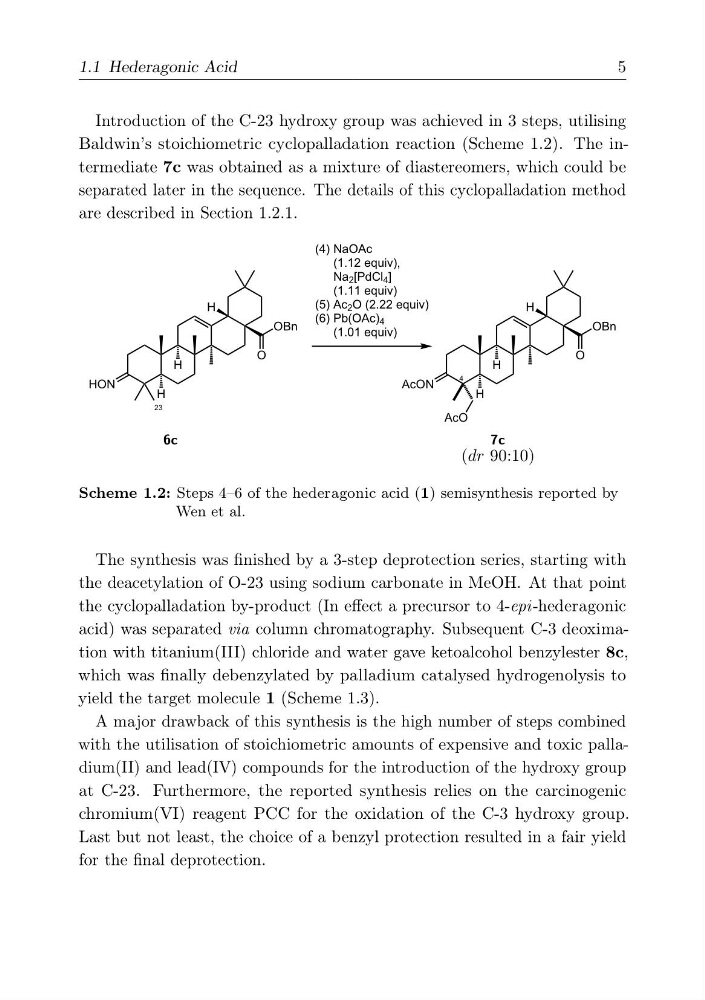
Introduction of the C-23 hydroxy group was achieved in 3 steps, utilising
Baldwin’s stoichiometric cyclopalladation reaction (Scheme 1.2). The intermediate 7c was obtained as a mixture of diastereomers, which could be
separated later in the sequence. The details of this cyclopalladation method
are described in Section 1.2.1.
H
H
O
H
(4)
(5)
(6)
OBn
H
AcO
23
4
H
O
H
OBn
HON
AcON
NaOAc
(1.12 equiv),
Na 2 [PdCl 4 ]
(1.11 equiv)
Ac 2 O (2.22 equiv)
Pb(OAc) 4
(1.01 equiv)
6c
7c
(dr 90:10)
Scheme 1.2: Steps 4–6 of the hederagonic acid (1) semisynthesis reported by
Wen et al.
The synthesis was finished by a 3-step deprotection series, starting with
the deacetylation of O-23 using sodium carbonate in MeOH. At that point
the cyclopalladation by-product (In effect a precursor to 4-epi -hederagonic
acid) was separated via column chromatography. Subsequent C-3 deoximation with titanium(III) chloride and water gave ketoalcohol benzylester 8c,
which was finally debenzylated by palladium catalysed hydrogenolysis to
yield the target molecule 1 (Scheme 1.3).
A major drawback of this synthesis is the high number of steps combined
with the utilisation of stoichiometric amounts of expensive and toxic palladium(II) and lead(IV) compounds for the introduction of the hydroxy group
at C-23. Furthermore, the reported synthesis relies on the carcinogenic
chromium(VI) reagent PCC for the oxidation of the C-3 hydroxy group.
Last but not least, the choice of a benzyl protection resulted in a fair yield
for the final deprotection.
5
Introduction of the C-23 hydroxy group was achieved in 3 steps, utilising
Baldwin’s stoichiometric cyclopalladation reaction (Scheme 1.2). The intermediate 7c was obtained as a mixture of diastereomers, which could be
separated later in the sequence. The details of this cyclopalladation method
are described in Section 1.2.1.
H
H
O
H
(4)
(5)
(6)
OBn
H
AcO
23
4
H
O
H
OBn
HON
AcON
NaOAc
(1.12 equiv),
Na 2 [PdCl 4 ]
(1.11 equiv)
Ac 2 O (2.22 equiv)
Pb(OAc) 4
(1.01 equiv)
6c
7c
(dr 90:10)
Scheme 1.2: Steps 4–6 of the hederagonic acid (1) semisynthesis reported by
Wen et al.
The synthesis was finished by a 3-step deprotection series, starting with
the deacetylation of O-23 using sodium carbonate in MeOH. At that point
the cyclopalladation by-product (In effect a precursor to 4-epi -hederagonic
acid) was separated via column chromatography. Subsequent C-3 deoximation with titanium(III) chloride and water gave ketoalcohol benzylester 8c,
which was finally debenzylated by palladium catalysed hydrogenolysis to
yield the target molecule 1 (Scheme 1.3).
A major drawback of this synthesis is the high number of steps combined
with the utilisation of stoichiometric amounts of expensive and toxic palladium(II) and lead(IV) compounds for the introduction of the hydroxy group
at C-23. Furthermore, the reported synthesis relies on the carcinogenic
chromium(VI) reagent PCC for the oxidation of the C-3 hydroxy group.
Last but not least, the choice of a benzyl protection resulted in a fair yield
for the final deprotection.