

4
1 Introduction
values of the other examined triterpenoids were 68 μmol l
−1 for bayogenin,
and 103 μmol l
−1 for arjunolic acid.
Furthermore, hederagonic acid (1) exhibited moderate cytotoxicity against
several cancer cell lines in biological studies.
[18] Considering the IC 50 values,
hederagonic acid (1) was among the most active compounds when compared
with other triterpenoids, such as betulinic acid, hederagenin (2), 23-hydroxybetulinic acid, oleanolic acid (5) and ursolic acid. With an IC 50 of
13.02 μg ml
−1 , hederagonic acid (1) was the second most active compound
against SMMC-7721 hepato carcinoma cells, and was found to have the
highest inhibitory effect against HeLa uterocervical carcinoma cells with an
IC 50 of 11.88 μg ml
−1 and against HL-60 leukocythemia carcinoma cells with
an IC 50 of 14.35 μg ml
−1 .
1.1.3 Previous Syntheses
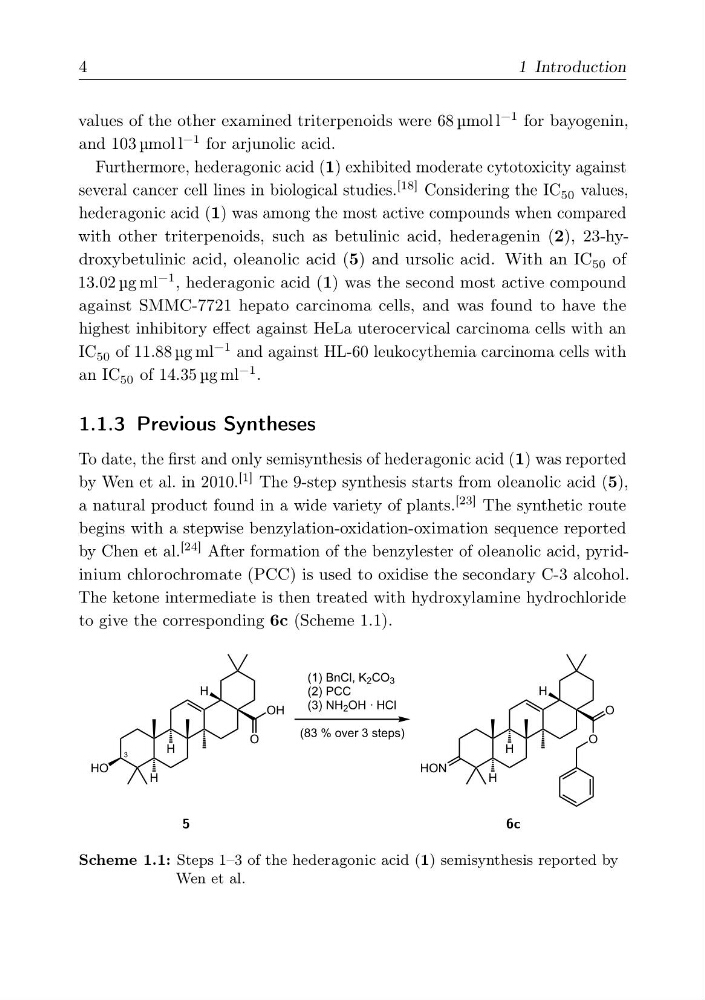
To date, the first and only semisynthesis of hederagonic acid (1) was reported
by Wen et al. in 2010.
[1] The 9-step synthesis starts from oleanolic acid (5),
a natural product found in a wide variety of plants.
[23] The synthetic route
begins with a stepwise benzylation-oxidation-oximation sequence reported
by Chen et al.
[24] After formation of the benzylester of oleanolic acid, pyridinium chlorochromate (PCC) is used to oxidise the secondary C-3 alcohol.
The ketone intermediate is then treated with hydroxylamine hydrochloride
to give the corresponding 6c (Scheme 1.1).
HO
H
H
OH
O
H
H
H
O
H
(1)
(2)
(3)
(83 % over 3 steps)
O
3
HON
BnCl, K 2 CO 3
PCC
NH 2 OH · HCl
5
6 c
Scheme 1.1: Steps 1–3 of the hederagonic acid (1) semisynthesis reported by
Wen et al.
1 Introduction
values of the other examined triterpenoids were 68 μmol l
−1 for bayogenin,
and 103 μmol l
−1 for arjunolic acid.
Furthermore, hederagonic acid (1) exhibited moderate cytotoxicity against
several cancer cell lines in biological studies.
[18] Considering the IC 50 values,
hederagonic acid (1) was among the most active compounds when compared
with other triterpenoids, such as betulinic acid, hederagenin (2), 23-hydroxybetulinic acid, oleanolic acid (5) and ursolic acid. With an IC 50 of
13.02 μg ml
−1 , hederagonic acid (1) was the second most active compound
against SMMC-7721 hepato carcinoma cells, and was found to have the
highest inhibitory effect against HeLa uterocervical carcinoma cells with an
IC 50 of 11.88 μg ml
−1 and against HL-60 leukocythemia carcinoma cells with
an IC 50 of 14.35 μg ml
−1 .
1.1.3 Previous Syntheses
To date, the first and only semisynthesis of hederagonic acid (1) was reported
by Wen et al. in 2010.
[1] The 9-step synthesis starts from oleanolic acid (5),
a natural product found in a wide variety of plants.
[23] The synthetic route
begins with a stepwise benzylation-oxidation-oximation sequence reported
by Chen et al.
[24] After formation of the benzylester of oleanolic acid, pyridinium chlorochromate (PCC) is used to oxidise the secondary C-3 alcohol.
The ketone intermediate is then treated with hydroxylamine hydrochloride
to give the corresponding 6c (Scheme 1.1).
HO
H
H
OH
O
H
H
H
O
H
(1)
(2)
(3)
(83 % over 3 steps)
O
3
HON
BnCl, K 2 CO 3
PCC
NH 2 OH · HCl
5
6 c
Scheme 1.1: Steps 1–3 of the hederagonic acid (1) semisynthesis reported by
Wen et al.