

6
1 Introduction
(57 % over 5 steps)
(9) H 2, Pd/C (10 wt%)
(48 %)
O
H
H
O
H
OBn
HO
H
AcO
3
H
O
H
OBn
23
AcON
(7)
(8)
Na 2 CO 3 (4.5 equiv),
MeOH
TiCl 3 (17 equiv),
HCl/NH 4 OAc, H 2 O
7c
8c
Hederagonic acid (1)
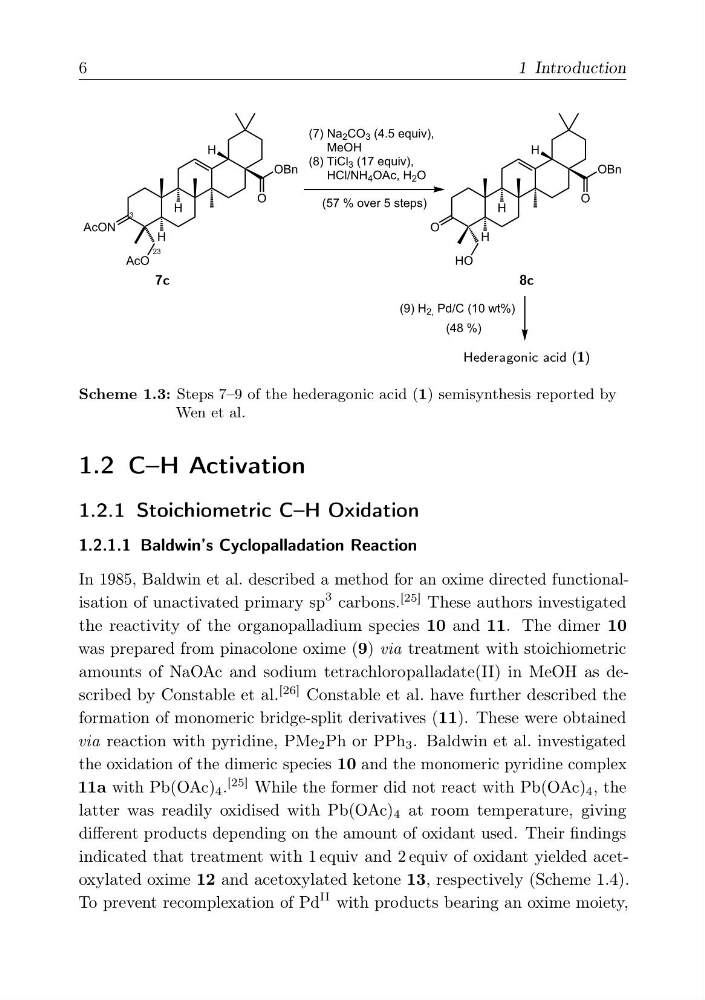
Scheme 1.3: Steps 7–9 of the hederagonic acid (1) semisynthesis reported by
Wen et al.
1.2 C–H Activation
1.2.1 Stoichiometric C–H Oxidation
1.2.1.1 Baldwin’s Cyclopalladation Reaction
In 1985, Baldwin et al. described a method for an oxime directed functionalisation of unactivated primary sp
3 carbons.
[25] These authors investigated
the reactivity of the organopalladium species 10 and 11. The dimer 10
was prepared from pinacolone oxime (9) via treatment with stoichiometric
amounts of NaOAc and sodium tetrachloropalladate(II) in MeOH as described by Constable et al.
[26] Constable et al. have further described the
formation of monomeric bridge-split derivatives (11). These were obtained
via reaction with pyridine, PMe 2 Ph or PPh 3 . Baldwin et al. investigated
the oxidation of the dimeric species 10 and the monomeric pyridine complex
11a with Pb(OAc) 4 .
[25] While the former did not react with Pb(OAc) 4 , the
latter was readily oxidised with Pb(OAc) 4 at room temperature, giving
different products depending on the amount of oxidant used. Their findings
indicated that treatment with 1 equiv and 2 equiv of oxidant yielded acetoxylated oxime 12 and acetoxylated ketone 13, respectively (Scheme 1.4).
To prevent recomplexation of Pd
II with products bearing an oxime moiety,
1 Introduction
(57 % over 5 steps)
(9) H 2, Pd/C (10 wt%)
(48 %)
O
H
H
O
H
OBn
HO
H
AcO
3
H
O
H
OBn
23
AcON
(7)
(8)
Na 2 CO 3 (4.5 equiv),
MeOH
TiCl 3 (17 equiv),
HCl/NH 4 OAc, H 2 O
7c
8c
Hederagonic acid (1)
Scheme 1.3: Steps 7–9 of the hederagonic acid (1) semisynthesis reported by
Wen et al.
1.2 C–H Activation
1.2.1 Stoichiometric C–H Oxidation
1.2.1.1 Baldwin’s Cyclopalladation Reaction
In 1985, Baldwin et al. described a method for an oxime directed functionalisation of unactivated primary sp
3 carbons.
[25] These authors investigated
the reactivity of the organopalladium species 10 and 11. The dimer 10
was prepared from pinacolone oxime (9) via treatment with stoichiometric
amounts of NaOAc and sodium tetrachloropalladate(II) in MeOH as described by Constable et al.
[26] Constable et al. have further described the
formation of monomeric bridge-split derivatives (11). These were obtained
via reaction with pyridine, PMe 2 Ph or PPh 3 . Baldwin et al. investigated
the oxidation of the dimeric species 10 and the monomeric pyridine complex
11a with Pb(OAc) 4 .
[25] While the former did not react with Pb(OAc) 4 , the
latter was readily oxidised with Pb(OAc) 4 at room temperature, giving
different products depending on the amount of oxidant used. Their findings
indicated that treatment with 1 equiv and 2 equiv of oxidant yielded acetoxylated oxime 12 and acetoxylated ketone 13, respectively (Scheme 1.4).
To prevent recomplexation of Pd
II with products bearing an oxime moiety,