

3 Scintillation Detectors for Charged Particles and Photons
81
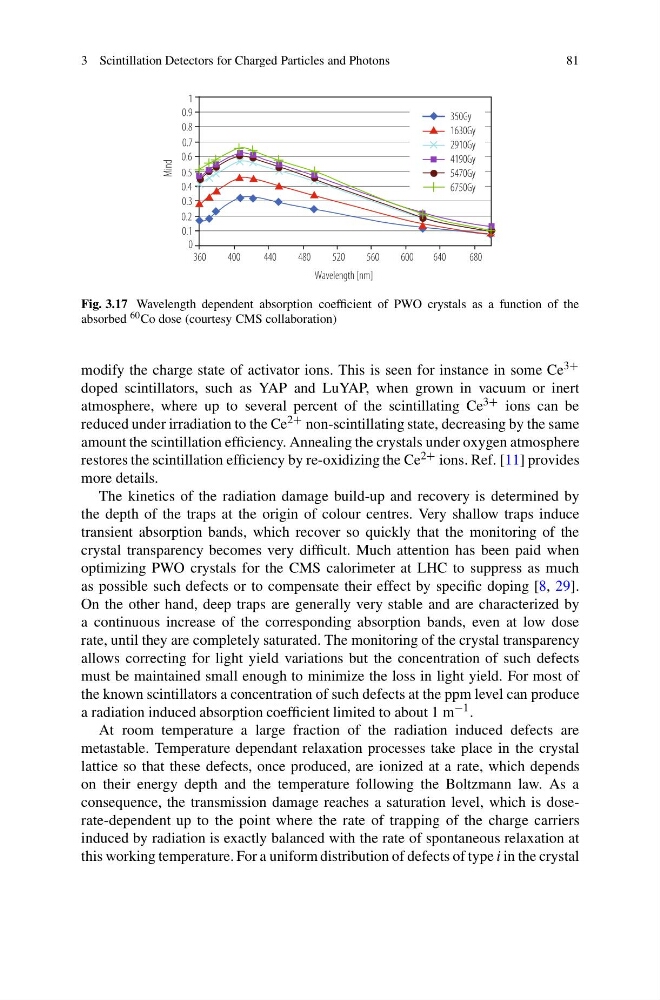
Fig. 3.17 Wavelength dependent absorption coefficient of PWO crystals as a function of the
absorbed 60 Co dose (courtesy CMS collaboration)
modify the charge state of activator ions. This is seen for instance in some Ce 3+
doped scintillators, such as YAP and LuYAP, when grown in vacuum or inert
atmosphere, where up to several percent of the scintillating Ce 3+ ions can be
reduced under irradiation to the Ce 2+ non-scintillating state, decreasing by the same
amount the scintillation efficiency. Annealing the crystals under oxygen atmosphere
restores the scintillation efficiency by re-oxidizing the Ce 2+ ions. Ref. [11] provides
more details.
The kinetics of the radiation damage build-up and recovery is determined by
the depth of the traps at the origin of colour centres. Very shallow traps induce
transient absorption bands, which recover so quickly that the monitoring of the
crystal transparency becomes very difficult. Much attention has been paid when
optimizing PWO crystals for the CMS calorimeter at LHC to suppress as much
as possible such defects or to compensate their effect by specific doping [8, 29].
On the other hand, deep traps are generally very stable and are characterized by
a continuous increase of the corresponding absorption bands, even at low dose
rate, until they are completely saturated. The monitoring of the crystal transparency
allows correcting for light yield variations but the concentration of such defects
must be maintained small enough to minimize the loss in light yield. For most of
the known scintillators a concentration of such defects at the ppm level can produce
a radiation induced absorption coefficient limited to about 1 m −1 .
At room temperature a large fraction of the radiation induced defects are
metastable. Temperature dependant relaxation processes take place in the crystal
lattice so that these defects, once produced, are ionized at a rate, which depends
on their energy depth and the temperature following the Boltzmann law. As a
consequence, the transmission damage reaches a saturation level, which is doserate-dependent up to the point where the rate of trapping of the charge carriers
induced by radiation is exactly balanced with the rate of spontaneous relaxation at
this working temperature. For a uniform distribution of defects of type i in the crystal
81
Fig. 3.17 Wavelength dependent absorption coefficient of PWO crystals as a function of the
absorbed 60 Co dose (courtesy CMS collaboration)
modify the charge state of activator ions. This is seen for instance in some Ce 3+
doped scintillators, such as YAP and LuYAP, when grown in vacuum or inert
atmosphere, where up to several percent of the scintillating Ce 3+ ions can be
reduced under irradiation to the Ce 2+ non-scintillating state, decreasing by the same
amount the scintillation efficiency. Annealing the crystals under oxygen atmosphere
restores the scintillation efficiency by re-oxidizing the Ce 2+ ions. Ref. [11] provides
more details.
The kinetics of the radiation damage build-up and recovery is determined by
the depth of the traps at the origin of colour centres. Very shallow traps induce
transient absorption bands, which recover so quickly that the monitoring of the
crystal transparency becomes very difficult. Much attention has been paid when
optimizing PWO crystals for the CMS calorimeter at LHC to suppress as much
as possible such defects or to compensate their effect by specific doping [8, 29].
On the other hand, deep traps are generally very stable and are characterized by
a continuous increase of the corresponding absorption bands, even at low dose
rate, until they are completely saturated. The monitoring of the crystal transparency
allows correcting for light yield variations but the concentration of such defects
must be maintained small enough to minimize the loss in light yield. For most of
the known scintillators a concentration of such defects at the ppm level can produce
a radiation induced absorption coefficient limited to about 1 m −1 .
At room temperature a large fraction of the radiation induced defects are
metastable. Temperature dependant relaxation processes take place in the crystal
lattice so that these defects, once produced, are ionized at a rate, which depends
on their energy depth and the temperature following the Boltzmann law. As a
consequence, the transmission damage reaches a saturation level, which is doserate-dependent up to the point where the rate of trapping of the charge carriers
induced by radiation is exactly balanced with the rate of spontaneous relaxation at
this working temperature. For a uniform distribution of defects of type i in the crystal