

80
P. Lecoq
symmetry group. However, they locally modify the electronic configuration and
affect the macroscopic crystal parameters, such as optical transmission, conductivity, thermo-luminescence properties, because these volume properties are sensitive
to the microscopic structure modifications. In ionic crystals, containing anions and
cations, five possible simple point defects of the crystalline structure have been
observed: anion vacancy V a , cation vacancy V c , cation replacement by impurity
ions, extrinsic atoms in inter-site positions and Frenkel type defects (anions and
cations displaced to interstitial sites).
All these defects are efficient charge carrier traps and can be stabilized by
capturing excess electrons or holes released by irradiation in the conduction or
valence band respectively. In oxide compounds for instance, the oxygen vacancies
are charge compensated by the capture of one or two electrons, which are in excess
in the conduction band after irradiation. The resulting F + : (V a + e – ) and F: (V a +2
e – ) electron centres play an important role in radiation damage effects. The captured
electron or hole in these so-called recharged defects has generally a number of
discrete energy levels available in the electrostatic environment of the defect and
optical transitions to upper energy levels induce absorption bands in the crystal
transparency window. These bands are the source of the crystal colouring under
irradiation and justify the name of colour canters for these defects.
The main consequence of irradiating a crystal is to produce radiation induced
absorption bands, which absorb a fraction of the scintillation light on its pathway to
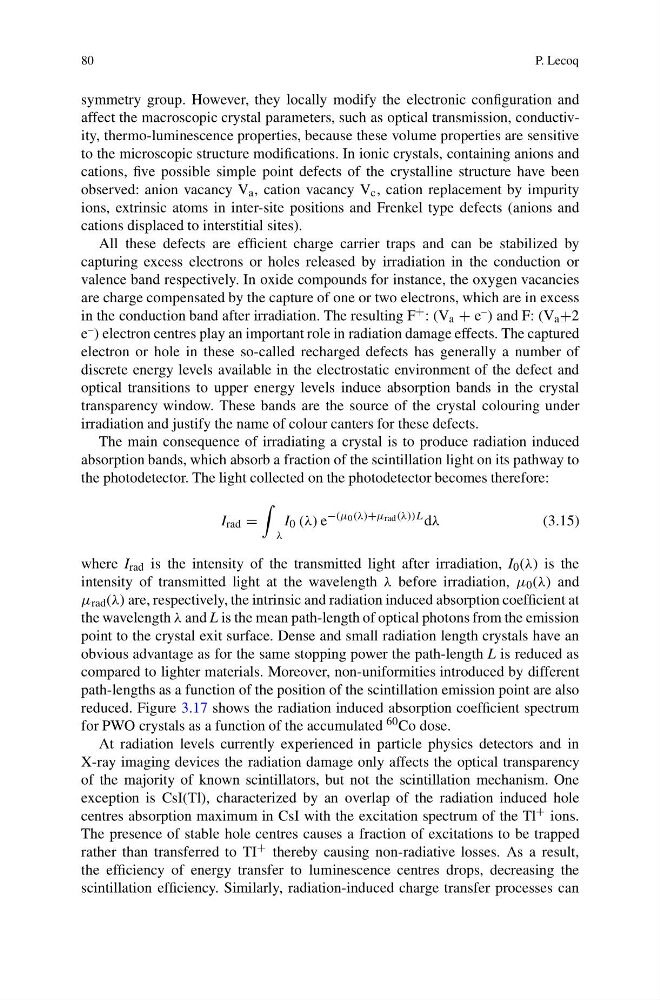
the photodetector. The light collected on the photodetector becomes therefore:
I rad =
λ
I 0 (λ) e
−(μ 0 (λ)+μ rad (λ))L dλ
(3.15)
where I rad is the intensity of the transmitted light after irradiation, I 0 (λ) is the
intensity of transmitted light at the wavelength λ before irradiation, μ 0 (λ) and
μ rad (λ) are, respectively, the intrinsic and radiation induced absorption coefficient at
the wavelength λ and L is the mean path-length of optical photons from the emission
point to the crystal exit surface. Dense and small radiation length crystals have an
obvious advantage as for the same stopping power the path-length L is reduced as
compared to lighter materials. Moreover, non-uniformities introduced by different
path-lengths as a function of the position of the scintillation emission point are also
reduced. Figure 3.17 shows the radiation induced absorption coefficient spectrum
for PWO crystals as a function of the accumulated 60 Co dose.
At radiation levels currently experienced in particle physics detectors and in
X-ray imaging devices the radiation damage only affects the optical transparency
of the majority of known scintillators, but not the scintillation mechanism. One
exception is CsI(Tl), characterized by an overlap of the radiation induced hole
centres absorption maximum in CsI with the excitation spectrum of the Tl + ions.
The presence of stable hole centres causes a fraction of excitations to be trapped
rather than transferred to TI + thereby causing non-radiative losses. As a result,
the efficiency of energy transfer to luminescence centres drops, decreasing the
scintillation efficiency. Similarly, radiation-induced charge transfer processes can
P. Lecoq
symmetry group. However, they locally modify the electronic configuration and
affect the macroscopic crystal parameters, such as optical transmission, conductivity, thermo-luminescence properties, because these volume properties are sensitive
to the microscopic structure modifications. In ionic crystals, containing anions and
cations, five possible simple point defects of the crystalline structure have been
observed: anion vacancy V a , cation vacancy V c , cation replacement by impurity
ions, extrinsic atoms in inter-site positions and Frenkel type defects (anions and
cations displaced to interstitial sites).
All these defects are efficient charge carrier traps and can be stabilized by
capturing excess electrons or holes released by irradiation in the conduction or
valence band respectively. In oxide compounds for instance, the oxygen vacancies
are charge compensated by the capture of one or two electrons, which are in excess
in the conduction band after irradiation. The resulting F + : (V a + e – ) and F: (V a +2
e – ) electron centres play an important role in radiation damage effects. The captured
electron or hole in these so-called recharged defects has generally a number of
discrete energy levels available in the electrostatic environment of the defect and
optical transitions to upper energy levels induce absorption bands in the crystal
transparency window. These bands are the source of the crystal colouring under
irradiation and justify the name of colour canters for these defects.
The main consequence of irradiating a crystal is to produce radiation induced
absorption bands, which absorb a fraction of the scintillation light on its pathway to
the photodetector. The light collected on the photodetector becomes therefore:
I rad =
λ
I 0 (λ) e
−(μ 0 (λ)+μ rad (λ))L dλ
(3.15)
where I rad is the intensity of the transmitted light after irradiation, I 0 (λ) is the
intensity of transmitted light at the wavelength λ before irradiation, μ 0 (λ) and
μ rad (λ) are, respectively, the intrinsic and radiation induced absorption coefficient at
the wavelength λ and L is the mean path-length of optical photons from the emission
point to the crystal exit surface. Dense and small radiation length crystals have an
obvious advantage as for the same stopping power the path-length L is reduced as
compared to lighter materials. Moreover, non-uniformities introduced by different
path-lengths as a function of the position of the scintillation emission point are also
reduced. Figure 3.17 shows the radiation induced absorption coefficient spectrum
for PWO crystals as a function of the accumulated 60 Co dose.
At radiation levels currently experienced in particle physics detectors and in
X-ray imaging devices the radiation damage only affects the optical transparency
of the majority of known scintillators, but not the scintillation mechanism. One
exception is CsI(Tl), characterized by an overlap of the radiation induced hole
centres absorption maximum in CsI with the excitation spectrum of the Tl + ions.
The presence of stable hole centres causes a fraction of excitations to be trapped
rather than transferred to TI + thereby causing non-radiative losses. As a result,
the efficiency of energy transfer to luminescence centres drops, decreasing the
scintillation efficiency. Similarly, radiation-induced charge transfer processes can